
Spring's all about making software development easier, but Spring Cloud Gateway takes the cake. Without writing a smidge of code, you can achieve not only basic HTTP routing, but also sophisticated party tricks like weighted routing and rate limiting. Let's explore.
Gateways Are Super Important
A gateway sits between consumers (software or human) and your applications. The more apps you have (and with microservice architectures we tend to have a few), the more pain you'll feel without a gateway, but even with one or a few apps, the benefits are clear.
For developers, gateways simplify development by handling cross-cutting concerns. For operators, they are a central point for monitoring. For security teams, an opportunity to protect against threats and enforce policies. And for consumers, gateways provide a better experience through a friendly API, single point of access, and increased reliability.
The "No-Code" Experience
With Spring Cloud Gateway (SCG), you can certainly get dirty with Java. But for many cases, you don't have to. Many of the capabilities of SCG can simply be configured in your handy application.yml file. OK, it's not drag-and-drop, but YAML is a far cry from coding.
To whet your appetite, take a look at this example of consumer API control and weighted routing, which directs about half the traffic to one of two endpoints.
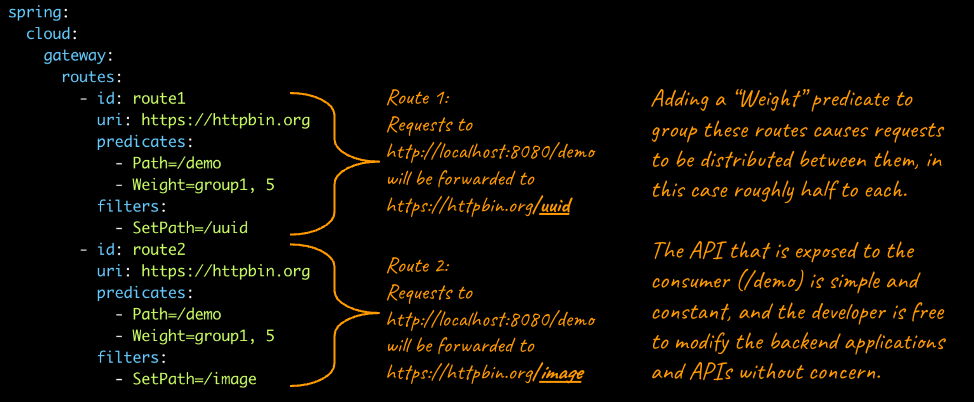
It doesn't get easier than this!
Hungry For More?
Try out the examples at https://github.com/ciberkleid/spring-cloud-gateway-sample or check out the docs at https://docs.spring.io/spring-cloud-gateway/reference/spring-cloud-gateway/configuring-route-predicate-factories-and-filter-factories.html.