-4NbIYL0Vljk5gC8aUNx6uFZMcTzVsu.png&w=96&q=75)
Headline:
What is this piece about? Who is it for? What will the reader get in exchange for reading through to the end? AND, why should they trust you (what's your credibility)?
Introduction:
(Repeat the information from the headline with slightly more detail.) What is this piece about? Who is it for? What will the reader get in exchange for reading through to the end? AND, why should they trust you (what's your credibility)?
Main Points:
What "proven approach" are you using to organize this piece? (Is this piece organized by Steps, Lessons, Mistakes, Tips, etc.?) How many do you plan on including? 3 Steps? 4 Lessons? 5 Mistakes?
Main Point #1
Reasons
To give the reader more context, give them more reasons why (or why not).
"Here are some reasons why”
Mistakes
To give the reader a “heads up” for what to look for, tell them what mistakes to avoid.
“But if you do start with a business plan, the mistake you’re going to make is….”
Action Steps
To give the reader a clear path forward, provide them with some action steps.
“So let me give you some action steps to help you avoid this mistake in the future”
Personal Story Examples
To help the reader understand you are a good source of truth, tell them a time this same thing happened to you.
“For example, when I was first starting my business…”
Curated Story Examples
And to help the reader see this isn’t an isolated incident, tell them a time someone else (noteworthy) did the same thing and was also successful.
“And if you didn’t know, this is the same way Marc Randolph started Netflix…”
Conclusion:
What's the final takeaway? What do you want readers to walk away with after reading this piece? What's the morale of the story?
By creating a skeleton of your piece in advance, it becomes significantly easier to know where to start.
Nobody likes staring at a blank page.
The 2 Most Important Uses For Subheads: Wheels & Spokes
When organizing your content, there are two different types of headings you should use.
Wheels: Big headings (H1) that signify the beginning of a new overarching section.
Spokes: Small headings/subheads (H2 or H3) that separate important sections within the overarching section.
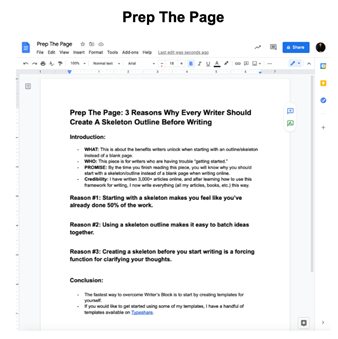
Since most essays and articles online fall between the 300-800 word range, you usually don't need to use both Headings & smaller subheads (because there's only so much room). For example, in the "Prep The Page" example above, each "reason" in the article is listed out using a heading. In this case, it really doesn't matter if your headings are big (H1) or smaller (H2 or H3) because they are all fulfilling the same purpose: separating ideas.
However, in longer-form blog posts and ultimate guides (like this piece here), it makes sense to use both to make sure readers are following your train of thought. Each major section would open with a big heading (H1), signifying the purpose of this overarching section. And then each sub-section within would be separated by subheads (H2 or H3), signifying where one idea stops and the next idea begins.
Using headings are an easy way to make your writing more "skimmable," and to also make it easy for readers to scroll and find a section that hooks their attention. If they find a section that speaks to their wants, needs, desires, or questions, that's where they are going to start reading. And if, when they start reading, they find your content valuable, insightful, memorable, etc., they that's when they are going to scroll back to the beginning and start reading.
Here's what Wheels & Spokes look like in action:

Lists, Bullets, and Bolded Sentences
Ah, but the fun has just begun.
Once you have your essay or article (or book) organized in Wheels & Spokes, you can then start adding decorations: lists, bullets, bolded sentences, italics, etc. These smaller lists make it even easier for readers to quickly get an idea of what you're writing about and, more importantly, what's in it for them.
For example, anytime you find yourself writing a paragraph that is "listing" things out, it's worth questioning whether that paragraph can be re-formatting in the form of a bulleted list. "The first thing you want to do when writing online is prep the page. Then, once you've prepped the page, see where you can turn long paragraphs into short bulleted lists. Third, get rid of any excess description—readers don't want to hear you say the same thing eight times."
Instead of writing all of that out, you can compress it by turning it into a quick bulleted list.
