
I've been thinking a bit lately about logical syllogisms and as logical puzzles as a way to access them. One of my favorites is the classic Catch-22, whose original version in Joseph Heller's novel prevented the cynical Capt. John Yossarian from escaping his WWII U.S. air force duties on grounds of insanity:

The general form of this infuriating entrapment reveals that it isn't a paradox at all:
X implies Y, so if you believe X, then you should believe Y. You must do Y.
~X (not-X) is true. If you see the truth, you must do Y. If you believe ~X, congrats, you are right! You must do Y.
Zen koans to the rescue!
On the other side you have the logical disaster that is the zen koan, a form of riddle that is used to explain the oneness and nonduality of things.
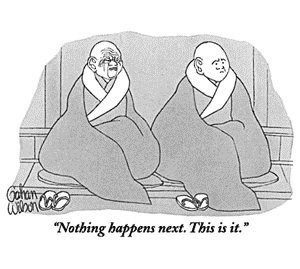
Bringing nonduality to a logic puzzle is like bringing a plasma gun to a knife fight, by whose mechanics "P = ~P" intrinsically allows literally means everything in the world can be proven to exist. Nonduality, therefore flying unicorn zombies. P=~P, therefore Jesus did not just exist, he's alive right now.
In other words: X, and also ~X. You are both crazy, and sane; get back on that plane.
Today a "catch-22" is colloquially understood as a bureaucratic trap -- an abuse of power in bad paperwork. But the original Catch-22 in its namesake book was just telling a different truth: that war is beyond the realm of reasonableness, that words are just things we say to command treacheries upon the flesh. The fundamental truth is fearfully constant; that Yossarian sees it does not make it go away.
Logic traps in public ethics
The world today is full of "If you see the truth of ~X -- congrats, you are right! You must do Y."
If you believe global capital markets are setting the world on an unsustainable path to climate change, you must fight them - certainly you should not cash in on oil money or bet on Canadian real estate.
If you believe systemic racism / classism / sexism exists, you must do all you can to be anti-racist / anti-classist / anti-sexist -- certainly you should not try to imitate or align yourself with your wealthy white male oppressors.
If you believe that you're in a consumer rat race of oppressive status symbols, you must boycott Hermes -- certainly you should not buy a fake Birkin for $300 from China.
I think that's a bind that many of us face. We are all Yossarian, seeing that we are in an imperfect system that people pretend not to see, because to see would also bind them to choices that sacrifice themselves. You don't learn about this until Heller's sequel, but Yossarian ends the war becoming part of the military PR machine he despises. He takes a deal in which he pretends to be a hero to save his own hide and go home.
There is an evolutionary advantage to cognitive dissonance.
There is a certain flavor of advice from the wealthy and successful to Slow down, love people, savor each minute: all this is true, and it is also not, perhaps, why we ask Bill Gates or Ray Dalio their advice.
"Do as I say." Play fair. Never cheat. Read about China. We want to know how they won a game that has so many losers. And of course they cannot say.
Another koan, then: We must imagine Sisyphus happy.
This is my fifth day of writing for #ship30for30. If you liked it, drop me a tweet so I know what to do more of.