
Elise Liu
/eliseliu

poet, storyteller, pragmatist, technologist, internet safety nerd. she/her. formerly product @Clubhouse, @Facebook, @HumanInterest. fellow at @integrity_inst. hopeful

Elise Liu
3y ago
This week, Elon Musk changed the name of Twitter to "X". "Soon the birds will be gone," he tweeted - no, X'ed- afterwards. What a great reminder of how often it is that CEOs seem desperately out of touch.
It's old water-cooler talk in corporate America - why would they do that?
I can't explain Musk, but more generally, leaders end up on the wrong side of "reasonable" for one of one of three reasons:
It's not their job to be right.
People are lying to them.
They are lying to you (the employees).
It's not the CEO's job to be right.
Let's start with the most reasonable: CEOs have the least front-line context and so are likely to make obvious errors because of that gap.
When thinking about delegation, leaders should be setting an initial vision and letting their teams make 80-90%+ of the decisions in the executing line, before weighing in to confirm they agree. Executives are as likely as not to do the first bit wrong.
Good leadership is designed to allow for correction.
Product roadmaps may seem strategic, but in reality they are all detail. What do users want? What are they using now? How long does it take to build things? Having accurate intuitions on this stuff is a talent, sure, but being right all the time is impossible. A health organization allows for those mistakes by tolerating dissent.
But what if yours doesn't?
People are sycophants and hierarchies amplify this.
We all tend to say what we think other people want to hear. It's a natural human instinct, because we are social creatures who like to be liked.
This effect is magnified in large hierarchies.
In large organizations, information memetically flattens and loses nuance with repetition. So do individuals' reputations. In hierarchies, incentives to echo the leader specifically are especially strong. So when it's not safe to be wrong, it's easier to defer.
Enter the well-mocked phenomenon of the HIPPO: HIghest Paid Person's Opinion (HIPPO). Deferring to the HIPPO tends to be safe. It's unmemorable, a way to escape not having done your homework. So leaders' opinions get amplified and flattened; their vassals don't challenge them; and everyone is incentivized on a personal level to believe what is easiest for them to believe -- whatever their boss already thinks.
Still, that doesn't explain the kind of "wrong" that feels most frustrating - when feedback isn't heard and everyone but a leadership team does strongly believe one thing.
Corporations are designed to withhold truth from employees
Strong hierarchies are designed to be bad at sharing information for a reason: control.
The first modern corporations were the Dutch East Indies and British East Indies Companies - financial arrangements for colonial military campaigns. Anyone who's watched A Few Good Men knows that militaries are not known for transparency: lies might be strategic, sacrifices might be made, and people might die.
Is your company operating like a military, ready for employees to die?
Probably not. But it's designed to value individuals as atomic, fungible, and ultimately expendable -- ironically, including CEOs. The corporation is designed to survive despite the interests of any constituent members.
So it makes sense that certain kinds of information are withheld.
For example, a product bet be pursued because of a legal/IP campaign. An expansion effort may be meant to dominate a competitor. Layoffs will be flatly denied until they happen.
If you're not ready for this, even a normal corporate environment can feel unsafe, gaslighting, and even traumatic.
You can survive and thrive
The key to surviving an environment that feels wrong is acceptance and clear boundaries. It is natural for executives to often seem wrong. Try to see if they are open to feedback (good ones will be). Don't let it weigh on you as a bug of your organization in particular, or, worse, as something wrong with you.
And let me know (here or privately) -- have you worked in an organization that felt wrong? What were people wrong about? How did you cope and thrive?
Elise Liu
3y ago
We must imagine Sisyphus happy.
One of the most important lessons I've gotten from psychology, and one that I am still re-learning, is how minds are inconstant and malleable things-- including thoughts, including this thought, and any other that occurs to you while reading it (h/t: Cognitive Behavioral Therapy).
Cynical thoughts create cynicism. Grateful thoughts create more opportunities for gratitude. Humans are prone to cognitive errors and distortions; for every story you have about why something is the way it is, there is another possibility.
Yesterday, I wrote cynically about Catch-22s and useful fictions, one of my favorite examples of logic colliding with the edge of what logic can do. But here are some more hopeful others:
Quantifying pain, joy, and life itself.
I was once a consequentialist, but I've been forced to embrace the utter unpredictability of "utility" and "meaning" among meaning-making machines. We all like different things, and how much we will like things is highly controllable by our attitude toward those things.
In this sense, it is poets, priests, influencers, and advertisers that create value, not engineers or scientists or financiers or project managers; the market follows money, but money follows ideas.
It seems similarly impossible to reason about human life and how much a minute of human life is worth. Compare the calculus of insurance, policy, or public health interventions
vs the lived experience of humans buying medical treatments for themselves, willing to pay a lot of money for life
vs the lived experience of humans working in jobs they hate--willing to pay a lot of life for money
vs the lived experience of humans choosing to fight in war or go into dangerous situations--willing to pay a lot of life for life.
(Planet Money's episode on this was phenomenal, by the way.)
The phenomenon of platitudes
Twitter and nursing homes alike are lousy with platitudes-- the sort of advice that seems wrong/useless until it seems obvious; satisfying to receive and retweet if you believe it, but rarely able to actually change minds: Go outside. Meditate. Practice kindness. Tell someone you love them, and get a hug every day. Be grateful. Drink more water and less alcohol, and probably spend less time on Twitter, too.
In a sense these sorts of platitudes are the answer to every question:
How can I be more popular?
How can I win friends and influence people?
How can I be happier... richer... less depressed... more alive?
One of my favorite contemporary poets, Andrea Gibson, describes this with the example of butterflies. Watching them struggle, we want to help them out of their cocoons, but that struggle is what makes them strong: "to become what we are meant to become, the becoming must be ours."
Today, I'm writing from a sun-dappled clean-aired corner of Lake Tahoe. I could write this essay in well-researched and cited form that tells you everyone you should read to know more about, but it's hard to say anything other than: well, you should come and see for yourself.
An answer in pataphysics
We all know what meta is: X about X. A movie about making a movie. An essay about writing essays. Thinking about thinking. (Cue groan.)
Sometime in the late 1890s a bunch of French philosophers assigned--t he headscratchers above metaphysics the term pataphysics. Most of their definitions (https://en.wikipedia.org/wiki/'Pataphysics) are a bit of a head-scratcher, or a head-inverter, but I'm hopeful that pataphysical approaches have a solution for some of the problems that clean logic and meta-logic can't answer.
"How can I become rich?" Volunteer to help those less fortunate than you is a pataphysical answer: one whose doing changes the question.
"How can I get a bunch of girls to have sex with me?" Make more friends--maybe in a hobby you like--and focus on your own emotional growth--advisers hope, maybe, that the young man asking will be safe for young women by the time he gets what he wants.
Robert Greene --famous for The Art of Seduction and The 48 Laws of Power -- is a brilliant writer of this style. "How do I get people to do exactly what I want, when I want it?" I won't spoil the answer.
Emily Dickinson: Tell the truth, but tell it slant.
A sort of zen koan, maybe.
"What is the answer to life, the universe, and everything?" Meditate more. The smell of pinecones in the morning. Your child's laughter. The first time you fell in love. Sisyphus, walking down the hill, glancing over his shoulder.
--
This is my sixth day of writing for #ship30for30. If you found it useful, retweet or DM me what so I know what to write more about.
Elise Liu
3y ago
I've been thinking a bit lately about logical syllogisms and as logical puzzles as a way to access them. One of my favorites is the classic Catch-22, whose original version in Joseph Heller's novel prevented the cynical Capt. John Yossarian from escaping his WWII U.S. air force duties on grounds of insanity:

The general form of this infuriating entrapment reveals that it isn't a paradox at all:
X implies Y, so if you believe X, then you should believe Y. You must do Y.
~X (not-X) is true. If you see the truth, you must do Y. If you believe ~X, congrats, you are right! You must do Y.
Zen koans to the rescue!
On the other side you have the logical disaster that is the zen koan, a form of riddle that is used to explain the oneness and nonduality of things.
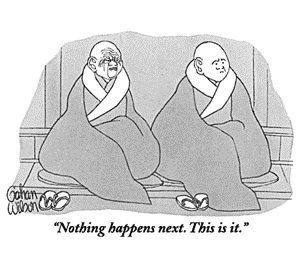
Bringing nonduality to a logic puzzle is like bringing a plasma gun to a knife fight, by whose mechanics "P = ~P" intrinsically allows literally means everything in the world can be proven to exist. Nonduality, therefore flying unicorn zombies. P=~P, therefore Jesus did not just exist, he's alive right now.
In other words: X, and also ~X. You are both crazy, and sane; get back on that plane.
Today a "catch-22" is colloquially understood as a bureaucratic trap -- an abuse of power in bad paperwork. But the original Catch-22 in its namesake book was just telling a different truth: that war is beyond the realm of reasonableness, that words are just things we say to command treacheries upon the flesh. The fundamental truth is fearfully constant; that Yossarian sees it does not make it go away.
Logic traps in public ethics
The world today is full of "If you see the truth of ~X -- congrats, you are right! You must do Y."
If you believe global capital markets are setting the world on an unsustainable path to climate change, you must fight them - certainly you should not cash in on oil money or bet on Canadian real estate.
If you believe systemic racism / classism / sexism exists, you must do all you can to be anti-racist / anti-classist / anti-sexist -- certainly you should not try to imitate or align yourself with your wealthy white male oppressors.
If you believe that you're in a consumer rat race of oppressive status symbols, you must boycott Hermes -- certainly you should not buy a fake Birkin for $300 from China.
I think that's a bind that many of us face. We are all Yossarian, seeing that we are in an imperfect system that people pretend not to see, because to see would also bind them to choices that sacrifice themselves. You don't learn about this until Heller's sequel, but Yossarian ends the war becoming part of the military PR machine he despises. He takes a deal in which he pretends to be a hero to save his own hide and go home.
There is an evolutionary advantage to cognitive dissonance.
There is a certain flavor of advice from the wealthy and successful to Slow down, love people, savor each minute: all this is true, and it is also not, perhaps, why we ask Bill Gates or Ray Dalio their advice.
"Do as I say." Play fair. Never cheat. Read about China. We want to know how they won a game that has so many losers. And of course they cannot say.
Another koan, then: We must imagine Sisyphus happy.
This is my fifth day of writing for #ship30for30. If you liked it, drop me a tweet so I know what to do more of.
Elise Liu
3y ago
On Monday night, after writing about burnout for #ship30for30, I went on a walk with another woman in tech and found out she was going through some of her own.
"People tell me I'm crushing it, that I'm doing the best work in my cohort and role. I got promoted twice in a year. But I have the suspicion that I'm getting taken advantage of... that I'm doing other people's jobs."
You probably are, I said.
"I already pay my therapist to tell me that," she said. We laughed.
She offered a framework of eudaemonic pleasure-- taking joy in the purpose and ends of the work you are doing, rather than in the tasks themselves. Unlike hedonic pleasure--joy in work for its own sake--eudaemonia speaks to the sense that what one is doing in life corresponds in some level with one's highest virtues.
Caring for the sick. Teaching children. Fighting for justice.
Ah, yes--nursing, teaching, and activism--some of the professions with the lowest pay and the most burnout. Indeed, I have never been so miserable at work as when I was doing work I deeply believed in. Every personal failure was a point of shame; every failure of someone else was a dangerous blocker of the arc of history toward justice.
I think of an insight from Heidi Priebe, one of the absolute best mental health YouTubers: self-abandonment happen when the inner children in us can't count on the inner parents in us to take care of our own needs; typically, all kinds of tantrums result, burnout among them. Maybe our inner children put off their needs so much when doing The Right Thing, their life's work, that it can be hard to sustain when the work (sometimes, inevitably) fails. I think of the Buddhist principle of nonattachment, and wonder: How can we trust eudaemonic pleasure when results are not in our control?
But I also think of everything neuroscience has taught us about hedonic adaptation and numbing behaviors and addiction loops and the body's dopamine-pathway determination toward the new and shiny and surprising over what is steady, predictable, true. Adults do hard things. How can we trust hedonic pleasure to lead us toward growth and not decay?
And I think of my own reluctance to write short essays with perfectly crisp takeaways, the tantrum my somatic system threw this weekend at the idea of having to share yet another 3-point actionable piece on LinkedIn, and how I calmed it: by deciding that perhaps I don't have an answer on this, only a pile of questions.
Instead, I welcome you to tell me. Why should we work? If blessed with the gift of an easy survival, how should we live?