Domanie Spencer

Domanie Spencer

/domaniespencer

Domanie Spencer

I help writers, entrepreneurs, executives, and organizations curate the power of communication by offering editorial and ghostwriting services.
Kerning Editorial Website
User Avatar

Domanie Spencer

1y ago

Pivot with Power: Purpose-Driven Reinvention Brings Progress
Domanie Spencer

Reinventing a career isn't easy. By definition, you are doing something different, and that could be terrifying. However, pivoting is not about "starting at the bottom." Pivoting with power leverages everything you have learned so far, to take you further.

3 strategies that ensure a level of purpose-driven progress:

  1. Be aggressively curious and expand your knowledge. Don't think small. Search out all aspects of your chosen career locally, nationally, and internationally - sign up for courses, attend seminars, webinars, networking events. Many resources are free of charge and allow for review before commitment. The more you listen, ask questions, and learn from experts, the more you can fine-tune your decision-making based on your experiences and strengths.

  2. Befriend to your inner critic. Yes, make friends. Self-doubt is, and will be, part of this journey as you wade through a learning curve. Instead of exhaustively beating it down every time, intentionally befriend it. Learn its ways. You will recognize the signs before it gains control, and like the friend who doesn't put up with drama, disinvite.

  3. Progress is the key, NOT perfection. The goals you set yourself don't have to be all-encompassing. Celebrate every step in the right direction. Show up and keep promises to yourself, recognize your growth and shifts. Even though it may be messy, progress is the focus.

User Avatar

Domanie Spencer

1y ago

2 Books to Read When Writing Simply Isn't Happening, and You Need a Friendly Nudge
Domanie Spencer

"We're taught to improve uncomfortable situations, to change things, alleviate uncomfortable feelings. But if you accept the reality you have been given - that you are not in a productive creative period - you free yourself to begin filling up again." Anne Lamott, in Bird by Bird

  • In the above excerpt, Anne Lamott writes about permitting yourself to accept the bad days when the "writing gods" seem to have taken a break. This is a book you will come back to time and again, mark-up pages that speak to you, and be reminded of the reason you always come back to writing.

"When it comes to the practice of writing, it cannot be the distraction that propels us but the patience - the openness, the willingness - to meet ourselves on the page. To stop being at the mercy of what we surround ourselves with, but rather, to discover our story." Dani Shapiro, in Still Writing

  • In writing about the creativity and the practice of daily writing, in finding your story, this book by Dani Shapiro is part memoir, part best friend, part practical motivator. Whatever genre of writing you practice, the author's experience through years of writing craft will remind you why you chose to write.

User Avatar

Domanie Spencer

1y ago

When Leadership Feels Heavier Than Ever Before, Going Back to Basics May Be Your Best Option
Domanie Spencer
  1. Expectations of constant flexibility due to constant change - With the current climate of shifting tariffs and general uncertainty, leaders are expected to anticipate, pre-plan upon pre-plan, and motivate their teams to follow suit.

    • Doubling down on cross-functional support will make the load lighter. Take half an hour to meet one-on-one with your colleagues, repair stressed work relationships. This is the time to build back support and rapport with stakeholders across the organization who contribute, with you, to the big picture.

  2. Cheerleader for all seasons - Leaders are expected to guide teams through change with a smile on their face. False positivity is different from a "can-do attitude," and teams can tell. Teams tend to feel unheard and invisible if leadership cheerily pushes on without acknowledging the chaos. This leads to team burnout and a lack of results.

    • Taking the time to set up the team for success will pay off in the long run - creating an open environment for questions, giving deep answers, talking through concerns. Creating shared goals within teams results in a shared load and shared success.

It's time to go back to basics where people are a leader's strongest assets.

User Avatar

Domanie Spencer

1y ago

As Writers, Are We Rewiring Ourselves to Forget That Creating IS the Point?
Domanie Spencer

I was blown away by an excerpt from Leigh Bardugo where she speaks about art in a world of "likes and follows."

"We have confused the reward of creating, with the reward of being praised for creating...The job of the artist is not to skip to the good part. The job of the artist is to make art when no one gives a damn..." Leigh Bardugo

  • When writing is part of our livelihood, likes and follows play a pivotal role in connectivity, which can lead to opportunities. This "praise" has become, for better or worse, a gauge of "success." However, in this pursuit of instant praise, it could unconsciously become one's only goal. The lack or reduction of likes and follows could be so detrimental to the writer, they give up too early, too soon, allowing the seeds of self-doubt to germinate, takeover.

This is where reminding and rewiring ourselves, and each other, to keep going, to make art, to write every day, and to analyze our writing together with our creative mind, IS the point.

User Avatar

Domanie Spencer

1y ago

When Someone Tells You Starting Over is Crazy, It's Not Always a Bad Thing
Domanie Spencer

What did I know about the publishing industry after working in the fashion industry for over 20 years? Nothing. What did I know about being an entrepreneur after only working in corporate America? Nothing.
People told me I was crazy when I pivoted to a new industry and may still think so; however, "crazy" isn't all bad. It has layers, and some layers are what get you through to the other side. I've learned these layers are also known as:

  1. Tenacity: Only you know what you are truly capable of. If you are committed to the goal you have chosen, you will find the paths to get you through.

  2. Curiosity: Ask the question in different ways until the answer makes sense. Starting over at any point in life can feel overwhelming. Break your questions down in the way that makes sense to you and seek out your answers, even when it may seem like you are the only one in the room with questions.

  3. Flexibility: Sometimes the decisions you make are not the best ones, especially as you're learning and gaining experience within your pivot. This is good. Mistakes and misses spark reassessment. Training your mind to rethink and re-strategize results in the kind of flexibility that allows for next-level accomplishments.

Success doesn't require sanity; it does, however, require a little bit of crazy.

User Avatar

Domanie Spencer

1y ago

3 Ways a Bad Leader Can Be Good for You
Domanie Spencer

As much as you learn from successful leaders, there are lessons learned from subpar leadership that can propel your own achievements. Using bad leadership as a catalyst for your growth is the smartest thing you can do for your career.

  1. Even bad leaders are good at something(s). It's how they got to where they are. For your own growth and increased ability to see beyond the obvious and immediate resistance, push yourself to acknowledge their strengths. Learning from within a challenging situation magnifies the lesson.

  2. You focus on building a team that doesn't consist of "yes people." Debate and disagreements are key to unearthing new ideas and building respect and critical thinking among the team. Leaders who foster an environment of acquiescence usually find themselves blindsided by the thing no one dared to say.

  3. Learn what not to do. This is self-explanatory, but within learning what not to do, observe your colleagues and team, and their reaction to the unfortunate trait that is being displayed. Be aware of your own feelings on the matter. Observing and acknowledging the results of any undesirable leadership behavior teaches the nuances of consensus-building and problem-solving.

Effective leaders are not problem-minded; they’re opportunity minded. They feed opportunities and starve problems. - Stephen Covey.

User Avatar

Domanie Spencer

1y ago

Writing Dialogue – 3 Tips for Stronger Dialogue That Will Elevate Your Storytelling
Domanie Spencer

When building believable dialogue in writing, only write what moves the story forward. If you can delete a sentence of someone's dialogue, or an entire paragraph of dialogue without a shift to the story, it's an indication the dialogue is superfluous.

Real-life dialogue doesn't work on paper. Observe how people talk to each other, but don't mirror what you hear in your writing. What you're looking for in real-life conversation is unusual word mixes, tone shifts, or particular words spoken in a particular accent or dialect. Real-life dialogue is messy, with plenty of pauses, starts, and restarts. If you write dialogue including plenty of "huh," "erm," "so…" etc., you've lost the reader. A quick exercise: deleting a majority of these filler words and re-reading your dialogue will help your dialogue deliver.

Hint: If your characters are naturally hesitant in speech, you can have them avoid eye contact, shuffle their feet, fidget, etc., to get the same feeling of insecurity across without unnecessary filler words.  

Dialogue tags are not actions. Many writers tend to confuse the two.

Incorrect: "Go without me," she sighed.

Correct: "Go without me," she said, sighing.

Correct: Rita sighed. "Go without me."

User Avatar

Domanie Spencer

1y ago

Regenerative Gardening: Soil Health is Your Health
Domanie Spencer

Dirt. It's a misnomer. Soil isn't dirty. It's life-giving, life-shielding, and the focus of regenerative agriculture. For decades, living in one city or another, my "garden" was a handful of clay pots, in postage-stamp-sized plots, or a jewel of a window box on 14th and 9th in New York City. Today, I'm turning acres of land from the perfection of landscaping to generative, sustained health. The first step in generative gardening is soil health. And no, you don't need acres of land for this practice. A postage-stamp-sized plot will do just as well.

Soil health is the key to increasing resilience against pests and diseases and allowing a natural ecosystem to flourish for varied plant growth.

I live in an area of the United States that offers clay soil in abundance. The first year was painful, and now four years later, I grow every vegetable I consume, and have plenty of produce to preserve and share using zero pesticides and zero store-bought fertilizer.

Here's where I started. No till, no dig.

I do neither. I lay unwaxed construction paper on top of the grass as spring emerges, and layer six inches of organic matter consisting of compost+top soil+mulch on top of the paper. I direct seed or direct plant into this layer. Year after year, the added organic matter naturally "turns" itself as it has for centuries.

This method nourishes microorganisms in the soil, helps maintain the soil's natural structure, and cycles nutrients through the seasons.

No till, no dig is the tip of the iceberg, and my series on regenerative practices will include other permaculture practices such as companion planting and water retention which allows for the replacement of synthetic herbicides, pesticides, and fertilizers. More to come!

User Avatar

Domanie Spencer

1y ago

A Critique Group That Fits Could Be the Best Thing That Happens to Your Writing
Domanie Spencer

“As a writer, you should not judge, you should understand.” – Ernest Hemingway

Writers have horror stories about critique groups, but choosing the right one can make all the difference in your writing. Take the time to ask questions before joining one that fits your needs. Here are 3 suggestions to keep in mind before committing to a group.

  1. Observe before choosing. A critique group should allow you to join a few sessions where you can simply observe the flow, camaraderie, professionalism, and manner in which the group interacts. There should be no pressure to contribute a piece or give feedback unless you wish to. Specifically ask how they maintain confidentiality and trust in each other's work.

  2. Varied perspectives. Constructive feedback is the goal of a critique group; however, it's best if group members are somewhat diverse in their writing. Different perspectives from both fiction and nonfiction writers within a group allow for broader and deeper learning of the craft. In giving and receiving feedback, your writing and understanding will grow in breadth and perspective.

  3. Network and support. Although writing is primarily a solitary function, a critique group you feel comfortable with will not only keep you accountable in your writing practice but also be supportive in your networking and writing endeavors.

Whenever writers gather in support of each other, only good things result.

User Avatar

Domanie Spencer

1y ago

Leadership Quotes to Ponder and Learn From
Domanie Spencer
  • A good leader inspires people to have confidence in the leader. A great leader inspires people to have confidence in themselves.” — Eleanor Roosevelt

  • A genuine leader is not in search of consensus, but a molder of consensus.” — Martin Luther King, Jr.

  • “If you want to improve the organization, you have to improve yourself, and the organization gets pulled up with you.” — Indra Nooyi

User Avatar

Domanie Spencer

1y ago

Friday Writing Prompts...Winding Down to Start the Weekend
Domanie Spencer

Whether it's 50 words or 250 words, these writing prompts will help frame your focus going into the weekend.

  • What's one thing that will bring joy over the weekend, that you will find time for?

  • What is one win you are grateful for this week, and one you look forward to next week?

  • Who was your favorite person to talk to this week, and why?

Pick one and attempt to write in one go, with as little editing as possible until the writing is done. This exercise is meant to lighten the load from within.

User Avatar

Domanie Spencer

1y ago

Series: Ancient Herbs - Turmeric, the Golden Spice
Domanie Spencer

Today, it's in anything from cosmetics to TikTok experiments, but the use of turmeric for its healing and cleansing properties can be traced back to 250 BC in India.

Here's a personal favorite: a non-caffeinated beverage that's said to help with reducing inflammation.

  • 1/2 teaspoon turmeric powder (its curcumin content is attributed to reducing inflammation)

  • A pinch of black pepper (the alkaloid piperine found in black pepper is said to help boost the absorption of curcumin)

  • 8 oz of comfortably warm water

  • 1/2 teaspoon of raw honey (optional, if a sweetener is needed)

  • A pinch of sea salt (optional for taste)

Mix until fully dissolved and enjoy any time of day. I usually partake after lunch.

Fine print: always do your own research before taking herbal supplements.

User Avatar

Domanie Spencer

1y ago

3 Reasons Why Intuitive Leadership Results in Success
Domanie Spencer

As the leader of high-performing teams over the years, I find the role intuitive leadership plays in any scenario too often overlooked. Understanding its subtle but critical contribution makes the difference between a successful team and a team that seeks out success.

  1. People first
    Business is about people. Intuitive leaders who recognize social cues, personality dynamics, and fluctuations within interactions are able to form robust, motivated teams who transition to becoming leaders themselves.

  2. Incisive decision-making
    Intuitive leaders recognize and lean into the lessons learned from every experience. This compounded wisdom leads to informed choices in high-pressure, high-speed environments.

  3. Maintain trust, bring on innovation
    Intuitive leaders hone their natural instincts and share their thoughts with their teams. Open, two-way discussions build and maintain trust. Trust welcomes transparency and innovation that lead to a consistent position in front of the curve.

Success in leadership is buoyed by one's team, and conversely, a team's success is boosted by intuitive leadership.

User Avatar

Domanie Spencer

1y ago

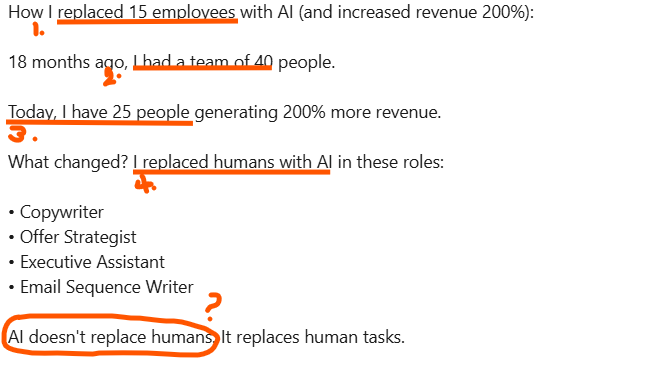
In a World Where AI is Producing Posts by the Minute, What Role Should People Play in the Comments?
Domanie Spencer

Today, a post began essentially saying "AI replaced humans" 4 times in 4 different ways, before it said, "AI doesn't replace humans. It replaces human tasks." As in many AI-generated posts, the cognitive dissonance was apparent.

The majority of folks in the comments, which numbered in the hundreds, praised the author/CEO for astutely framing the message. They agreed that this shift results in faster inputs/outputs, increased returns on ROI, and is the way of future success. While agreeing with most of these comments, I wondered: Did the human comments make up for the post's inadequacies? And if so, why?

  1. Does thought leadership mean less in the very human need to connect the dots when what leaders say (via AI) doesn't make sense?

  2. Do we as humans want to align ourselves with the AI gold rush to the point that we abandon critical thinking in reading?

  3. If the dissonance in this post was about anything but AI, would the comments have been less agreeable?

It's intriguing as it is disturbing, and I look forward to further research. Feel free to share your thoughts. This excerpt is from the top of the post.

User Avatar

Domanie Spencer

1y ago

Midlife Has Been Rewritten: An Insider's Look
Domanie Spencer

Midlife is no longer a crisis. I say this as a fully-fledged mid-lifer who has never felt calmer while maneuvering through career pivots, unwanted algorithm offerings, general political mayhem, and increasingly achy bones.

  • The clarity that comes with midlife is soul-shifting. Somewhere after the happy urgency of the 40s, as though looking through binoculars and imperceptibly turning the diopter, life comes into clearest focus. What you see ahead is yours to make what you will, because just beyond what you see, your mortality lurks. And for the first time, you truly acknowledge its existence. There is immense power in that.

  • The endless chatter and over-saturation of "anti-aging" everything, has naturally brought us to a turning point: to be comfortable that aging is what it is, and that one can proceed through it in one's own remarkable way. You can age gracefully, you can do it kicking and screaming, or choose anything in between. Simply owning it makes the difference. It's easier said than done, but it can be done by ignoring the chatter outside of yourself.

A quote attributed to Sir Anthony Hopkins I read today frames midlife exactly. "My philosophy is: It's none of my business what people say of me and think of me. I am what I am, and I do what I do. I expect nothing and accept everything. And it makes life so much easier."

User Avatar

Domanie Spencer

1y ago

Fiction Writing is an Exercise in Self-Trust. These 2 Suggestions Will Make It Easier...
Domanie Spencer

“Writing is like driving at night in the fog. You can only see as far as your headlights, but you can make the whole trip that way.”
― E.L. Doctorow, Author.

  1. Get comfortable with discomfort. Fiction writers rarely know where the writing is going to take them. The narrative shifts, the characters change, and suddenly, you are writing down roads unforeseen. Instead of attempting to pull your words back on track, allow the writing to take you where it may. They are your words; they are your pages. You can always delete/move/copy/paste later. Allow yourself the fortune of harnessing the power of the written word.

  2. No, you don't need to know everything before you start. Many fiction writers believe that one must have extensive knowledge about a place and time before writing a fictional piece about it. If your process is massive research before you begin, that's fine, but know you don't need to wait for complete and accurate facts to write. Creativity in fiction writing is the power of "unknowing." Yes, you can make sure that the castle in Scotland did indeed exist at a particular time, if you like, but research can come after the writing is done. Let the writing lead your story.

I find long-form fiction one of the most enjoyable to write, read, and edit. As evidenced in the writing, a writer's strength in self-trust is key to writing successfully in this genre.

User Avatar

Domanie Spencer

1y ago

I Never Agreed with the Advice: "Never Meet Your Heroes," Until I Met Her. It Taught Me an Important Lesson
Domanie Spencer

Although cautioned, the understanding of being disillusioned by heroes eluded me. Heroes, duly chosen, were meant to be above the fray in all the ways you want them to be. I was sure of it.

Then it happened. A small shift, but the disappointment was palpable.

She is a prolific writer with an epic following and lauded works spanning over two decades. She commands the respect of every writer who has, at one time or another, read her work in search of refining their craft.

A group of us were at a weekend master class, ecstatic to be in her presence, and on a 10-minute break. The beverage handed to her was too sweet. She took one sip, spat into the saucer, slammed the cup on the table with several curses, and walked out of the room. The handful of us who witnessed this, visibly deflated. We stared at each other, knowing our collective bubble was losing air. She apologized on her return, explained she was having a very bad day, and that it wasn't an excuse for her behavior. The next day, she wove the incident into her teaching.

I realized then, the delusion that resulted in my dismay was of my own making. It doesn't minimize her brilliance as a writer or her creative gift. It simply eviscerated the illusion of a built-in pedestal. This hero in particular, and perhaps all heroes everywhere, are only on a pedestal because we put them there.

User Avatar

Domanie Spencer

1y ago

Every week, these 2 activities move my editorial business forward. They Could Help Yours Too:
Domanie Spencer

1) I research indie (self-published) authors who have great reviews on Amazon and Goodreads in Memoir, and purchase one of their books.

Reason: We edit memoirs frequently, and this research helps refine our offering to our clients in terms of guidance on shifts and revisions.

So what? Honing in on your core businesses and elevating the quality of offerings ensures repeat clients and an excellent reputation for new partnerships.

2) I actively search out one leading writer who has traditionally published in a subgenre I'm unfamiliar with and purchase their bestselling book.

Reason: Kerning Editorial doesn't edit all genres or subgenres, but in reading/analyzing, the unfamiliar becomes less so. It opens up avenues of thought and options for client partnerships. (I support independent bookstores in this purchase. A good option: https://bookshop.org/)

So what? Constant learning builds the framework to be able to pivot swiftly as trends, markets, and industries shift.

User Avatar

Domanie Spencer

1y ago

I Thought Strategic Multitasking was Key, Until Being Fully Present in the Moment Multiplied My Results
Domanie Spencer

Pivoting to run an entrepreneurial editorial business, with no previous experience in the publishing industry, seemed like I had lost the plot. But, no.

The key to learning a new industry and recognizing the sweet spot to launch my enterprise resided in deeply focused moments where my mind was fully present.

Previously, my calendar looked like a kaleidoscope, starting at 8 am through 11 pm, sometimes double-booked, and sometimes on weekends. This won't be shocking to most corporate folks; you're putting out fires while you have lunch, texting while walking from one meeting to the next. You respond to emails at 6 am while preparing for a commute and get on a late-night conference call on your drive home. It's all very normal. I enjoyed it. It was effective. I now call it a Corporate High.

When I began my entrepreneurial journey with this same layered urgency, I was surprised not to reap instant results. I quickly found that the largest successes in my business come from hearing what was not being said. Being the new kid with "new eyes" on a very large, very established block, I doubled down on my focus and recognized hidden opportunities.

Fully present, fully focused, fully aware - it's an Entrepreneurial High, and it's powerful.

User Avatar

Domanie Spencer

1y ago

Let's Bust a Few Misconceptions About Memoir Writing so You Can Finally Finish Yours
Domanie Spencer

Many memoir writers I have worked with undertake this journey to gift their family, friends, and colleagues a record of their experience. Ultimately, they find it's a valued gift to themselves where their insights and memories of an important time and place find a home in perpetuity.

  1. Memoir is not an autobiography. Autobiographies tell of a person's entire life. Facts are copiously researched, family trees are triple-confirmed, permissions to share are filed, etc. Memoir, on the other hand, can be about any point in time, or happening, in a person's life. A weekend. A love affair. A childhood. A place. The focus is on the growth and movement of the main character (you), from who you were at the start to who you were at the end of your story.

  2. You can't write about things that never happened and people who didn't exist - if you do, it's Fiction. Nothing wrong with Fiction, it's simply not Memoir. In Memoir writing, your memories are your own, as are the interpretations of those memories. You don't have to show receipts or records or proof of anything; however, as a genre, it is expected that the telling of your story is not a fabrication but a factual representation of your memory.

  3. Memoir does not have to follow Nonfiction guidance although categorized as such. It can be written in the blissfully opaque world of "Creative Nonfiction." This means you can draw from all the narrative tools in Fiction - dialogue, tension, metaphor, character building - to tell a gripping, compelling story.