Ladi Jiya

Ladi Jiya

/ladijiya-careers

Ladi Jiya

Career reinvention without the guesswork - via Substack, LinkedIn, plus tools that work, strategy sessions that unlock your path, and execution support to get you there faster.

MOVE//Reinvent on SubstackLinkedinXFacebook
User Avatar

Ladi Jiya

1y ago

Experiment Relentlessly
Ladi Jiya

Remember when VUCA was something you prepared for?
Volatility. Uncertainty. Complexity. Ambiguity.

Now it’s just how work feels most of the time.

With skills for AI-exposed jobs changing 66% faster than others (LinkedIn 2024), you can’t plan your way through this pace of change.
You have to test your way through it.

I talk to hundreds of professionals every year. Many are in what one called "the messy middle".
Still employed but restless. In transition. Trying to reinvent.

The pattern is always the same.
People who move forward experiment.
People who stay stuck wait to feel ready.

Progress comes from motion, not mastery.

The professionals who stay relevant treat their careers like living projects. They run small tests, get feedback, and adjust.

That’s been my story too. Curiosity has guided every pivot — from telecoms to HR consulting to career strategy, and now into AI, where I’m learning how technology can facilitate career transition journeys.

Experimentation isn’t chaos. It’s disciplined curiosity.

You don’t need a five-year plan anymore.
You just need a habit of testing what’s next.

Because stability no longer comes from staying still.
It comes from learning fast enough to stay ahead of change.

What small experiment could you run this week?

User Avatar

Ladi Jiya

1y ago

Visibility is a Skill
Ladi Jiya

You already have a brand.

It's what people say about you when you're not in the room. The reputation attached to your name in meetings, emails, hiring conversations.

Most people don't know what theirs is.

Audit it: Ask three colleagues what you're known for. Listen to performance reviews. Notice which opportunities find you, and which don't.

That's your brand in motion.

Why visibility gets dismissed:

Empty self-promotion. No substance.

Real visibility is different:

  • Grounded in results

  • Collaborative - helping others, paying it forward

  • Honest - sharing what you're learning, not just wins

When you show the work, people trust you.

The gap most people miss:

Strong internal brand. Respected. Delivered results.

Then redundancy hits.

The market has no idea who you are.

Visibility isn't performance. It's insurance.

It ensures optionality. Multiple pathways when you pivot. Opportunities finding you instead of you chasing them.

It's the difference between letting your career happen to you and shaping your own story.

How to build it:

Internally: Share lessons after launches. Offer insight, not updates. Connect work to outcomes. Use your company's platform to build your voice; don't hide behind the brand.

Externally: Write reflections. Ask questions in public. Show up in professional communities. Share what you're learning.

Be consistent, clear, credible.

The truth:

Competence earns trust. Visibility earns opportunity.

User Avatar

Ladi Jiya

1y ago

Own Your Career like a Business
Ladi Jiya

You've Been the CEO All Along. You Just Didn't Realise It.

The old deal is gone.
Loyalty no longer buys security. Performance no longer guarantees progression.
You can do everything right and still get restructured, replaced, or rendered irrelevant.

At some point, the shift happens: from employee to operator.
From waiting for permission to shaping your own direction.

Whether you acknowledge it or not, you've been making CEO-level decisions about your career for years: how you allocate time, attention, and energy. Where you build expertise. Which relationships you invest in.

You are You, Inc., a business with assets, customers, and a market position.
Your skills are your product. Your relationships are your distribution. Your track record is your proof.

The question now is: are you running it strategically?

That means knowing what you own:
→ Core excellence: what you're legitimately great at
→ Rare combinations: your unfair advantage
→ Strategic relationships: who knows you, trusts you, would hire you
→ Track record: proof, not credentials
→ Visibility: who knows what you're capable of

Every professional has capital. But not everyone knows how to deploy it.
Some demand control before they've built leverage. Others build so much they become too valuable to move. Both get stuck.

Owning your career isn't about going solo.
It's about building optionality.

Audit your capital. Invest where demand is rising. Build proof that travels with you. Act your way into new opportunities: stretch, collaborate, experiment.

Security doesn't come from a contract.
It comes from leverage: from relationships, proof, and positioning.

Optionality isn't about keeping every door open.
It's about having enough leverage to choose which ones you walk through.

User Avatar

Ladi Jiya

1y ago

Think in Skills, Not Titles
Ladi Jiya

Work has changed.

The gig economy cracked open flexibility. COVID made remote work normal – and competition global. Now AI has dissolved boundaries between roles, industries, and professions.

Work is no longer a job. It's a mix of projects, problems, and possibilities.

And yet, many professionals are still trying to fit into titles that no longer fit them.

I work with over a hundred experienced professionals each year – some in intensive coaching engagements, others through workshops and peer networks. The hardest part of reinvention isn't rewriting a CV. It's rebuilding identity.

When your title disappears, so can your confidence. People who've led teams for decades suddenly wonder: Who am I without the role?

This isn't starting over. It's translation.

The shift begins with one question: What problems have I solved?

Your value isn't tied to where you worked – it's in what you made possible.

Here's how to translate it:

Name what you actually do. Not responsibilities. Capabilities that create results. What do people ask you to fix? What do you make look easy?

Identify the problem behind each skill. A skill without a problem is trivia. A skill that solves an urgent problem? That's a market position.

Find where those problems are growing. Follow the money. Look adjacent. Watch what's breaking.

Test for relevance. Run each skill through three filters: Evidence (proof of results), Story (judgement, not just execution), and Access (a path to people who need it).

Your next chapter isn't a job title. It might be a fractional role. A consulting niche. A product role in a new sector. A portfolio of projects.

The package matters less than the clarity: I solve X problem for Y people, and here's the proof.

You've built expertise. Now it's time to make it portable.

User Avatar

Ladi Jiya

1y ago

Adapt Early: Build AI Fluency
Ladi Jiya

If you're feeling breathless watching AI evolve, I understand.

The pace is extraordinary. What's cutting-edge today feels outdated in six months.

But you've mastered other things before. You can do this too.

The shift: tools vs fluency

AI fluency isn't about chasing the latest model. It's about learning to think with AI as a thinking partner.

Understanding where it helps and where you lead. What you do. What AI does. Where the handoff happens.

What becomes valuable

As AI accelerates execution, what becomes scarce is discernment.

Recognising quality output when everyone has access to the same tools. Asking the right question. Setting the right constraints. Interpreting what the machine can't see.

Your judgement. Your context. Your relationships. These become premium.

How to start

Begin with the fun and familiar. Don't jump in at the deep end.

Plan a trip. Create a recipe. Or pick something at work that's repetitive or time-consuming, something you know deeply.

Use AI there first. Because AI doesn't think. It recognises patterns. You need to know your domain well enough to assess: is this good or is this nonsense?

Start where you're strongest. Automate something small. Build confidence. Then expand.

Bring others along

If you lead people, this isn't just about your fluency. It's about helping others build theirs. Create environments where experimentation is safe and curiosity is rewarded.

Teaching fluency builds yours faster.

Adapting early isn't a new skill. It's a continuation of who you already are.

You've done harder things than this. Start exploring. Stay curious.

You've got this.

User Avatar

Ladi Jiya

1y ago

When Everything Breaks, Show Up Anyway.
Ladi Jiya

Five minutes before showtime, everything was broken.

The tools I'd been building? Not ready.

The interactive HTML presentation I'd created? Crashed at the last minute.

My carefully planned demo session? Gone.

I had to pivot completely.

I showed up to today's session expecting to demonstrate polished tools.

Instead, I explained what happened, apologised, and said:

"But I'm still committed to the promise - helping you get clarity. Let's figure this out together."

I gave them the custom agents - just without the sleek wrapper.

Substance over packaging.

What happened next reminded me why I do this work.

When I asked what they were taking away, every single person said essentially the same thing:

The relief of knowing they weren't alone.

The realisation they have what they need to move forward.

Hope. Possibility. Connection.

These are accomplished senior leaders. Smart, capable, experienced.

Yet so many of us are carrying quiet uncertainty about AI, the shifting world of work, this brutal job market, ageism, and just life, lifing.

I've noticed Gen X professionals tend to hold back, waiting until we're "ready."

You know what I've learned from Gen Z?

Audacity.

The willingness to show up imperfectly and figure it out as we go.

Confession: I've been wanting to retreat. Focus on the work alone, avoid the mess of human connection.

Today reminded me of the old saying:

If you want to go quickly, go alone.

If you want to go far, go together.

I showed up with broken tools and a crashed presentation.

But I showed up.

And somehow, that was enough.

How was your day?
User Avatar

Ladi Jiya

1y ago

Find the Job Behind the Job Ad
Ladi Jiya

Most people treat interview prep like a guessing game.
You scour the job description, rehearse your skills, and try to anticipate what the hiring manager really wants.

Stop guessing. There’s one question that cuts through the noise:

“What does success look like in this role?”

Ask it as early as you can, with the recruiter, the hiring manager, anyone you meet. It’s a context-generating machine.

Most job ads list responsibilities, not outcomes. This question forces them to define what truly matters.

Then go deeper:
“In six months, what would the person you hire need to have accomplished for you to think, ‘Yes, we made the right choice’?”

That question changes the entire dynamic.
It forces clarity if they haven’t defined success.
It gives you a map. Their answer becomes the cheat sheet for the rest of your responses.
And it bridges the gap between the job description and the real job.

When you ask this, you stop performing and start partnering.
You’re not there to impress.
You’re there to align yourself with their definition of success.

User Avatar

Ladi Jiya

1y ago

The Quiet Power of Context Mastery
Ladi Jiya

I used to think interview preparation was about answers, having the right examples, the right metrics, the right way to describe your impact.
But after years of interviewing senior professionals, I know differently. The best candidates didn't come to answer questions. They came to ask them.

They'd done their homework. But they'd also done their due diligence. They understood the company's context, the shifts, the pressures, the inflection points.

And that understanding changed how they showed up. They weren't performing for approval. They were engaging as peers.

That's the quiet power of context mastery. It changes the conversation completely, from you versus them to both sides looking together at the company's real issues.
When that happens, the tone shifts. You're not a candidate being assessed. You're already part of the solution.

One conversation still stands out.
Five people interviewed for a senior sales role. All confident. All credible.
Only one walked in already seeing the business through the company's eyes. He referenced market reactions, recent moves, what he believed the role was there to fix.

He demonstrated the willingness and ability to do the work it took to reach that level of understanding.
That commitment to discovery and preparation wasn't just impressive; it was relevant.
The role required someone who could build trust and think collaboratively with customers.
And in that interview, he demonstrated exactly how he would do it.

He wasn't louder or flashier. He was simply more tuned in. He spoke like someone already thinking from the inside.

That's when I realised: interviews at senior level aren't about proving competence. They're about proving you understand context.

Because when you do, you stop waiting to be chosen. You start recognising that choice has always been mutual.

Every interview is an investment decision, theirs in you, and yours in them.

And that shift changes everything.

User Avatar

Ladi Jiya

1y ago

The Reinvention Manifesto: How Experienced Professionals Stay in Motion
Ladi Jiya

Earlier, I shared a story about Eneke the bird, a reminder that the world has learned to shoot without missing, and we must learn to fly without perching.

Here is a practical follow-on. A manifesto for those of us who have spent decades mastering our craft and are now learning to master change itself.

1. Adapt Early.
AI is not going anywhere.
Learn to think with it, work with it, and use it to deepen what you already do.
The professionals who thrive will not be the ones who compete with machines, but the ones who collaborate with them

2. Think in Skills, Not Titles.
Your job title is not your identity.
You are a portfolio of skills, experience, and judgment.
Know which problems your skills solve and where those problems are growing.

3. Own Your Career Like a Business.
Loyalty and performance are no longer insurance.
Optionality is.
Build foresight. Build relationships. Build proof of value that travels with you.

4. Visibility Is a Skill.
Competence is assumed.
Visibility is what multiplies it.
Use your employer’s brand to amplify your own, not replace it.
Be known for something specific.

5. Experiment Relentlessly.
Pilot ideas. Test markets. Try things before you need to.
Stability now comes from iteration, not inertia.

6. Build Network Equity.
Opportunities flow through people.
Build your network before you need it, and nurture it like an ecosystem with generosity and curiosity, not transaction.

7. Redefine Success.
Freedom, not tenure.
Optionality, not certainty.
You have earned expertise.
Now earn autonomy.

This is what it means to fly without perching.
The rules have changed. But so has the opportunity for those willing to move first.

User Avatar

Ladi Jiya

1y ago

The Triangle of Success
Ladi Jiya

I spent yesterday reading the Michael Page 2025 Technology Market Trends and the Harvey Nash Tech Salary Report.

One insight struck me: The "Triangle of Success" framework and the 50%+ salary premium it commands.

Here's what the data shows.

The market has split in two. Generalists are being commoditised, competing for the same roles and accepting lower offers. Meanwhile, professionals who combine technical depth, industry knowledge, and business acumen are commanding significant premiums.

This is the new equation of value:

Technical Expertise × Industry Knowledge × Functional Capability = 50%+ salary premium

Not addition. Multiplication.

A cloud engineer who understands AWS? Valuable. A cloud engineer who understands AWS, knows fintech regulations, and can present security posture to the board? Irreplaceable.

If you're a senior professional, you already have all three. But most people compete on job title alone. They never make the triangle explicit.

The simple formula:

"[Technical] professional who delivered [Functional outcome] in [Industry context]"

Example:

"Director of Cloud Operations who led PCI-DSS compliance for a fintech platform, presenting quarterly security posture to the board."

Three dimensions. One sentence. Instant differentiation.

Your sector knowledge is your moat. Stop hiding it.


Sources:

User Avatar

Ladi Jiya

1y ago

Track Capital, Not Openings
Ladi Jiya

If you're a senior professional searching for your next move, stop scrolling job boards. Start tracking capital.

Every major leadership change begins when money moves. A fund invests. A company is acquired. Before recruiters even know a role exists, investors are already asking: Who can make this work?

That's where opportunity starts, quietly, months before the market catches on.

Where Capital Creates Movement

Executive-search data shows that about two-thirds of PE-backed companies replace or add at least one C-suite leader within a year of acquisition. Capital moves, leadership follows.

I know an executive search firm whose entire strategy is built around this: partnering directly with venture and private-equity investors so they hear about leadership gaps before anyone else.

I once spoke to a COO who never applied for his current role. His name came up in a private-equity investors' WhatsApp group. Reputation moving faster than any CV ever could.

The Invisible Executive Problem

Many senior professionals assume their reputation travels farther than it does. Many only realise how invisible they are during a career transition, when their name means nothing outside their last company.

Visibility isn't automatic. It's built deliberately, in the places where decisions get made.

How to Use This

You don't need insider access to start. You build it.

Spend thirty minutes a week scanning deal news. Note two or three transactions. Follow the people involved. When someone posts about a challenge you've solved, respond with one clear example. Not advice, just what worked:

❌ "Great post! Integration is so important."
✅ "We had this exact issue. What worked: 15-min weekly standups between old/new teams for 90 days only. Faster decisions, less theater."

You're not chasing openings. You're showing how you think.

Most people chase jobs. The smart ones track capital.

User Avatar

Ladi Jiya

1y ago

The Art of Flying Without Perching
Ladi Jiya

Today I’m sharing one of my favourite quotes from Chinua Achebe:

Eneke the bird was asked why he was always on the wing.
He replied, “Men have learned to shoot without missing their mark,
and I have learned to fly without perching.”

He wrote it decades ago, but it’s a perfect metaphor for work today.

For many experienced professionals, the ground beneath us has shifted.
The rules we were raised on - perform well, stay loyal, build tenure - no longer guarantee safety.

I think of a client I worked with.
Twenty-five years in the same organisation. Solid career. A leader who had just delivered a major project that was hailed across the firm.
A week later, HR called. Strategy had changed. His part of the business was moving overseas. Three months to wrap up, and he was required to support the setup in the new country and train the people there to do his job.

It was not failure. It was not performance. It was timing.
And it is happening everywhere.

For many experienced professionals, twenty years of experience has never mattered less or more, depending on what you do next.
Loyalty was always a one-way street. Some of us are just realising it late.

In the old world, performance and loyalty meant security.
In the new world, adaptability and audacity mean relevance.

You will not thrive because you are the most skilled.
You will thrive because you are willing to test, learn, and move before certainty arrives.
You think with new tools, work across boundaries, and apply your expertise in new ways.

Too many professionals are still running their careers in waterfall mode: long plans, fixed paths, waiting for sign-off.
The ones who win approach their careers the agile way. Iterate. Adapt. Iterate again.

It is not about abandoning what you have built.
It is about carrying it forward differently.

So what branch are you still clinging to?

User Avatar

Ladi Jiya

1y ago

You Already Know How to Do This. You’ve Done It Before.
Ladi Jiya

You are experienced.

You have led teams, delivered results, made tough calls with incomplete data.

That judgment, the same one that got you here, is still your biggest advantage.

But I see it all the time.
When leaders hit a career transition, that judgment disappears.

It is even worse in the current market, which quite frankly is brutal.

They freeze.
They rush to job boards.
They copy what everyone else is doing.

It is like they forget how to think strategically about themselves.

If your company was entering a new market, you would never start by scrolling listings.

You would step back and ask questions.

Where is the demand shifting?
Who has the problem we are best positioned to solve?
Who needs what we can deliver and can pay a premium to get it?
And how can we access them?

Then you would find the answers.
You would build a way into that market.
You would form a team, create a plan, and do what it takes to get there.

That is why I am often baffled by the helplessness I sometimes encounter.

I understand redundancy is destabilising.

But you have fought battles before.
You are a veteran of many battles.
You know how to lead through uncertainty.

The same discipline that built your career can rebuild it.
Start there.

User Avatar

Ladi Jiya

1y ago

Let AI Do What It Does Best
Ladi Jiya

AI really excites me. We are all talking about it, using it, thinking about it. It feels like so much change so quickly.

The Gift of Vision

For me, the biggest boon has been the ability to see - really see. You know that song, 'I can see clearly now'? That's what AI has done for me. I've always envied people who could tell you what happens in ten years, in twenty years. Futurists who can analyse data and see the future so clearly - it feels like wizardry to me, actually.

AI has given me that ability. To see further ahead and understand today clearly, with insights that once required complex analytics. If you ask the right questions, AI will help you find the data, analyse it, and walk with you as you make sense of it. The insights and opportunities it has helped me and my candidates unlock is just incredible.

The Real Challenge

Which is why I believe we should embrace it and lean into its power. People worry about obsolescence, feel anxious about the race against AI. I believe the real challenge is not mastering new tools but adapting what you know to an AI-shaped world.

We didn't get here without wisdom and knowledge. We've had good careers, successes, expertise - what we have is valuable and becomes even more valuable when you layer AI on top of it.

What Makes Us Human

People who thrive will lean into what only human beings can do: judgement, discernment, relationships, making meaning in ways machines cannot. Let AI do what it does best. Let's lean into being human.

User Avatar

Ladi Jiya

1y ago

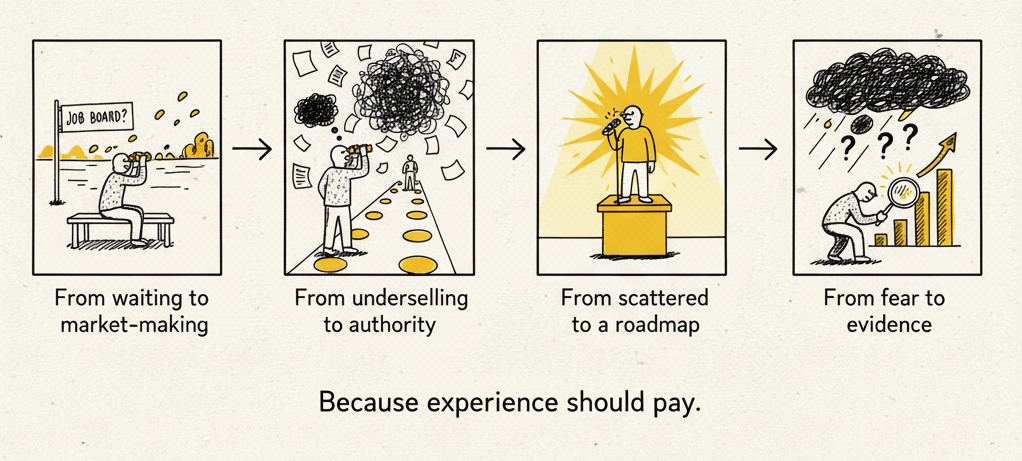
Because Experience Should Pay
Ladi Jiya

I just signed up for Ship 30 for 30 with Dickie Bush & Nicolas Cole.

For the next 30 days, I’ll be writing daily about executive job search, starting your own business, and how AI can help you reinvent your career.

Why I am doing this:

  • Writing every day sharpens my thinking

  • I want to see what’s genuinely useful to you

  • I’m growing MOVE//Reinvent, my newsletter on career reinvention without the guesswork

I’ve worked with hundreds of professionals in transition. No two journeys are the same, but the focus always is: find where your skills and experience command a premium, whether that’s in a role or in consulting. My starting point is simple: experience should pay. That’s what I’ll be sharing.

If you’ve got a question, a roadblock, or something you wish someone would finally cover, share it with me. Let’s work through it together.