Aaron Leitz

Aaron Leitz

/aaronleitz

Aaron Leitz

Photographer | Artist

WebsiteTwitterInstagram
User Avatar

Aaron Leitz

2y ago

Your Goals Need to be Actions
by Aaron Leitz

It would be frustrating if my goal was to become a better writer.

I have been working long days this week out of town on a work trip. It has been hard to find the time to even think about what to write. Let alone write it.

If I were to evaluate my progress towards becoming a better writer this past week I would be disappointed. But that's not my goal.

My goal is to spend 30 minutes every day gathering my thoughts, ideas and then writing as many words as I can.

That's as complicated of a writing process as I can handle right now. And that's ok. Because at least it is a process.

As long as you set goals that are Action Oriented with outcomes you can control there is only upside.

User Avatar

Aaron Leitz

2y ago

Respect the Process
by Aaron Leitz

"Process saves us from the poverty of our intentions." - Elizabeth King

I want to write a really great essay. But I can't seem to figure out how to write what I want to say.

So I figure out a title for the essay first. Just as the expert writers taught me. And just like that the writing becomes easier. Not great but at least it's a start.

And I can see that if I follow the process of writing down my essay title first I make it a lot farther than I do when I just stare at a blank page with the intention of writing something.

My process may not be refined or optimized but it is there.

The only thing you can do is focus on the process. That is where the value is.

Intentions are cheap.

User Avatar

Aaron Leitz

2y ago

The Want of Wonder
by Aaron Leitz

"We are perishing for want of wonder, not for want of wonders." - G.K. Chesterton

I am out of town for work this week. The days are long and filled with creative and logistical challenges. It is impossible to stay adequately hydrated. Jet lag is real.

But what a wonderful stroke of luck. That I happen to be alive at this moment in time.

To have traveled from one end of the country to the other end in a matter of hours while taking in a view few in the history of humanity have ever seen.

To be able to instantly communicate with my family thousands of miles away.

To be able to take a video of a big iguana I saw today and send it to my son.

User Avatar

Aaron Leitz

2y ago

Are You a Traveler or a Tourist?
by Aaron Leitz

"The traveler sees what he sees. The tourist sees what he has come to see."

-G.K. Chesterton.

We spent two weeks in Paris last fall.

We walked through the endless rooms of the Chateau de Fontainebleau.

We stood in line at the Louvre and muscled our way to within 12 feet of the Mona Lisa.

We went to the Eiffel Tower.

We wandered the 4th arrondissement in the evening in the rain.

User Avatar

Aaron Leitz

2y ago

Consistency is the Most Important and Only Universal Skill
by Aaron Leitz

This essay is a punt.

I'm giving up on writing a well articulated 250 word essay by the end of the day. I tried but it's not going to work out given the circumstances. So I'm punting.

But punting is not quitting.

Punting is simply giving up on a short term objective in order to protect a more important long term objective. I'm willing to write and publish a not-very-good-in-my-opinion essay because it keeps me moving towards my most important goal.

Write and publish some words every day.

Because I know that if I show up and write and publish every day it will get easier.

It can be frustrating as an experienced professional to learn a new skill. Especially when your current skillset doesn't cross over into the new arena.

You feel as if you're starting all over again. Because you are. And it's been a long time since you were a beginner.

The only thing you can do is to lean in and rely on The One Universal Skill.

Consistency.

User Avatar

Aaron Leitz

2y ago

Information Overgrowth
by Aaron Leitz

In her essay "Work With Material,", the artist Anni Albers writes:

"For we are overgrown with information, decorative maybe, but useless in any constructive sense. We have developed our receptivity and have neglected our own formative impulse."

Albers outlines an important struggle faced by modern day creatives.

We are overgrown with information.

The sheer quantity and variety of information and content available for us to consume is staggering. Instagram. Twitter. YouTube. Mainstream media. Alternative media. And never before have there been so many ways to capture, organize and store all of pieces of content that we find.

We have developed and fine tuned our receptivity.

And by doing so it is easy to forget that this consumption is useless in any constructive sense. The gathering of more information, tips and frameworks may feel like we are making progress.

But it is just motion.

A distraction from the basic truth that all we need to do is act on our formative impulses.

Because creativity comes from the simplicity of action.

You just have to act.

Anni Albers' essay was written and published in 1938.

User Avatar

Aaron Leitz

2y ago

When You See Someone Doing Something That You Think is Great You Should Tell Them
by Aaron Leitz

Derek Sivers writes:

"When you think something nice about someone, you should tell them."

So that's what I'm doing this year (and every year after). When I come across someone doing something cool, fun, interesting or that impacts me, I email them and let them know.

In the past few weeks I have reached out to

  • An architect in New Zealand

  • A graphic designer in Chicago

  • A motion picture colorist in Los Angeles

  • A writer in London

  • A business strategy consultant in Canada

There is no pitch or offer or ask for advice. Just a simple compliment for compliment's sake. Sometimes my message is only a sentence or two.

It feels GOOD to compliment someone. Especially someone you don't know.

And having been on the receiving end of a few such messages I can confirm that it feels good to receive a compliment from someone. Especially from someone you don't know.

With all the posturing and flashiness on websites and social media these days, many individuals have created a professional brand image of themselves that can feel unapproachable. But the responses I get back are always gracious and a good reminder that they're just regular people trying to do good work. Just like us.

User Avatar

Aaron Leitz

2y ago

Do Your Difficult Things Together as a Family with The 15 Minute Challenge
by Aaron Leitz

My 11 year old son plays the piano. A few months ago he was working on a song that was a little bit beyond anything he'd ever played before. He'd get to a hard part and then stop and move onto another song.

I knew he was capable of playing the song. He just needed a push.

And it just so happened that I needed a push to do my shoulder PT exercises that I had been slacking on.

"Here's the deal." I said. "Every day we're going to work on a difficult thing together. While I'm working on my PT exercises you're going to work on your song. It doesn't matter how far you get. Maybe some days you'll only figure out a few notes. Some days it will feel like you're not getting anywhere. That is ok.

The most important thing is that you work on it. Every day for 15 minutes."

My wife popped her head in the room. "That sounds great! While you guys are doing your thing I'll work on my French that I've been putting off for the past week!"

And just like that the Family 15 Minute Challenge was born.

  • The 15 Minute Challenge

Each family member chooses a Difficult Thing to work on every day for at least 15 minutes. The Difficult Things cannot be household chores or remedial tasks from a to-do list. Difficult Things are done to improve yourself. Honing a skill. Learning a new one that seems just out of reach.

  • 15 minutes is the sweet spot.

15 minutes is enough time to make meaningful progress on your Difficult Thing. Often times the 15 minutes turns into an hour. But it's still a short enough stretch of time that passes quickly if you're just not into it that day.

  • Together in solidarity.

The hardest part of doing the Difficult Thing is always starting. Knowing that everyone in the house is doing their Difficult Thing on their own but at the same time is really motivating.

Our son knows that while he is working through his piano piece note by note, mom is in the dining room conjugating French verbs and dad is downstairs grunting through his shoulder PT exercises.

That we're all in this together.

User Avatar

Aaron Leitz

2y ago

Level Your Horizon to Take Your iPhone Photos from Amateur to Pro.
by Aaron Leitz

I've been a professional photographer for 17 years and the most important improvement you can make to your photos is to keep the horizon level. A level horizon in your photos relaxes the viewer and invites them into the image.

Sometimes it's not always possible to get a photo with our iPhone that is perfectly level. Sometimes we just forget. Luckily it's an easy fix with the iPhone's photo editing tools.

On your iPhone tap on the photo you want to level and then tap "edit." Across the bottom of the screen are three icons. Tap the third one on the far right that looks like a crop tool.

There are three adjustment tools to use to perfect the perspective of your image:

  • Use the first adjustment tool to rotate the image to get a perfectly level horizon

Bonus Adjustments:

  • Use the second adjustment tool to tilt the image forwards and backwards to make vertical lines perfectly vertical

  • Use the third adjustment tool to tilt the image left and right to make horizontal lines perfectly horizontal

That's all there is to it. No more wacky landscape photos where trees and buildings look like they're about to topple over. And no more family portraits that look like everyone is about to slide off of the screen!

User Avatar

Aaron Leitz

2y ago

The 3 Components of All Good Interior Design Photographs
by Aaron Leitz

I have been a professional interior design photographer for 15 years. I've created thousands of photographs of interior spaces and have studied thousands more.

All great interior design photographs have the same 3 characteristics.

1) Grounded perspective

A good composition grounds the viewer with a perspective that matches reality. Views that are straight-on, called "one-point perspectives" are the most effective. The horizon or floor is level and flat. Walls and vertical elements are straight up and down.

A grounded perspective relaxes the subconscious mind, inviting the viewer into the image to stay a while. A crooked perspective, however slight, immediately distracts the viewer as the subconscious recognizes that something is not right.

2) Motivated lighting

The human eye is very sensitive to differences in light and contrast. The eye follows light. The best interior photographs take advantage of this and use light and contrast to guide the viewer's eye through the frame.

In the above photograph the foreground and edges of the frame are kept slightly darker than the center of the frame. Encouraging the eye to linger in the center of the image (and perhaps wonder "what are they going to do with all of those peaches?!")

3) Great composition and styling

Interior Design spaces contain objects, textures, patterns and surfaces that compete for the viewer's attention (see above photo!). When these elements overlap, merge, or are positioned in distracting ways the eye has to stop its journey to figure out what is going on.

A great interior design photograph positions elements in a way that the eye can easily identify them and their relationship to other elements in the frame.

User Avatar

Aaron Leitz

2y ago

Goal Setting: Actions Versus Outcomes
by Aaron Leitz

Outcome Goals are focused on the outcome and not the process.

Action Goals are process oriented by definition.


  • Outcome Goals depend on circumstances outside of your direct control.

Many things beyond your control have to go your way for you to accomplish an Outcome Goal.

  • Action Goals are under your direct control. Chances are greater that you can accomplish an action goal.


  • Outcome Goals do not have a clearly defined path to success.

Uncertainty leads to fear, procrastination and ultimately failure.

  • Action Goals have a clearly defined path. The steps are the goal.


  • Outcome Goals are limited by your current skillset and mental map.

The less experience/knowledge you have about a particular goal the greater the chance that your goal ends up being too easy and you meet it in a week or too hard and you fail. Either way the goal is useless.

  • Action Goals are performed within your current skillset.


  • Outcome Goals are focused on the future.

  • Action Goals happen in the present.


  • Outcome Goals have an endpoint.

The short sightedness of Outcome Goals encourage us to behave in ways that are unsustainable in order to achieve the goal. Once the goal is met, then what?

  • Action Goals can last a lifetime (becoming habits).

User Avatar

Aaron Leitz

2y ago

A 3 Step Framework for Setting Goals That You Can Actually Achieve
by Aaron Leitz

The problem with most goals is that they are defined by outcomes outside of our control.

Outcome oriented goals are set-ups for failure. Since we can't directly control the outcome we can't be certain if our our efforts to reach our goal will be "worth it." Uncertainty leads to fear. Fear to procrastination.

The solution is to redefine our goals in such a way that success is determined by our actions alone.

Step 1) Start with your Outcome Goal.

  • "I want to lose 10 pounds."

  • "I want to sell more artwork."

  • "I want to be a thought leader."

It's ok if the success of your Outcome Goal depends on factors that are out of your control.

Step 2) Find and choose Actions

Brainstorm Actions that you can take that will move you towards achieving your Outcome Goal. The smaller and easier the Action the better. Some Actions might take a little more Motion (research, planning) to get going.

Decide on one or two or three Actions that if performed on a consistent basis would likely move you closer to achievement of your Outcome Goal.

Step 3) Redefine the Goal as performing Actions Consistently

Performing your chosen Action Steps consistently is your new goal.

  • "I will lose 10 pounds" becomes "I will walk 10,000 steps everyday and not eat after 7pm"

  • "I will sell more artwork" becomes "I will work on my art at least 15 minutes everyday and I will contact three potential art buyers everyday."

  • "I want to be a thought leader" becomes "Read about a topic for at least 30 minutes every day and post about that topic on Twitter at least once a day." (I'm guessing on this one...)

When your goals are based on Actions you can't lose. Even if you try and "fail" you will have learned a lesson or skill that can be applied to your next try. The key is to make Action the goal.

User Avatar

Aaron Leitz

2y ago

The Book that Changed How I Thought About Being a Professional Creative
by Aaron Leitz

"The Win Without Pitching Manifesto" by Blair Enns is the best book I've read on establishing a business mindset as a creative.

There are 12 "Proclamations" in the book that cover many important topics. But Proclamation No.1 is the most essential and thus powerful:

"We Will Specialize."

This is Proclamation No.1 because it cuts right to the fundamental struggle faced by creative professionals:

Creatives want to solve ALL the problems. Creatives are fascinated with the new and curious about the different. And while this is not necessarily a bad thing it puts creative businesses at a competitive disadvantage.

"Generalist" creative businesses face

  • Increased competition as similar options are available to the client from both specialist and generalist competitors

  • Pressure to reduce fees because potential clients have more options

  • Working relationship is more client-directed as they are treated more as a commodity rather than an expert partner

By specializing and building a specific expertise it is easier for creative businesses to

  • Reduce or eliminate competition

  • Charge higher fees

  • Gain greater control of client relationships

User Avatar

Aaron Leitz

2y ago

Not Making Progress on your Personal Side-Projects? They May Not Be Stupid Enough. 3 Ways to Keep Your Side-Projects Stupid.
by Aaron Leitz

Tobias Van Schneider is a designer who has founded 3 companies. Before he opened his own design studio he was the lead product designer at Spotify. So he knows a thing or two about doing projects.

He is also an advocate for keeping personal side-projects "stupid" to help see them to through to fruition. Here are three ways to keep your side-projects stupid.

  • Don't take your project too seriously

Keep your project fun. This may sound trivial but in practice can be harder than it sounds. Set only as many rules that are required to keep you interested and moving. Keep the stakes low. Give yourself permission to make mistakes. Relish in the opportunity to learn. Change your mind. Go off on a tangent. Explore.

  • One step at a time

Take only the next step that is required to move the project forward in the direction you want it to go. Resist the temptation to think too far ahead about what your project could become. Focusing on the future and all of the possible outcomes that may or may not happen often leads to doubt, overthinking and procrastination. This kills projects before they even get off the ground.

  • Forget about growth

Work on your side project because it interests you. Not because you see a need in the market or an opportunity to make money. There is a temptation to stop at the first hint that your project may not be "viable." When you focus on growing or scaling your project you become outcome oriented and less focused on the process of creating.

User Avatar

Aaron Leitz

2y ago

I've Been Writing Online Everyday For Less Than 2 Weeks. Here are 3 Things I've Learned About Consistency.
by Aaron Leitz

I have been writing online for the past 12 days straight (soon to be 13 if I can just figure out what I'm trying to say here!). I've learned a lot already but the one thing I am struck by is the importance of consistency.

  • Consistency is key

It's a cliche statement for a reason. Nothing matters more than showing up and doing the thing with consistency. Consistency is so fundamental because it is the only part of any process that is BINARY. You are either doing the thing or you are not. Everything else is on a spectrum: effort, magnitude, duration.

  • Consistency is ultra-powerful

I am convinced that developing a capacity for consistency is the most important meta-skill there is. Consistency is the gateway to all learning and growth. The consistency I'm developing by writing is starting to bleed into other areas of my life. I am starting new habits as I gain confidence in my ability to show up and write every day. Taking a morning walk. Going to bed at a more consistent time.

  • Consistency attracts consistency

As I develop my consistency skill I notice that it is becoming easier to try out new habits that require consistency. There is less internal arguing with myself on the topic of getting out of bed in the morning. The block of time I have made for daily writing is "attracting" other small blocks of time. Habits are stacking and becoming routines.

User Avatar

Aaron Leitz

2y ago

Memento Mori
by Aaron Leitz

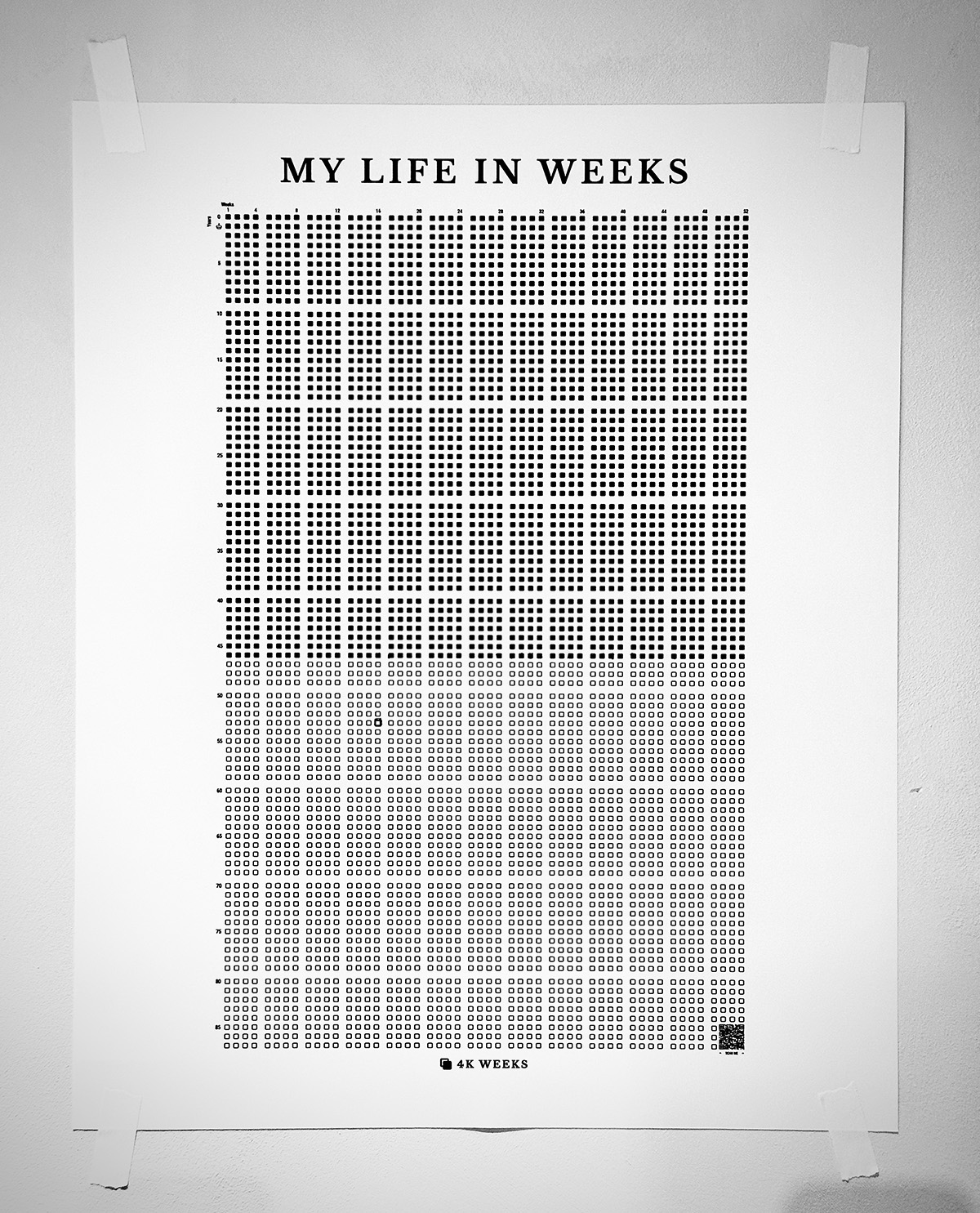
Today is my birthday and I have less than 2,500 weeks to live.

Chances are you have less than a few thousand weeks to live as well.

But this is not a cause for alarm or sadness. Because the fact that our time is finite is what fills our life with meaning. Our choices become more meaningful when we are conscious of the fact that saying "yes" to something means that we are saying "no" to a million other things. When we face up to the fact that it is impossible to do everything, the things we choose to do become that much more important.

Unfortunately a finite life is difficult to visualize. And so we are easily convinced that how we choose to go about our days is inconsequential. As there will be many more days to fit it all in, to get it all done, to do all the things, to check all the boxes.

I have a "Life Calendar" taped above my desk in my studio.

I use it as a visual reminder of my finite time. To prioritize the things that are most important to me.

Everyone should have a reminder of the "Big Picture." It need not be as graphic (in the literal and figurative sense) as a calendar where you tick off the weeks until your death.

Make it something simple:

  • Carry a Memento Mori coin in your pocket.

  • Read the New York Times Obituaries section once a week.

  • Keep a small skull on your desk.

  • Buy one of my "Remember You Must" photo prints. 😁

User Avatar

Aaron Leitz

2y ago

Stop Calling Yourself a Freelancer if You're a Solo Creative Professional
by Aaron Leitz

Imagine you are a business owner in need of a creative professional to collaborate with on a new logo for your business and you have a choice between:

A) Tracy - a freelance graphic designer

B) Tracy - runs her own graphic design business

Who would you rather hire to help solve your graphic design problem?

Let me know your answer and reasoning in the comments.

In the meantime I'm going to guess you chose Option B. And the reason was because of the word "freelance."

Only a few hundred years ago the term "freelancer" meant a soldier-for-hire. Freelancers were mercenaries paid to show up to a battle with their weapons and follow commands.

And as far as your clients are concerned, the meaning of the term hasn't changed much since. Swords have been swapped for laptops or cameras or really nice pens but the other expectations of a freelancer remain.

  • Freelancers are hired first and foremost for their tools not their expertise.

  • Freelancers are expendable. Interchangeable commodities hired to fill a short term need.

  • Freelancers are expected to follow the project assignment as given.

Creative professionals who run their own business on the other hand

  • Are hired first and foremost for their expertise in solving a particular problem.

  • Are viewed as long term and/or frequent collaborators.

  • Are respected for their input in guiding the direction of the project.

Are you the owner of a creative business or a freelancer?

User Avatar

Aaron Leitz

2y ago

The Three Simple Rules I Use to Make Art Everyday
by Aaron Leitz

In 2021 I made 142 pieces of art in 142 days.

But that's not what I had wanted to do.

I wanted to work on a different more complicated project. But as I started working I realized that my "artistic muscles" weren't strong enough to do the project the way I wanted to.

So I went back to the basics and started a new simpler project.

An "Artistic Workout Regimen" that followed 3 simple rules. (cue training montage and music...)

Rule 1: Keep it Simple

The more constraints you can put on your medium, methods, processes, techniques and subject matter the better.

My project: make a square out of cellophane and paper and photograph it.

Rule 2: Focus on the Process, not the Outcome

As you go about making your art you will be tempted to judge its "quality." You may wonder what other people will think of it. Is this stupid? Can I sell this? You may want to stop midway and start over. Don't do that. Commit to the process, put in the reps and forget about the outcome.

There are no dead ends in the process of creating. Only twists, turns, intersections, zigs and zags.

Rule 3: Produce something every day for 30 days

Consistency is a muscle that must be trained. And for many of us this muscle is extremely weak. Simplify your subject matter and your process and producing a finished piece each day is possible. You just have to put in the work.


User Avatar

Aaron Leitz

2y ago

3 Reasons Why Professional Creatives Should Specialize
by Aaron Leitz

"I fear not the man who has practiced 10,000 kicks once...I fear the man who has practiced one kick 10,000 times." - Bruce Lee

I've been a professional photographer for 17 years. I do very little direct marketing and my work schedule is as busy as I want it to be.

Because I am a specialist.

Here are three perks to being a creative specialist:

  • Gain deep expertise faster

When you solve the same creative problem over and over again your understanding of the problem becomes deeper and more nuanced. You develop and internalize routines, systems and processes that allow you to quickly move past generalist "surface level" issues so that you can focus on the more complex and unique problems facing your clients.

  • Less competition, easier sales

The more specialized you are the fewer direct competitors you have. Clients seek you out because of your unique expertise. With less alternatives available you become more valuable. You are a creative partner, a collaborator, an expert advisor. No longer a commodity.

  • The Halo Effect

When you are very good at something people tend to think that you are very good at other things as well. Being perceived as an expert specialist on one area often leads to all other sorts of interesting opportunities and creative projects in other areas.

How often have you heard someone say something like? -

"I talked with Brad last night at the dinner party about why my houseplants aren't doing well. You know he's a neurosurgeon."

There you go. Halo Effect.

User Avatar

Aaron Leitz

2y ago

A, B and Z are The Only Three Letters You Need to Make Progress on Your Dream Project Today.
by Aaron Leitz

There are many steps to take to get from where you are right now to where you want to be. More than all the letters of the alphabet.

With entrepreneur Shaan Puri's simple "ABZ" framework you only need to know 3 letters to start: A, B and Z

Here's how it works:

  • A : Your Current Situation (starting point)

Start with a good understanding of where you are right now.

  • Z : Your Goal (finish point)

Clearly define what you want. The end goal. Your desired Future State.

  • B : The Next Step

The next smallest step you can take to make progress towards your goal. This step needs to be an action. Step B should be pretty obvious and a step that you are capable of making. If you need to do a lot of motion (research, learning, planning) before taking action then your step B is not small enough.


To go from A to Z simply start with B.


Chances are you haven't taken Step B because you're stuck trying to figure out how to make steps D, F, G, K, N, U and Y as well. Or worried about all the other letters you're going to have to deal with down the road. Letters that don't even exist yet.

Whenever you find yourself stuck again forget about all the other letters and take a few minutes to redefine A and B. And then take the next small step.