Edufuturists
/edufuturists
The future of learning
Edufuturists
3y ago
One of the most pervasive beliefs in society is that traditional education is the best way to prepare for the real world. This notion is deeply ingrained, often passed down from generation to generation, and reinforced by educational institutions and societal norms.
The Problem: A Mismatch Between Education and Reality
So why has this belief taken such a strong hold? It's largely a matter of historical inertia and societal tradition. The education system has been doing things the same way for so long that change is often viewed with skepticism. This has led to a one-size-fits-all approach to education that is increasingly at odds with the complexities and demands of the modern world.
Example #1: The focus on rote memorisation doesn't prepare students for a world where information is readily available but critical thinking is required to navigate it.
Example #2: The emphasis on individual achievement and competition doesn't align with the collaborative nature of most modern workplaces.
Example #3: The lack of flexibility in curricula doesn't allow for the development of creative problem-solving skills, which are crucial in almost any career today.
The Flaw: Outdated Methods for a Modern World
The belief is flawed because it's based on an outdated understanding of what "the real world" requires. Ana Lorena Fabrega, an advocate for decentralised education and Chief Evangelist at Synthesis, pointed out that the skills and attitudes cultivated in most schools are not those that lead to success or fulfillment in modern life.
"Schools are broken partly because they are so centralised."
Her new book, The Learning Game, is an outstanding critique of this swindle and highlights how school often stifles creativity, curiosity, and the ability to think for oneself. She emphasises the need for a more flexible, student-centred approach that fosters these qualities. Studies have shown that 65% of the jobs today's students will hold in the future don't even exist yet, making the ability to adapt and learn more important than ever.
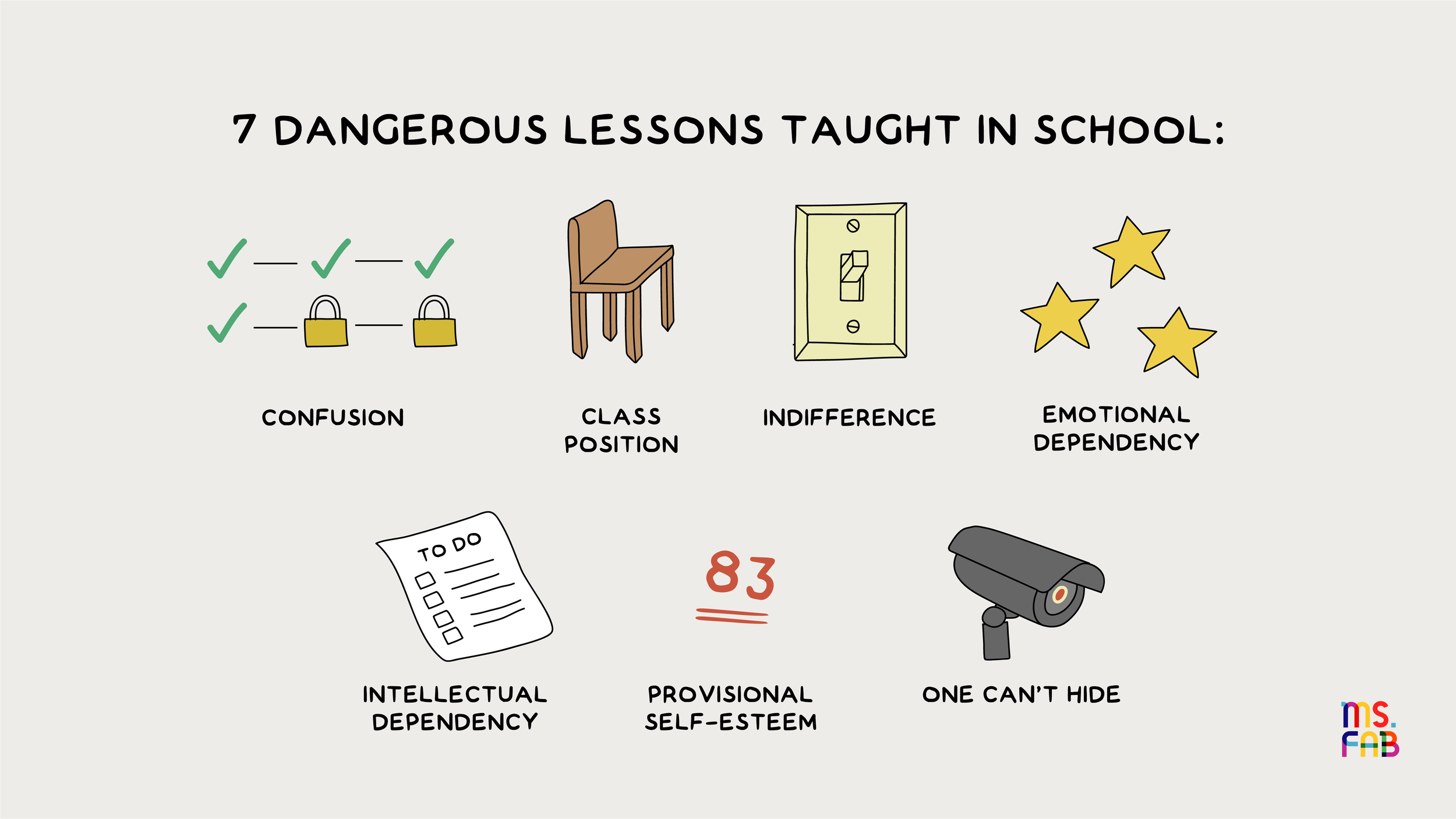
She references John Taylor Gatto's brilliant exposé: Dumbing Us Down: The Hidden Curriculum of Compulsory Schooling where he says there are 7 Dangerous Lessons teachers are forced to teach our kids:
Confusion
Class Position
Indifference
Emotional Dependency
Intellectual Dependency
Provisional Self-Esteem
One Can't Hide
These are part of the great swindle our kids are being force-fed.
How to Shift Your Mindset: From Compliance to Adaptability
The first step in shifting your mindset is to question the traditional path that education sets for us. Both Fabrega and Gatto advocate for a more individualised approach to learning, one that takes into account each student's unique skills, interests, and learning styles.
By adopting this new perspective, you can begin to see education not as a one-size-fits-all solution, but as a platform for developing the skills and attitudes that are actually relevant to modern life. This shift in mindset can lead to more fulfilling careers, better mental well-being, and a more adaptable skill set.
Why the Old Model is Becoming Obsolete
The traditional model of education is increasingly out of step with the needs and opportunities of the modern world. Technological advances are democratising access to information and learning resources, making the teacher-centred, textbook-driven model increasingly redundant.
1. Online platforms are making personalised, lifelong learning a reality.
2. Employers are placing greater value on skills and adaptability rather than degrees and test scores.
3. A new generation of educators and learners is demanding more from an education system that has long resisted change.
The belief that traditional education is the best preparation for the real world is not only outdated but harmful, limiting both individual potential and societal progress. By embracing a new, more flexible and individualised approach to education, we can better prepare for a future that is anything but traditional.
Edufuturists
3y ago
Will VR and the Metaverse change education for the better? Is it time for something different?
It was great to have Melissa McBride back with us for a second time to discuss her insights on these tools and technologies which seem to have taken a bit of a back seat recently because of the rise of Generative AI until Apple launched Vision Pro. We think it could be that VR, Metaverse (or Spatial Computing as they are calling it!) and AI might well be bedfellows after all. So let's dive into 4 key ways they might get under the covers:
Immersive Learning Environments
VR can create realistic and immersive simulations that enable students to experience hands-on learning in various subjects. This experiential learning enhances engagement and deepens understanding by allowing students to explore historical events, dive into the depths of the ocean, or conduct scientific experiments in virtual labs.
Personalised Learning
VR technology can adapt to individual learning styles and preferences, offering personalised educational experiences. Virtual tutors and adaptive learning systems can analyse student performance and provide tailored instruction, ensuring each student receives the support they need. This personalised approach promotes better learning outcomes.
Accessibility and Inclusion
The Metaverse and VR can address accessibility challenges by providing inclusive educational experiences, all powered by AI tutors. Students with physical disabilities or limitations can engage in virtual environments that overcome physical barriers, allowing learners to participate and learn alongside their classmates. Additionally, VR can provide multi-sensory experiences that cater to diverse learning needs.
Lifelong Learning and Professional Development
The Metaverse can extend beyond traditional education and support lifelong learning. Professionals can participate in virtual workshops, attend conferences, or receive virtual training in a simulated work environment. VR can provide opportunities for skill development, career advancement, and continuous professional growth. Many businesses are now using VR such as PwC.
Indeed, PwC's findings have been insane:
40% of the v-learners saw an improvement in confidence compared to classroom learners and 35% improvement over e-learners to act on what they learned after training in VR.
V-learning is the most cost-effective way of learning when it’s done on a large scale. At 375 learners, VR training achieved cost parity with classroom learning. At 1,950 learners, VR training achieved cost parity with e-learn. At 3,000 learners, VR costs become 52% less than classroom.
V-learners completed training 4 times faster than classroom training.
V-learners felt 3.75 times more emotionally connected to the content than classroom learners and 2.3 times more connected than e-learners.
Three-quarters of learners surveyed said that during the VR course they had a wake-up-call moment and realised that they were not as inclusive as they thought they were.
V-learners were 4 times more focused during training than their e-learning peers and 1.5 times more focused than their classroom colleagues.*
It will be interesting to see if these predictions and thoughts play out and, as we know, education can take an ice age to move forward and change. We also have to face the fact that there needs to be significant investment at government level to create skilled educators who can use these tools, and apply them correctly to their context and learners. Watch this space, it is exciting and one with so much opportunity.
Edufuturists
3y ago
Ok...so that may be just a quote from Back to the Future, but we are sure that there are some significant changes coming for the future of education.
For those who attended our Uprising event, and anyone who has opened previous newsletters, you'll be familiar with the electronic or printed version of our 2023 Trends booklet. It was great this week on the podcast to discuss these trends and share the learnings and weak global signals we have spotted over the past 12 months.
We are in good company with organisations such as the Future Design School, and Google in releasing reports and information on their thoughts of the future of education, but here are the 4 key things we discuss:
Assessment - Goodbye, Exams!
Assessment, say goodbye to traditional exams! In the future, we'll witness a shift from standardised testing to more holistic and personalised assessment methods. Instead of cramming for a single high-stakes exam, students will be evaluated based on their real-world problem-solving skills, critical thinking abilities, and creativity. Continuous assessments and project-based evaluations will rule the roost, giving students a chance to shine beyond the confines of a test paper. Some podcasts which cover these are: David CM Carter, Adam Roney, and Garrett Smiley
Curriculum - Tailored for the Future
Curriculum, get ready for a makeover! As the world evolves rapidly, education will adapt to meet the demands of the future. The curriculum of tomorrow will be flexible, interdisciplinary, and focused on practical skills. It will emphasise areas such as problem-solving, collaboration, adaptability, and digital literacy. Subjects like AI, sustainability, and entrepreneurship will take centre stage, empowering students to thrive in the ever-changing job market. Some podcasts which cover these are: Ariel Camus, Yaacov Hecht, and Martin Allen Morales
Teaching and Learning - Extending Beyond the Classroom
Teaching and learning, welcome to the era of immersive experiences! The future will witness a shift from traditional classroom instruction to experiential and student-centred learning. Teachers will become facilitators, guiding students through hands-on projects, simulations, and virtual reality experiences. Collaborative learning, both in person and online, will foster creativity, critical thinking, and empathy. Personalised learning pathways and adaptive technologies will ensure that each student's unique needs are met. Some podcasts which cover these are: Josh Dahn, Sam Gichuru, and Gavin McCormack
Technology - Enabling Education Revolution
With rapid advancements in technology, education will undergo a revolution. Artificial intelligence, virtual reality, augmented reality, and gamification will transform the learning experience. AI-powered adaptive learning platforms will provide personalised feedback and recommendations, tailored to each student's strengths and weaknesses. Virtual classrooms will connect learners globally, enabling cross-cultural exchange and collaboration. Smart devices and wearable technology will integrate seamlessly into the educational ecosystem, enhancing engagement and accessibility. Some podcasts which cover these are: Episode 167, Melissa McBride, and Donald Clark.
the future of education is poised for a revolutionary transformation. As we bid farewell to traditional exams, we embrace a new era of assessment that values real-world problem-solving, critical thinking, and creativity. The curriculum itself will undergo a much-needed makeover, becoming flexible, interdisciplinary, and geared towards practical skills that empower students to thrive in the ever-changing job market. Teaching and learning will extend beyond the confines of the classroom, embracing immersive experiences, hands-on projects, and collaborative learning that foster creativity and empathy. Technology will serve as the catalyst for this revolution, with artificial intelligence, virtual reality, and gamification revolutionising the learning experience, while adaptive technologies ensure personalised learning pathways for each student.
Education will transcend borders, connecting learners globally and enabling cross-cultural exchange and collaboration. The future of education holds limitless possibilities, empowering learners to unleash their full potential and embrace a world of knowledge and innovation. As we embark on this journey, let us embrace change, adapt to new methodologies, and revolutionise education for the betterment of future generations. The time for a new educational paradigm is now.
Edufuturists
3y ago
In the realm of education, a commonly held belief most people accept as the truth is that effective learning can only take place within the four walls of a classroom. This archaic view is deeply entrenched in our society, primarily due to our adherence to traditional models of education that have been passed down generations. Not only that, the voices that shout the loudest have been the only ones that have been heard
This ingrained belief has resulted in a one-size-fits-all approach to teaching, leading to:
Example #1: Students who struggle to conform to the traditional classroom model being labelled as "slow learners" or "problematic."
Example #2: A lack of customisation in teaching methodologies, which fails to cater to the diverse learning styles and paces of individual students.
Example #3: A stifling of creativity and critical thinking, as rote learning and exam-focused teaching take precedence.
The flaw in this belief lies in its rigidity and its failure to acknowledge the human-centric aspect of learning. It also echoes the problems that Lieutenant Gilbert Daniels found in aircraft design in his research with Harvard:
When I left Harvard, it was clear to me that if you wanted to design something for an individual human being, the average was completely useless.
This is where the human-centred design approach comes into play. This approach prioritises the unique needs, capabilities, and aspirations of each learner. A study by Stanford's d.school showed that when a human-centred approach was implemented, student engagement and comprehension improved significantly.
Education is not about filling a vessel but kindling a flame (Socrates)
By shifting from the outdated 'classroom-is-king' mindset to embracing the principles of human-centred design in education, we can revolutionise the way we impart knowledge.
The first step is to recognise and appreciate the diversity among learners. This understanding should be the foundation of designing curricula and teaching strategies.
By doing this, education becomes a more inclusive and engaging experience. Students will no longer be passive recipients of information but active participants in their learning journey. Personalised learning experiences can lead to improved comprehension, better retention, and a heightened sense of curiosity and creativity.
The days of traditional classroom-centric education are numbered.
We are already witnessing a global shift towards more flexible and personalised learning environments, spurred by technological advancements and a growing recognition of the need for reform in education. The future belongs to human-centred design in education, where every student's unique learning style is respected and catered to. This new wave of education is not only more inclusive but also more effective in preparing students for the challenges of the 21st century. And that's a future worth being part of.
Edufuturists
3y ago
This week, it was great to chat to Brian Curcio around the need for focus on educating our young people and adults on finance. He and his team have created Rapunzl, a financial literacy, EdTech tool to revolutionise how we teach students about investing (the good and the bad of crypto, for example) and to provide equitable access to high-quality, project-based learning tools for students across the world. It is not just about how but why we need to understand our finances and investments better.
In the current global financial crisis, where many are living hand to mouth, is education the way we can help the world help themselves when things get tough?
Financial education is often overlooked and undervalued when it comes to the development of young people. However, it is important to understand that financial literacy is an essential life skill that every individual needs to possess. The need for good financial education cannot be overstated, especially in a world where financial responsibilities are becoming more complex and challenging by the day. So, let's explore why young people need to be equipped with good financial education and how it can be made fun.
Be able to make the right decisions
Firstly, good financial education is critical to enabling young people to make informed financial decisions. It equips them with the necessary skills to manage their finances effectively, make wise investments, and avoid debt traps. With proper financial education, young people will be able to set realistic financial goals, create budgets, and stick to them. This, in turn, will help them build a strong financial foundation for their future.
Make it fun to make it stick
Secondly, financial education can be fun and engaging. Young people tend to be more interested in learning when they find the subject matter enjoyable. Therefore, educators can make financial education more interactive and engaging by using games, quizzes, and simulations. For example, they can use online games that simulate real-life financial situations to help young people learn the basics of budgeting, saving, and investing. This is where Rapunzl comes in!
Make fewer mistakes
Finally, financial education can help young people develop healthy financial habits. By learning about the importance of saving, investing, and managing debt early on, young people will be able to avoid common financial mistakes that can have long-term consequences. They will also be better equipped to navigate the complexities of the financial world, which will enable them to make sound financial decisions that will benefit them in the long run.
Good financial education is clearly key for young people, and it can and should be made fun and engaging to help it stick. By doing so, young people will be better equipped to manage their finances, make wise investments, and avoid traps and issues which can arise. School might not have taught us how to get a mortgage, the difference between gross and net profit or what a good APR % is, but we can do better for our kids.
Edufuturists
3y ago
This is our first-ever guest blog from Dr Paula Christie, Lead: Research and Enhancement at College Development Network (CDN).
College Development Network (CDN) works with Scotland’s colleges to develop their people, share their great work, and enhance student success. Through the work of its Research and Enhancement Centre, CDN is exploring the impact of poverty and trauma on the future success of college students in Scotland.
As many as 240,000 children and young people in Scotland are brought up in poverty and tackling child poverty is a top priority according to the Scottish Government. More than a third of UK households are grappling with fuel and food poverty as the consumer price index increased 9.2% year-on-year for December 2022.
Poverty is not a new subject for colleges in Scotland - for many years a significant proportion of the college student population has traditionally come from the lowest socio-economic backgrounds. In 2022, 34% of college students were from the 20% most deprived postcodes in Scotland.
Colleges play a crucial role in tackling poverty and inequality and in driving a more inclusive economy. This is the theme of the third of the CDN Research and Enhancement Centre’s ‘Pathways from Poverty’ reports. Trauma-informed practice is an approach grounded in the understanding that exposure to trauma can impact an individual’s neurological, biological, psychological and social development.
Through an in-depth study of the approach taken by West Lothian College to addressing the challenges faced by its learners, their families and their community, CDN’s research team examined the role and impact of a college in post-pandemic Scotland.
Colleges have indirectly always focused on poverty, inequality, and inclusion. Scotland’s colleges have long offered a route to connect people to the skills and experience needed to take on new opportunities to study and to work. Without this role as a driver of educational and career progression, fewer people from deprived backgrounds would have the support and chance to gain the qualifications that can be a passport to better work and greater wellbeing.
Creating a safe space for learners to develop is more important than ever before. The realities faced by students coming from poorer backgrounds are complex, and a whole-system approach that factors in all stakeholders is pivotal to overcoming these complexities. By establishing an environment in which vulnerable learners can prosper, colleges are breaking down barriers to education and widening access, often with the benefits extending beyond the learners and into the wider community. The trauma-informed approach is an important step in steering students away from a crisis and offering them a positive future.
Edufuturists
3y ago
During Covid (and even before) one thing at universities which was challenged in many ways was the design of courses. How courses are focused on lectures and students being told information, usually attending large lecture halls in person. Learning and course design is one thing we discussed with Teesside University, winner of Edufuturists University of the Year 2022.
They have created a toolkit to help support the redesign and creation of their courses with learning being the first thought, especially the learning journey of the students. This toolkit was done in Collaboration with Jisc and focuses on the following principles for their learning design:
Developing authentic and creative learning experiences and assessments
Preparing future ready digitally empowered learners
Embedding digital literacy in courses
Developing authentic and creative learning experiences and assessments
It is great to hear that designing learning experiences which can be applied to a context and the real world is something which is now being applied to HE, and something we have discussed often across many podcasts. We also believe that choice and the ability to access varied assessments throughout the course is key. Learners need a choice on how they provide information and articulate it. As a group who produce podcasts, why is it that this creative medium is not seen more often as an assessment tool in learning, when over 464 million people globally listen to them for their personal learning and enjoyment? This is one example but hopefully programmes like this see an end to exam exam exam or assignment, assignment assignment. There are other ways to skin a cat!
Preparing future ready digitally empowered learners
In education, of course learning facts and being able to ‘know things’ is a key component but for decades, skills development has been overlooked. We know that people need to be able to communicate, collaborate and critically analyse information to be ready for life beyond school, college and university but so many employers continue to tell us that they have to spend time working with new employees when they make the step into work. To see these concepts and skills now being embedded and front and centre is something which we have been crying out for years and was so needed.
Embedding digital literacy in courses
Today, people work, socialise, communicate and do so much more in the digital world, and to neglect this fact is at the detriment of education. In the words of Sugata Mitra when he was on our podcast we need to ensure we solve new problems with new solutions and not try carrying on trying to solve these new problems with old solutions.
What Teesside has done is a strong step forward and it was great to explore it on the podcast, but we hope this becomes the norm and not something which is a niche or which only a handful of universities approach their learning pathways.
Edufuturists
3y ago
We often discuss on the podcast how the education system in places like England needs a revolution, and we still believe it really does. But this week’s podcast brought a stark reminder that for many, our quality of education would be a fine thing as access to any education in some parts of the world is not guaranteed.
The question and panic for many around online learning and access to it again was debated during and long after Covid-19 was causing mass lock downs globally, but for many young people around the world, access to learning in this way would solve an issue not faced by many. In fact, because of their location and sparsity of schools, or the terrain or the lack of teachers this could be the best solution.
UNICEF tell us: 'Education is a basic Human Right'. But the fact is that out of the 1.8 million who begin school at primary school age in Uganda, only 800,000 of them go on to complete it, and post that, only 30% of those 800,000 ever go on to start secondary school. The stat is even greater still beyond those 1.8 million who never even attend school because of financial or geographical reasons.
Enter Yiya
This week we chatted to the wonderful leaders at a tech platform called Yiya. Its principle and mission is simple: to enable those without access to education to have it. The challenge for them is that online school would solve the problem but how can they access it without at least a smartphone or connectivity. This would mean that traditionally the learning would be passive and also once the instruction has been given, there's no way of supporting the learning or providing feedback to students.
They manage to innovate with what many would class as a low tech solution but one which has made such an impact on the lives of many, but also for many of their children and children's children too. The organisation has now provided a way for students to engage in their learning and also be provided with reports on progress and support on how they can improve.
Through their work they have also supported individuals with a focus on science and maths to be creative and solve real solutions for their lives such as pedal-power washing machines, and battery packs which charge phones and other tech through the use of cycling.
Edufuturists
3y ago
Our podcast guest this week, David CM Carter, has been in the mentoring, coaching and private equity world for 45 years. During that time, he has been widely regarded as one of the world's leading CEO mentors. He has also recently been asked to join an All-Party Parliamentary Group to look at the future of employability. Yet he believes the work he is doing at Entelechy Academy will be his greatest legacy.
One of the most important things he learned in his 45 years at the top of his game is the importance of finding your ikigai. Ikigai is a Japanese concept that translates to "a reason for being" or "a sense of purpose" and is the title of a brilliant 2017 book by Héctor García. It is the intersection of:
what you are good at
what you love
what the world needs
and what you can be paid for.
Finding your ikigai is crucial for reaching entelechy, a term coined by Aristotle, which refers to the realisation of one's full potential. Aristotle said,
"The end or goal of man is an activity of the soul in accordance with reason or virtue."
Aristotle
In other words, reaching entelechy is about living a life that is in line with your values and using your unique strengths and talents to make a positive impact on the world. Here are 5 techniques to find your ikagai to reach entelechy.
#1: Reflect on your values and passions.
Here’s how it works:
Step 1: Make a list of your values, such as honesty, loyalty, and compassion.
Step 2: Make a list of your passions, such as music, cooking, and photography.
Step 3: Reflect on how your values and passions align with the needs of the world.
This simple template allows you to achieve a greater understanding of your ikigai.
#2: Identify your strengths and skills
Here’s how it works:
Step 1: Make a list of your strengths, such as creativity, communication, and problem-solving.
Step 2: Make a list of your skills, such as programming, design, and writing.
Step 3: Reflect on how your strengths and skills align with your values and passions.
Quick note: Don't compare yourself to others. That's a mistake. These steps work better when you focus on your own unique abilities.
#3: Identify opportunities for growth and development
Here’s how it works:
Avoid being complacent
Seek out opportunities for growth and development instead
If you avoid complacency and seek out opportunities for growth, you'll unlock your full potential.
Easy, right?
#4: Surround yourself with supportive people
Here’s how it works:
Step 1: Seek out people who share your values and passions
Step 2: Surround yourself with people who have different strengths and skills than you
Step 3: Find mentors and role models who can guide and inspire you
Do these 3 things, and you'll be able to achieve your goals more easily.
#5: Take action
Here’s how it works:
Tip 1: Identify small steps you can take to move towards your ikigai
Tip 2: Take risks and be open to new opportunities
Tip 3: Remember that finding your ikigai is a journey and allow yourself to make mistakes and learn from them.
That’s it! By following these techniques, you can find your ikigai and reach entelechy, living a life that is full, realised and happy.