Vishnu Anand

/vishnuanand

Vishnu Anand

Entrepreneur | Founder @ Teravictus | Writes about AI
LinkedinX
User Avatar

Vishnu Anand

6mo ago

3 human traits AI can simulate but can never truly replace
Made by @vishnu10

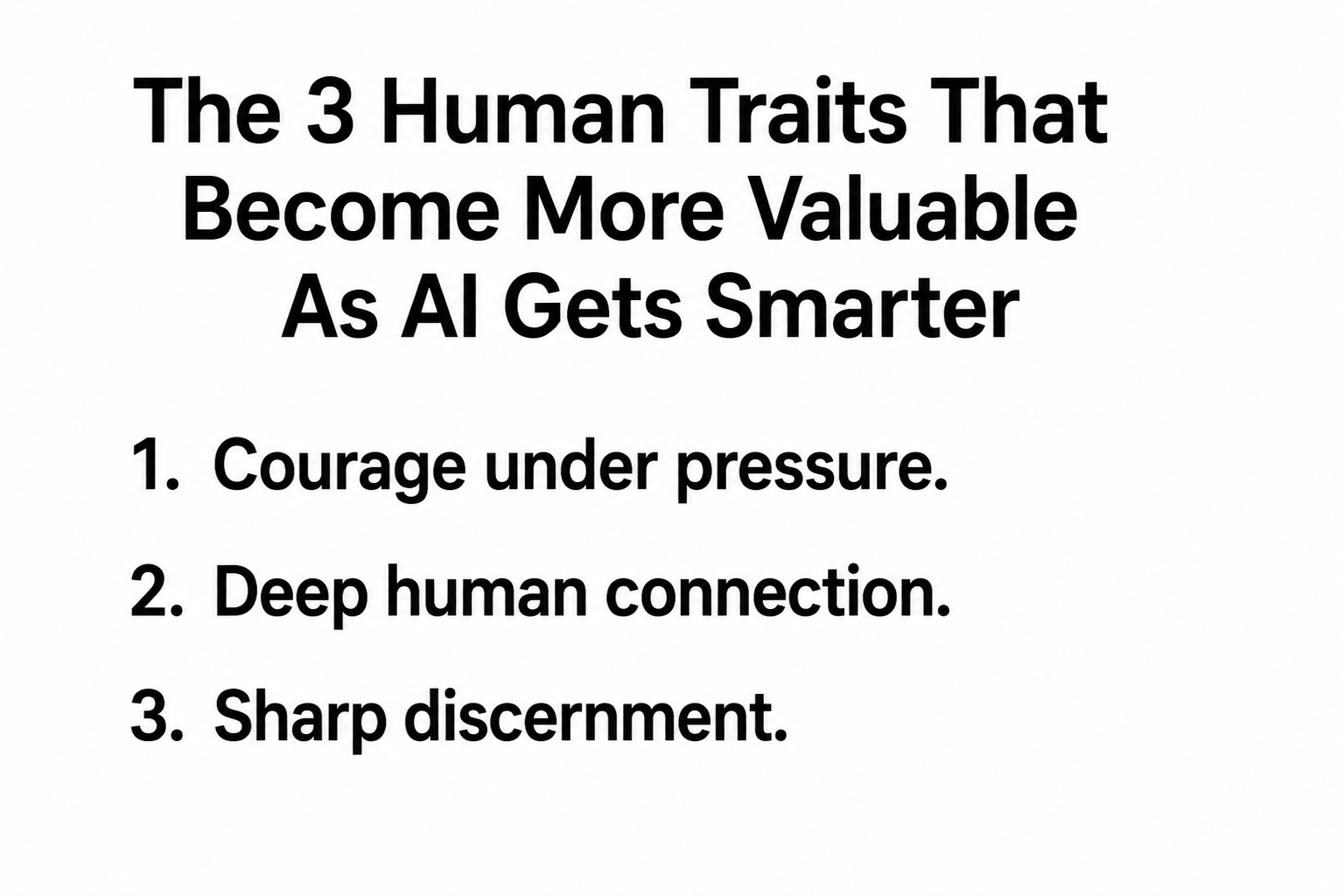
LLM's good at predicting what a human would have answered but it can't think and feel like a human (like you).

Below are 3 traits that I can think of immediately right now

  • Courage under pressure.

  • Deep human connection.

  • Sharp discernment.

Specifically not easy to develop. Takes time and commitment.

User Avatar

Vishnu Anand

6mo ago

The Best Business Relationships I’ve Seen Were Never Transactional — They Were Built On These 5 Traits
Made by @vishnu10

Over the years, I noticed that the best professional relationships all followed a similar pattern.

The first type is purely transactional: Here, you do your best to complete the tasks agreed upon and then the relationship ends right there or when you switch jobs.

The second type one usually starts the same way and expands gradually through time.

I dissected on what makes them compound and broke it down into 5 fundamental traits:

  1. Alignment of values: Traits like integrity, work ethics and overlapping passions form primitive strong roots to the relationship.

  2. Clear and resonant communication: Not only about using clear words but also emotional resonance is core here.

  3. Reliability: Delivering on whatever was agreed and being available when issues occur.

  4. Collaboration: Being helpful to each other and building them to grow.

  5. Mutual respect: This is a great compounder when it is authentic.

These traits form a strong root. Growth is a variable of time and is purely asymmetric.

User Avatar

Vishnu Anand

6mo ago

After Talking To RevOps Teams, I Realized Most Companies Are Still Building AI On Top Of Reporting-Era Systems.
Made by @vishnu10

RevOps teams should not build AI on top of systems never designed for intelligence.

From my personal conversations with folks from RevOps, they use AI tools for tasks:

  • Analyze data related to customer retention and automate some routine work related to hand-offs.

  • Drafting emails.

  • Generating reports, etc

But AI systems will never hit peak potential unless you completely leverage their "speed": AI is capable of producing high-quality output without getting tired.

AI-native systems will:

  • Detect deal slippage in real time.

  • Analyze CRM, email, and call activity.

  • Identify likely root causes.

  • Recommend actions.

  • Trigger workflows automatically.

The companies that win won’t necessarily have the best AI models. They’ll have:

  • Cleaner operational data

  • Unified GTM context

  • Reliable workflows

  • Agent-ready infrastructure

Because AI is only as effective as the operational systems it runs on.

User Avatar

Vishnu Anand

6mo ago

Your CRM Looked Fine — Until AI Exposed How Broken The Foundation Really Was
Made by @vishnu10

Your CRM says 10,000 accounts. Your pipeline says otherwise.

→ 30% of CRM records have missing or outdated fields.

→ Reps spend 28% of their week just finding truth.

→ AI on dirty data = confidently wrong at scale.

Fix the foundation before you bolt on the future.

User Avatar

Vishnu Anand

6mo ago

Connect better with others: Your internal systems affect external relationships. Fix them. Form meaningful better relationships in the age of AI
Made by @vishnu10

Deep human-human connections is something AI can never interfere with.

With AI automating cognitive work, I believe humans next will evolve around this area (among other things).

Activating deep human connection requires you to develop those traits within you even before you make an attempt externally to connect with others.

The fundamental requirement to develop these traits is for your autonomic nervous system (ANS) to operate in parasympathetic state.

In Parasympathetic state your mind is:
- Calm.
- Emotions are grounded.
- There is no low-grade constant anxiety, stress and worry.

When you operate from this state, your mind automatically gets feelings that helps you to form meaningful and purposeful bonds externally with other people (not high-level transactional relationships).

Have a great Sunday!

Made with Typeshare.co

User Avatar

Vishnu Anand

6mo ago

What will the future of work actually be built on in the AI era?
Made by @vishnu10

If AI can think, decide, and execute what exactly becomes “work” for humans?

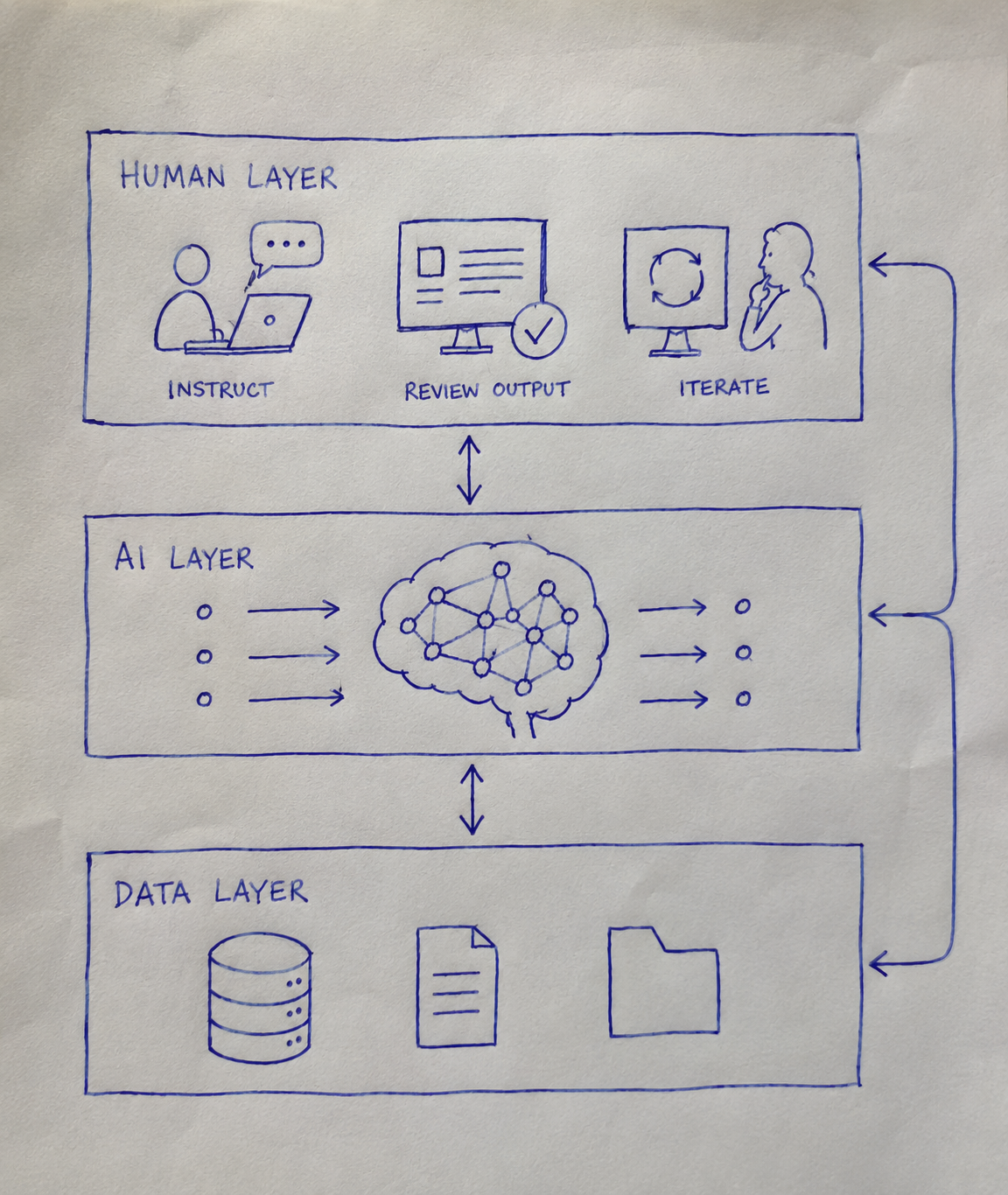
After reading and learning from top creators and entrepreneurs — and after spending countless hours using multiple AI tools and building on top of them — I believe the future will be built on 3 fundamental layers.

Out of these, two layers will work to serve humans without fully replacing them.

Put simply, from bottom to top:

Data layer
(the foundation)

↓

AI layer
(the intelligence + execution layer)

↓

Human layer
(the judgment + human-human layer)

Each layer will form an interdepent loop to co-operatively enhance output capability of each other layer.

Here are the traits of each layer that make them indispensable from the other layers:


Layer #1 -> The data layer

This layer is the foundation built on years of proprietary data: project details, employee history, customer information, go-to-market strategies spread across multiple platforms.

In the future, this layer will be controlled by both humans and AI. Humans control the type of information that goes in this layer and what data each specific AI needs to access. AI's will read data and write back simply based on what instructions have been instructed to them.

Humans own what data goes in and define how each AI should use.


Layer #2 -> The AI layer

The layer which creates fear and uncertainity in humans: will it replace us?

Though there is no wide-spread scientific and social evidence to prove this yet, you can empirically try and find out that AI is good at specifically:

  1. Provides detailed analysis comprehensively and faster than humans ever could.

  2. Understands goals, constraints and generates a comprehensive solution at a quality and pace that humans can never match.

Given this is where we humans invested our efforts to build expertise, where do we stand in the future of the workforce? (check out layer 3)


Layer #3 -> The human layer

What meaningful work will humans do?

Humans here will communicate with their customers to understand their requirements and form deeper human relationships. They will translate human business needs into AI-powered jobsheets. And they will own the risk and uncertainity of the entire operation end-to-end in all aspects.

The human work moves on top the cognitive layer today to better understanding human requirements, designing AI jobsheets and what data they should feed to.

User Avatar

Vishnu Anand

6mo ago

Two powerful emotional traits that will keep you winning
Made by @vishnu10

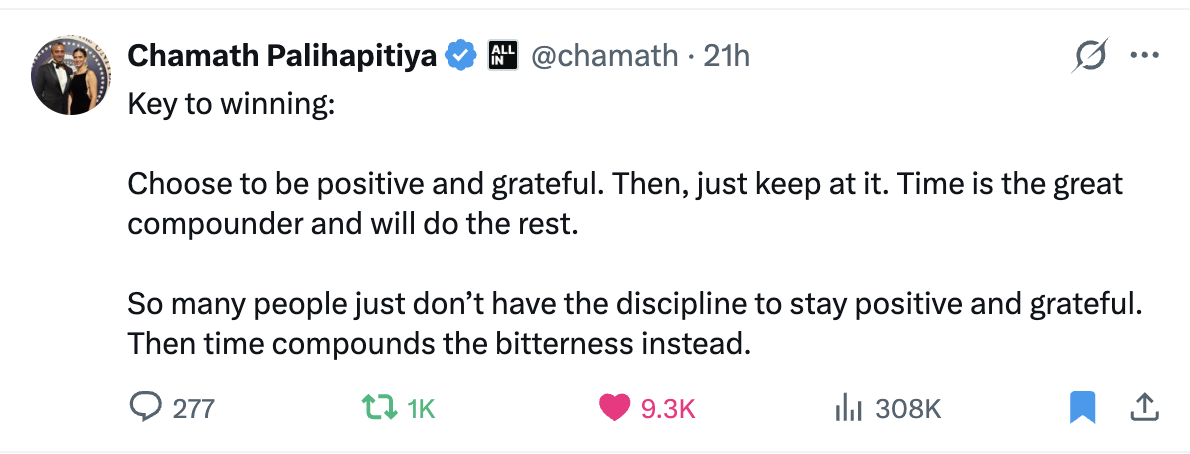
Key to winning:

Choose to be positive and grateful. Then, just keep at it. Time is the great compounder and will do the rest.

So many people just don’t have the discipline to stay positive and grateful. Then time compounds the bitterness instead.

User Avatar

Vishnu Anand

6mo ago

How are you optimizing Sales ops with Claude today?
Made by @vishnu10

How are you optimizing Sales ops with Claude today?

MCP connectors readily available for select CRMs, outreach tools, billing, conversation tools, etc to connect to Claude.

Few applications that I can think of right now:
- Analyze which ICP group renews least and understand why that happens.
- Look at past conversation data and understand how each deal in the past closed successfully.
- Better forecasting: Ask Claude to look at each data-point of each deal across all platforms. Compare that with historical closes to re-calibrate your current quarters forecasting.

How are you using it today?

User Avatar

Vishnu Anand

6mo ago

Hidden problems that RevOps leaders secretly know of
Made by @vishnu10

RevOps leaders aren't fighting data problems. They're fighting prioritization.

→ The fix is never the mystery — getting it on the roadmap is.

→ Nobody funds invisible problems until they blow up at renewal.

→ You were right six months ago — you just couldn't get the room to listen.

What did you flag that only became urgent after it broke?

User Avatar

Vishnu Anand

6mo ago

RevOps: Mindset shift or another niche team?
Made by @vishnu10

RevOps - it's a mindset shift more than a team.

Phase 1: Silos create blind spots.
Phase 2: Unified data reveals true pipeline velocity.
Phase 3: Grateful for RevOps leaders turning chaos into 3x growth.

Who’s simplifying their revenue stack?

User Avatar

Vishnu Anand

6mo ago

Resolve.ai for Revenue: What SRE Taught Me About GTM Ops
Made by @vishnu10

Resolve .ai is an AI for production engineering. It behaves like a SRE on every on-call shift ie

- Takes alerts from your existing tools.
- Forms hypothesis.
- Runs investigations.
- Ships fixes or PR's.

so humans do not start from zero.

Look at the problems it solves:
- Slow & manual incident handling.
- Alert overload.
- Tribal knowledge risk.
- MTTR + cost pressure.

Resolve . ai's answer is simple but powerful:
You already have great signals (metrics, logos, traces). What your're missing is an AI SRE that can see across all of it, investigate and act.

Now, taking that same lens to GTMOps:

Most teams don't have a "monitoring problem."
They have a data and workflow problem.

- Deals live in your CRM.
- Conversations stay in Gong (or any other voice recording software).
- Billing + invoices live in your payment processor and finance stack.
- Customer health and behavior live in product + support tools.

Everyone is "on-call" in GTM but there is:

- Slow and manual response to answer basic questions.
- Signal overload and no prioritization.
- Tribal knowledge risk in GTM.
- Revenue MTTR + efficiency pressure.

This is the gap we are tackling with Teravictus:

We bring together deal and payments data from multiple siloed sources into one unified source of truth.

Once you have a single and reliable foundation, 2 important things become possible:

1. RevOps, SalesOps and GTMOps can finally query and analyze data from a single source of truth.

2. You can build a reliable agents on top of that unified truth.

AI without clean, unified data is just a clever demo.

AI on top of a single, unified GTM truth unlocks your on-call SRE for GTM and payments.

User Avatar

Vishnu Anand

6mo ago

What I learnt from speaking to a sales manager today
Made by @vishnu10

I spoke a sales manager at a 500+ person company few hours back and they sounded fuzzy when I asked them about their AI plan.

I once spoke to a leader who told me that they learnt vibe-coding to prep to navigate their company through the AI wave.

The key to start using AI is not to expect steady results like how you do with previous generation software.

Instead what successful people do and I have learnt from them is to use AI as a second-brain for complicated tasks where you ask it to dig deep and you analyze and take a decision.
For straightforward tasks, you simply pass in a prompt and it should be able to complete end-to-end.
By doing this, you start to build skill and learn how to properly leverage it with time. And that's how you build leverage.
Start right now, else with the pace at which it's evolving, you will start to feel behind very very soon. Message me if you need resources to get started and I can share few that I have.

User Avatar

Vishnu Anand

6mo ago

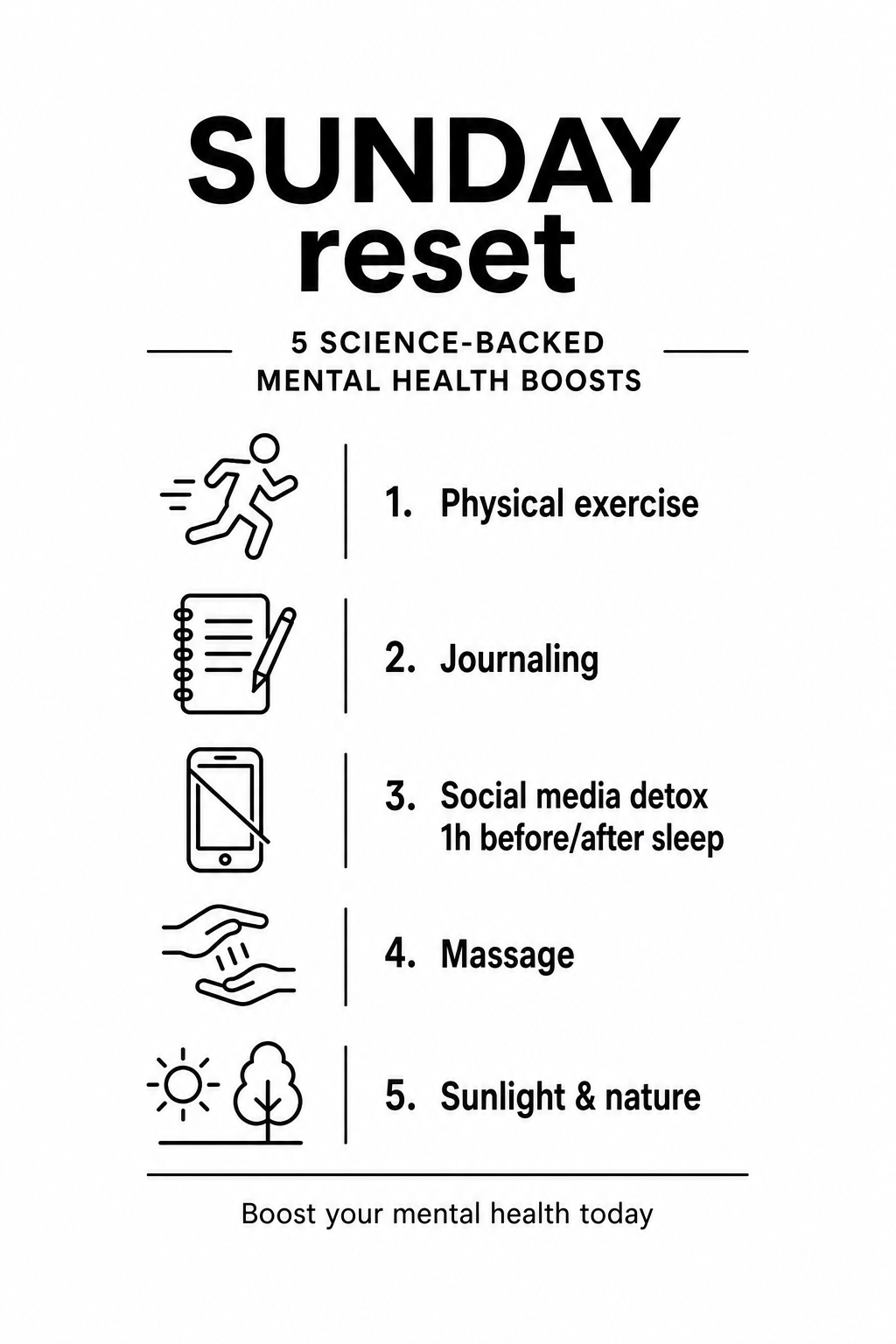
How are you taking care of your mental health this Sunday?
Made v

SUNDAY reset: 5 science-backed mental health boosts

- Physical exercise.
- Journaling.
- Time off social media 1h before and after sleep.
- Massage
- Time out in sunlight and nature.

User Avatar

Vishnu Anand

6mo ago

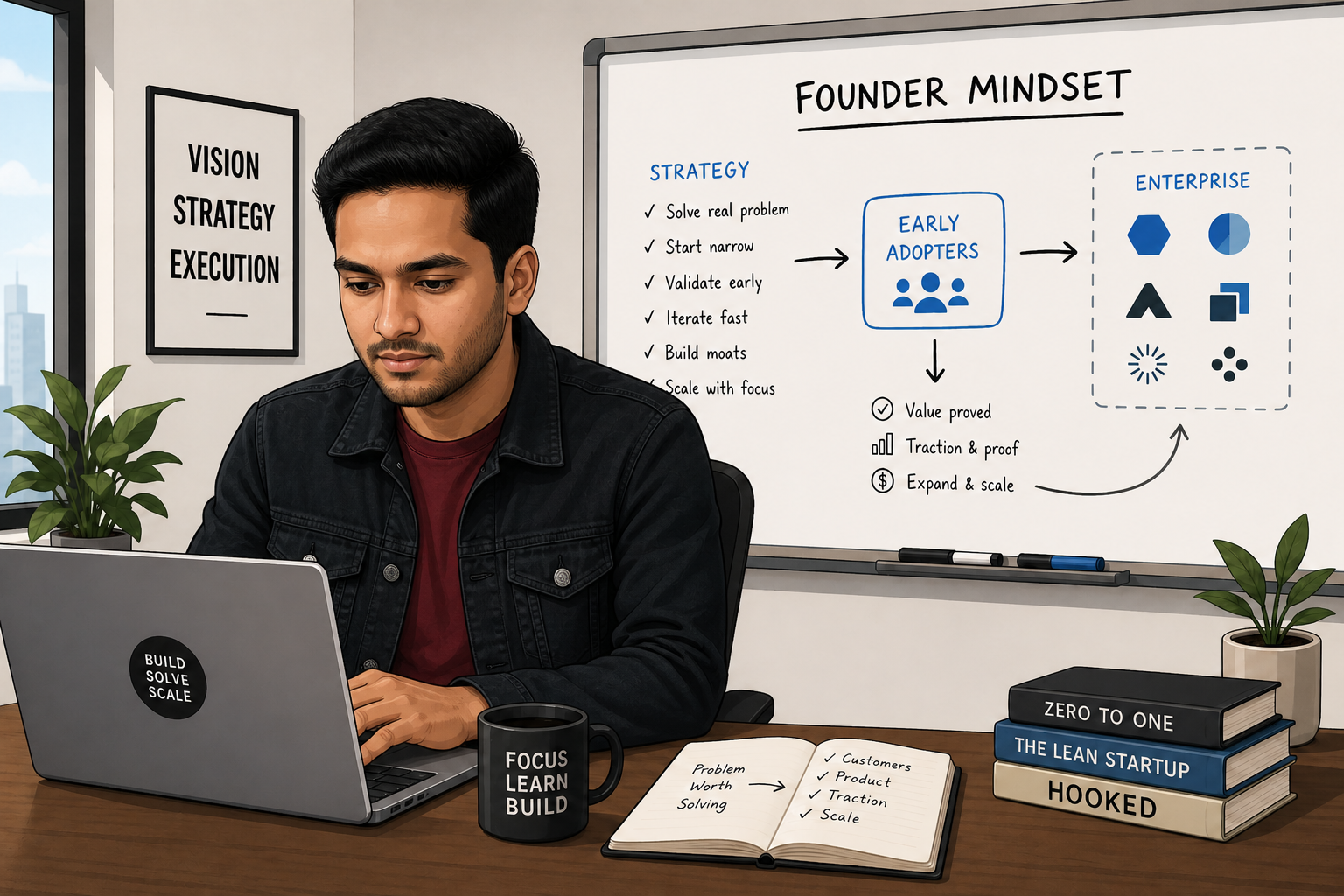
I studied what distinguishes high-achieving founders and broke it down in the simplest way below.
Made by @vishnu10

The founders who win early adopters first, and enterprise trust later, usually operate with a very different mindset than the average founder.

I did an extensive study of Paul Graham, Marc Andreessen and Elon Musk’s observed and written behavioral traits to understand how successful founders operate at different stages of a company.

And I’ve assembled them below in the simplest way.

Phase 1: Visionary magnet
The bold, polarizing, resilient, and future-oriented mindset of the founder attracts early adopters in this phase of building the company.

Elon’s bold and polarizing view allowed believers to self-select in.

Phase 2: Hands-on proof
Once early adopters are in, founders display their work ethic by doing unscalable work, listening closely to adopters, going the extra mile, and turning early users into tangible case studies and advocates.

Phase 3: Enterprise translation
With valid credibility established, the founder now becomes more outcome-oriented to scale up.

Big companies and other adopters can then justify a low-risk bet on the company.


Apart from these traits, I also found that they had:
- High activeness,
- Integrity,
- Relentlessness,
- Long-term thinking,
- High performance in other areas of life as well: eg: health, fitness, music, writing, etc.
- High motivation to work despite being successful already: e.g. Sergey Brin coming back from retirement to build AI at Google
- Techno-optimism,
- High mission oriented drive

Early adopters buy the founder’s conviction; big companies buy the founder’s proof.

User Avatar

Vishnu Anand

6mo ago

What makes an early tech adopter?
Made by @vishnu10

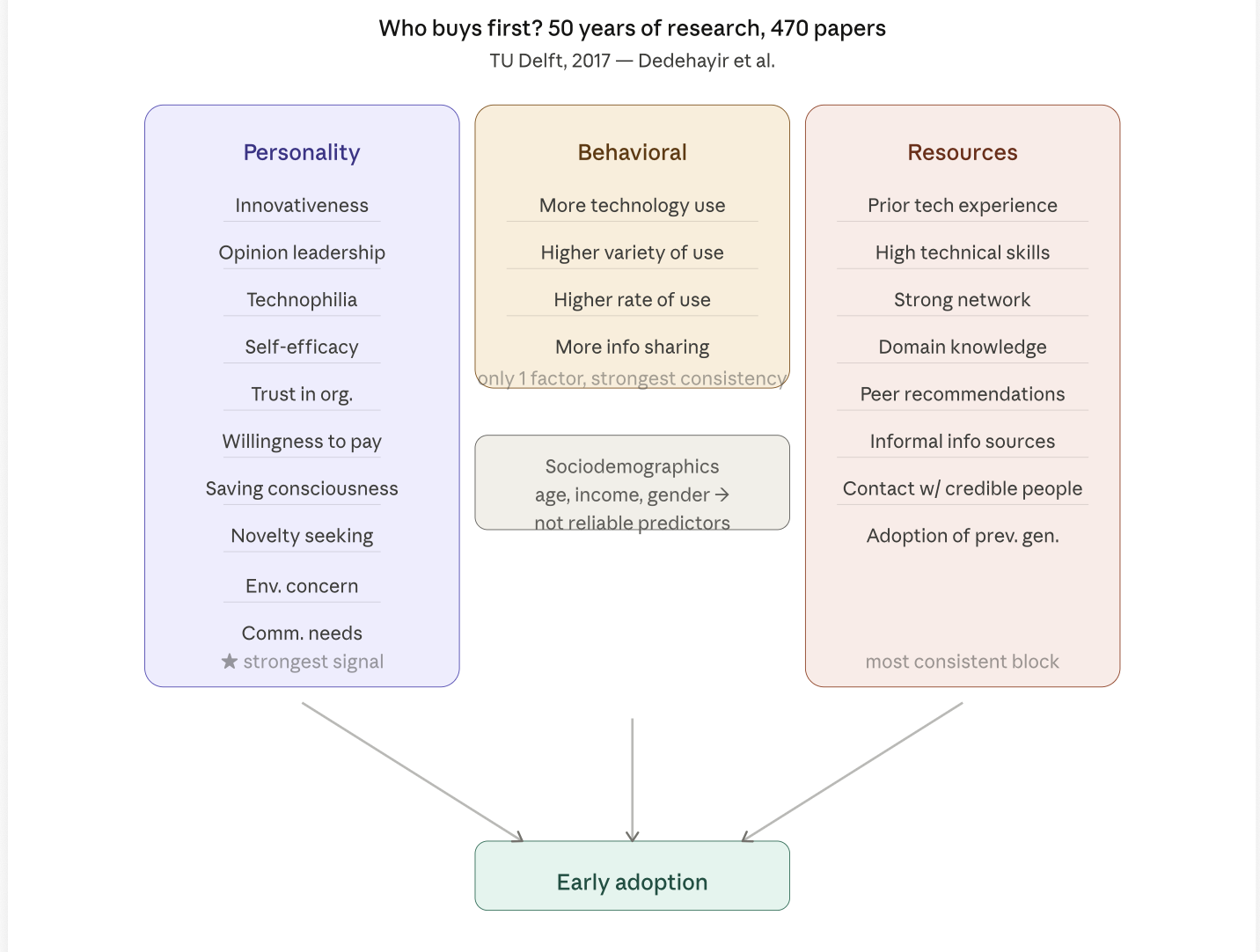
After synthezing 50+ years of innovation diffusion across 470 papers,

TU Delft proposed in a a 3-factor model to group adopters across different industries:

i) Personality.
ii) Behavioral.
iii) Resources.

For early adopters, these traits that stood out across the 3 factors:

Personality

- Innovativeness
- Environmental concern: for agriculture industry, specifically.
- Trust in adoption
- Technophilia
- Self-efficacy
- Opinion leadership
- Willingness to pay
- Saving consciousness

Behavioral:

- More technology use: Not because they had to but they were willing to.

Resources

- Prior experience with similar technology
- High technical skills
- Network
- Knowledge

User Avatar

Vishnu Anand

6mo ago

Beyond Metrics: The Gap Between Data and Revenue Insights
Made by @vishnu10

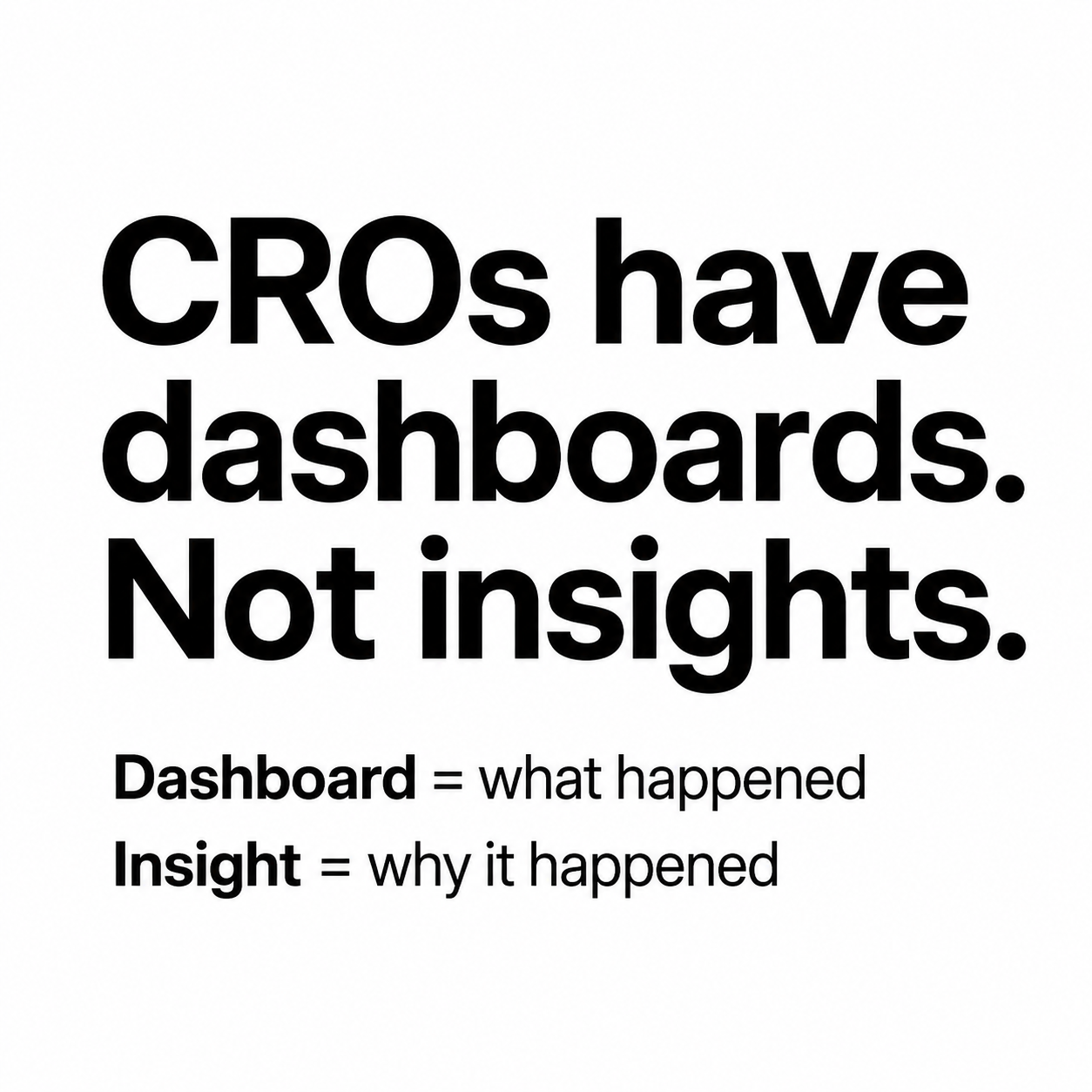
CROs have dashboards and not insights.

That's the real problem.

Most teams already track:

  • Win rate.

  • Pipeline

  • CAC

  • LTV

  • Forecast

But having numbers is not the same as understanding what is actually working.

A dashboard can tell you what happened.

It cannot always tell you why it happened.

That's where most revenue teams get stuck:

  • The process is unclear, so the data is weak.

  • The funnel is blended, so the numbers hide the truth.

  • The reporting looks good, but the reality is messy.

  • Annual planning starts and everyone realizes the numbers were never fully trustworthy

The hard part is not tracking metrics.

The hard part is making sure the process behind the metrics is acutally clean.

User Avatar

Vishnu Anand

6mo ago

GTM operators are hitting a wall using Claude
Made by @vishnu10

Claude is powerful but GTM operators are hitting real limits.

Maja Voje surveyed 200 GTM AI operators to ask what they disliked about Claude today.

Here are the reported limitations, ranked by number of mentions:

- Credits, cost, and usage limits: Running out of credits, throttling, usage limits even on the Max plan, unpredictable usage on small tasks.

- Memory limitations: Losing context between sessions, no persistent long-term memory, manual workarounds required.

- Context window and token limits: Running out mid-task, large operations failing, duplication across sessions.

- Integration and data gaps: Weak Google and Salesforce integrations, limited connectors, restricted access to company data sources.

- Reliability and consistency: Hallucinations, shallow outputs, inconsistent results across sessions.

- Team collaboration: Skills are not easily shareable, updating a skill does not cascade to teammates, poor team workflow support.

User Avatar

Vishnu Anand

7mo ago

The senior RevOps leader who couldn't get leverage from AI
Made by @vishnu10

𝗧𝗵𝗶𝘀 𝘄𝗲𝗲𝗸, 𝗜 𝘀𝗽𝗼𝗸𝗲 𝘁𝗼 𝗮 𝘀𝗲𝗻𝗶𝗼𝗿 𝗥𝗲𝘃𝗢𝗽𝘀 𝗹𝗲𝗮𝗱𝗲𝗿.

Among the many things they told me, one stuck:

They didn't have clarity on how to build leverage with conversational engines like Claude and ChatGPT to maximize their day-to-day productivity.

Here's the fundamental intuition I've built using these engines daily for the last 2.5 years across multiple tech and business systems:

𝗔𝘂𝘁𝗼𝗺𝗮𝘁𝗲 𝗺𝗲𝗻𝗶𝗮𝗹 𝘁𝗮𝘀𝗸𝘀 𝘄𝗶𝘁𝗵 𝗮 𝘀𝗶𝗺𝗽𝗹𝗲 𝗽𝗿𝗼𝗺𝗽𝘁

Today's AI is good at this.

Creating and updating Google Sheets, setting up basic automation with GTM tools, first-draft work — easy to do, easy to delegate.

If a task takes you 20 minutes and zero judgment, it shouldn't be on your plate anymore.

𝗔𝗻𝗮𝗹𝘆𝘇𝗲 𝗰𝗼𝗺𝗽𝗹𝗲𝘅 𝗱𝗮𝘁𝗮 𝗮𝘁 𝘀𝗰𝗮𝗹𝗲

Leveraging this is a bit trickier.

The best way I've seen is to treat each output like another data point — not an ultimatum.

Develop your intuition from the complex data, then use it to make a better decision.

I learned this the hard way. There were several instances where I took responses blindly and ended up not achieving the right results.

The real shift isn't in the prompt. It's in how you hold the answer.

Treat the model like a smart intern with a confident voice. Useful, fast, often right — but never the final word.

The senior operators who get leverage from AI aren't the ones with better prompts. They're the ones who kept their judgment on the inside of the loop.