Vishnu Anand
6mo ago
Entrepreneur | Founder @ Teravictus | Writes about AI
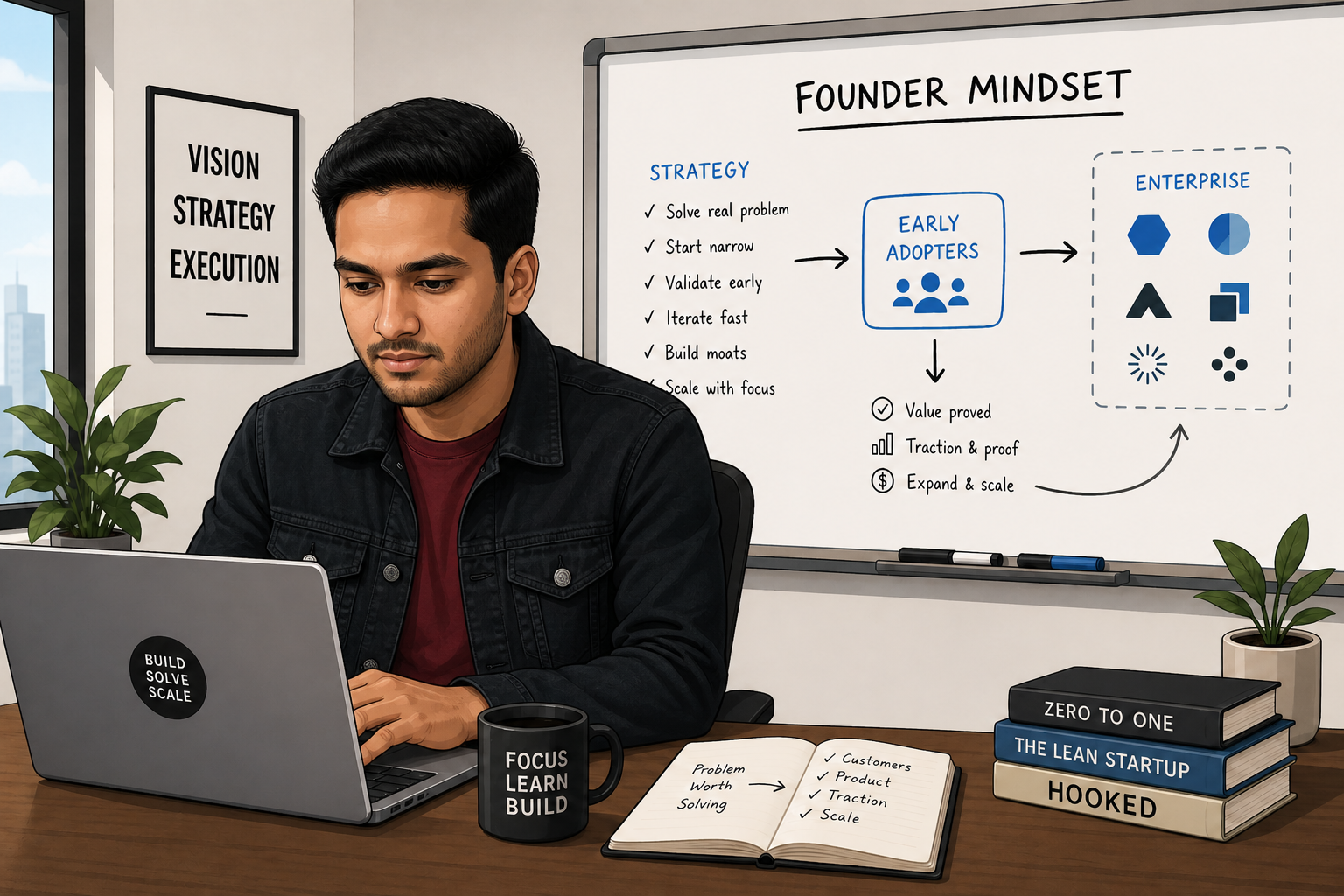
The founders who win early adopters first, and enterprise trust later, usually operate with a very different mindset than the average founder.
I did an extensive study of Paul Graham, Marc Andreessen and Elon Musk’s observed and written behavioral traits to understand how successful founders operate at different stages of a company.
And I’ve assembled them below in the simplest way.
Phase 1: Visionary magnet
The bold, polarizing, resilient, and future-oriented mindset of the founder attracts early adopters in this phase of building the company.
Elon’s bold and polarizing view allowed believers to self-select in.
Phase 2: Hands-on proof
Once early adopters are in, founders display their work ethic by doing unscalable work, listening closely to adopters, going the extra mile, and turning early users into tangible case studies and advocates.
Phase 3: Enterprise translation
With valid credibility established, the founder now becomes more outcome-oriented to scale up.
Big companies and other adopters can then justify a low-risk bet on the company.
Apart from these traits, I also found that they had:
- High activeness,
- Integrity,
- Relentlessness,
- Long-term thinking,
- High performance in other areas of life as well: eg: health, fitness, music, writing, etc.
- High motivation to work despite being successful already: e.g. Sergey Brin coming back from retirement to build AI at Google
- Techno-optimism,
- High mission oriented drive
Early adopters buy the founder’s conviction; big companies buy the founder’s proof.