Juan David 🚢
/juandaveth

Writing about Ethereum, education and open source. Co-founder at ethkipu.org

Juan David 🚢
♦️Understanding Ethereum
2y ago
While the execution clients are the heart, pumping transactions through the network, the consensus clients are the nervous system, keeping everything coordinated and functioning smoothly.
Consensus clients are crucial for Ethereum’s security and integrity. They make sure the network agrees on transactions, maintaining trust. Ensuring all nodes share the same view of the blockchain, keeping everything in sync.
Why Consensus Clients Matter
Validators work together without a central authority, agreeing on the blockchain’s state. By validating and attesting to blocks, consensus clients protect against malicious actors.
Like a well-coordinated nervous system, consensus clients help Ethereum adapt to changes and recover from external forces. Think as the brain filtering stimuli from the environment and reacting in a coherent way.
An Example: Prysm
Prysm is a popular consensus client for Ethereum. It handles block proposals, validation, and attestation, ensuring the network stays synchronized. Just like a nervous system coordinates body functions, Prysm coordinates Ethereum’s consensus process.
Consensus clients are the nervous system of Ethereum. They keep the network parts working together, validating transactions, proposing new blocks, and maintaining synchronization.
Juan David 🚢
🧑💻Open Source
2y ago
There was a time I trained for Bogotá's half-marathon. I did with a coach, someone that paced during the 21 km. The idea of Hacking Sprints vs. OSS Marathons made me think about this approach for newcomers to running or contributing.
Imagine training for a race. You could sprint, push yourself hard for a short distance, and enjoy crossing the finish line. That’s what hackathons are like: intense, exciting, and focused on prizes. But real endurance? That comes from the marathon, the long journey of contributing to open-source projects.
Think of it as training for a marathon. You have a coach, a seasoned mentor who designs a customized plan for you. They lay out a roadmap from where you are now to where you want to be. They guide you and answer all your questions.
In coding, as in running, having a coach means more than just getting tips. DevRel engineers review your code, provide feedback, and help you develop best practices. Each pull request is a step in your training, each review a session of constructive coaching.
Hackathons are sprints, chasing the immediate prize. The satisfaction of the OSS Marathon is different. It’s about going farther, becoming part of a community. It's about the long-term journey and the joy of seeing your contributions at the finish line.
And here's the best part: a running coach is on the same path, walking the same distance with you. They're committed to your success, just as a mentor in open source is there for the long haul.
They're there to guide you every step of the way as an aspiring programmer, ensuring you become a better developer ready for the marathons ahead.
Juan David 🚢
♦️Understanding Ethereum
2y ago
Imagine Ethereum as a living organism, with its Execution Clients acting as the heart, keeping everything alive.
Collecting Blood
Just like blood enters the heart, transactions flow into Ethereum's execution clients. These clients collect all incoming transactions into a pool, waiting to be processed.
Oxygenation
Before blood circulates, it needs oxygen. Similarly, transactions must be validated. Execution clients verify each transaction’s authenticity. This step is like oxygenating blood, ensuring it's ready to flow into the body.
Pumping into Organs
Once validated, transactions are processed. The execution client updates account balances and executes smart contracts, just like the heart pumps oxygen-rich blood to vital organs. As blood nourishes the body, the execution client updates the chain state, ensuring all parts of the network are synchronized.
Keeping the Heartbeat
Each heartbeat sends fresh blood throughout the body, maintaining life. Execution clients bundle valid transactions into new blocks. This heartbeat keeps Ethereum alive.
Execution clients are the heart of Ethereum. They receive, validate, and process transactions, updating the blockchain and creating new blocks.
Next post, I'lll explore the role of consensus clients (Ethereum's nervous system) ensuring all parts work together.
Juan David 🚢
💚Public Goods
2y ago
I was excited about what I learned while listening to Juan Camilo Cárdenas on a podcast, discussing Elinor Ostrom's work. Her insights on governing shared resources inspired a thought: how would she argue for the benefits of public goods in the age of Ethereum?
Ostrom often used examples from nature to illustrate her points. Imagine a forest, shared by a community. Instead of a single authority managing it, the local community members collectively take care of it. They decide on harvesting, replanting efforts, and protection against overuse. This shared responsibility ensures the forest thrives.
Now, translate this to the digital realm with Ethereum. Instead of relying on centralized entities, Ethereum is managed by its users through decentralized structures like DAOs. Each participant has a voice in decisions about protocols, mirroring the community governance Ostrom defined in her famous book, Governing the Commons.
In this decentralized ecosystem, Ethereum acts like that community-managed forest. Users collaborate to maintain and improve the network, fostering a sense of ownership and responsibility. This approach ensures the platform remains resilient and adaptable with the community’s needs.
Just as a forest thrives under collective care, Ethereum flourishes through decentralized management, proving that public goods, when managed by the people, can sustain and grow. Like an infinite garden.
Juan David 🚢
♦️Understanding Ethereum
2y ago
I was watching Vitalik's "Ethereum in 30 Minutes" and got inspired to write about why Ethereum is so powerful. I’ve condensed it in 3 minutes.
Vitalik highlighted key features of blockchains: they facilitate large-scale consensus, are censorship-resistant, always available, avoid dependence on centralized parties, and enable interactions between people who don’t trust each other.
“Blockchains are great for things that need stability, so there is a good reason why money is the first app,” Vitalik said on stage.
But what makes Ethereum special is its general-purpose platform. Here’s the magic:
Independent Innovation: Anyone can build on Ethereum. It’s an open playground for developers to create without needing permission.
Network Effects: Different applications can talk to each other. Imagine a DAO interacting with Uniswap to invest funds collectively.
Lower Barriers: Building new things on Ethereum is easy. Developers can use open-source frameworks.
Unforeseen Usefulness: This is where it gets exciting. Ethereum ends up far more useful than even the creators imagined.
It’s like creating the smartphone and realizing it can do more than just calls. DeFi, NFTs, DAOs are just the beginning.
Ethereum combines the reliability of blockchains with the flexibility of open source.Vitalik's talk remind us that Ethereum's true power lies in its unforeseen potential.
So anon, what will you build on Ethereum?
Juan David 🚢
💚Public Goods
2y ago
Today, I was listening to a podcast with my Economics teacher, Juan Camilo Cárdenas, discussing Elinor Ostrom's contributions to economics. Ostrom, a Nobel laureate, showed how communities successfully manage shared resources through collective-choice arrangements. This principle is especially relevant to how decisions are made within Decentralized Autonomous Organizations (DAOs).
DAOs: Modern Collective-Choice Arrangements
Ostrom's research demonstrated that communities thrive when they actively participate in the rules and decisions that govern their resources. Collective-choice arrangements ensure that those directly affected by decisions have a role in making them, leading to better compliance and more effective management.
DAOs are the Web3 embodiment of that principle. They distribute decision-making power among all members, typically through governance tokens. This ensures that decisions reflect the diverse perspectives of the community, similar to how local stakeholders contributed to effective resource management in Ostrom’s studies.
A Case Study: MolochDAO
MolochDAO is on of the first examples of a DAO that embodies Ostrom’s principles. Created to fund Ethereum projects, it operates on a simple governance model where members propose grants and vote on which projects to fund. Each member has an equal say, ensuring that the collective wisdom guides decision-making, reflecting Ostrom’s collective-choice arrangements.
Elinor Ostrom’s principles of collective-choice arrangements are a blueprint for Web3. DAOs like MolochDAO show how decentralized systems can let communities manage their digital resources. By adopting these principles, Web3 can create a fairer digital future where everyone has a stake and a voice.
What can we learn from her work to shape the future of decentralized coordination?
Juan David 🚢
♦️Understanding Ethereum
2y ago
Picture this: You’re at a conference. You meet someone interesting, and they hand you their business card. But instead of a name, it’s a 40-character string. Awkward, right?
How do you remember that person? How do you navigate the world without a name? Enter the Ethereum Name Service (ENS), your digital passport to the decentralized world.
Just like a passport identifies you and lets you travel across borders, ENS identifies you in Web3 and lets you interact effortlessly across dApps and services. Without it, you’re lost in the sea of unknown.
Have you ever tried sharing your Ethereum wallet address with someone? It looks something like this: 0x5c8f… and goes on for another 36 characters. Not exactly user-friendly. What if you could replace that string of randomness with something like yourname.eth? Now, it’s easy to remember, easy to share, and yours.
I wrote about this a while ago on What is Ethereum for me. We identify with ourselves using names. There’s a particular way of naming people inside Ethereum. For example, my ENS is juandav.eth, the last three letters are a sign of the family I feel part of. My first name is Juandavid, I shortened it to juandav and stated my last name as .eth.
Playing with id = eth.
In the decentralized world, your name is more than just a string; it’s about owning your digital identity. So, why settle for a 0x + 40-character string when you have a name?
Because in the end, it’s not just about being cog in the system, it’s about being onchain.
Juan David 🚢
🧑💻Open Source
2y ago
I’ve been diving into the world of open-source architecture and discovered an intriguing parallel between the Linux kernel and Ethereum. Imagine them as the invisible workhorses of the digital world, working behind the scenes to keep our daily digital life running.
Resource Manager
Picture the Linux kernel as a maestro, orchestrating a symphony of programs. It allocates CPU time and memory, deciding which tasks to run. Similarly, Ethereum nodes act as directors in the blockchain symphony, allocating their computational power to validate transactions and add new blocks, ensuring harmony in the network.
Security Guard
Now, imagine the Linux kernel as a security guard, standing watch to ensure that programs don’t access restricted areas of memory. Ethereum’s consensus mechanism does a similar role, safeguarding smart contracts. Every node in the network performs validity checks, guaranteeing the integrity and security of the chain.
Mediator of Communication
Think of the Linux kernel as a trained mediator, facilitating communication between software and hardware components. The Ethereum Virtual Machine (EVM) mirrors this function in the onchain world, acting as a mediator for decentralized apps. It ensures that these apps can interact within the network, much like the kernel does for your computer.
Both the Linux kernel and Ethereum represent the importance of effective resource management. Without the Linux kernel, your computer would struggle to juggle multiple applications, leading to crashes. Similarly, without Ethereum’s resource management, the blockchain could become unreliable, undermining the promise of decentralization.
By understanding these parallels, we can appreciate the invisible workhorses: Linux and Ethereum, both quietly powering our digital lives.
Juan David 🚢
♦️Understanding Ethereum
2y ago
Recently I've been writing every day about Ethereum. My goal is to explain it in simple terms. In the collection I've created with the tag Understanding Ethereum, I realized that there is a journey while you learn. Akin to move yourself from one point to another:
Gas Fee as the Fuel of a Road Trip
On Ethereum, gas fees are like fuel. They power every action you take, from simple transactions to complex smart contracts, need the fuel to get the car moving. Sometimes it's expensive, on that post I explained how much the road trip will cost.
The Mempool: Your Gateway to the Ethereum Highway
Next time you sign a transaction, think of it as a car lining up to enter the Ethereum Nation. It waits in the mempool until it’s approved. This waiting area is essential for ensuring all transactions are valid. Just like at a toll booth, where cars with tags zip through faster, transactions with higher gas prices get prioritized.
Ethereum’s Airport: Full Nodes and Validators Simplified
Immigration officers and airplane crew, full nodes and validators; they might seem different, but their goal is the same: keeping Ethereum's airport moving, secure, and efficient.
Understanding Ethereum can indeed feel like a journey, with each concept representing a stop along the way.
Gas fees fuel your travels.
The mempool acts as your gateway.
Full nodes and validators ensure a secure ride.
Just like a road trip, navigating Ethereum requires knowing the key components that keep it running. As we continue on this path, remember that each step brings us closer to mastering it.
Safe travels on your Ethereum journey!
Juan David 🚢
🧑💻Open Source
2y ago
In 1991, Linus Torvalds was a 21-year-old student at the University of Helsinki. While working on a personal project to create a free operating system kernel, he decided to share his progress with the world.
The Humble Announcement
On August 25, 1991, Linus made a now-famous post to the comp.os.minix newsgroup:
I’m doing a (free) operating system (just a hobby, won’t be big and professional like gnu) for 386(486) AT clones. This has been brewing since April, and is starting to get ready. I’d like any feedback on things people like/dislike in minix, as my OS resembles it somewhat
I’d like to know what features most people would want. Any suggestions are welcome, but I won’t promise I’ll implement them :-)
PS. Yes - it’s free of any minix code
Torvalds’ message is particularly admirable for its humility and modesty. He described his work as "just a hobby" and not something that would become big.
This casual tone and humor are a key characteristic of Linus Torvalds.
"Just a Hobby"
Linus' story is an example of how passion projects, even those started "just for fun" can grow into something monumental and revolutionary.
You might wonder why those big words? Well he was the creator of the Linux Kernel. In future posts I’ll dive in on the history of this open-source breakthrough.
Juan David 🚢
🧑💻Open Source
2y ago
Richard Stallman’s frustration with a Xerox printer at MIT was a small problem that revealed a much bigger issue. The printer broke frequently, and without access to its source code, Stallman couldn’t fix it. Xerox refused to share the code because it was proprietary.
This denial motivated Stallman to act.
In 1983, he launched the GNU Project to create a free Unix-like operating system. He founded the Free Software Foundation to promote software freedom and wrote the GNU General Public License (GPL) to guarantee that software remained free.
Stallman’s vision was about more than software, it was about freedom.
He believed that knowledge and tools should be shared to foster innovation and collaboration. The free software movement he ignited emphasizes transparency.
The transparency of open-source software means anyone can inspect, modify, and enhance it, preventing hidden traps. Like him being denied to change the printer's driver.
The printer incident was a catalyst for monumental change. It showed that standing up for your rights can lead to a freer world. Today, Stallman’s legacy lives on, proving the power of freedom in the digital age.
So, what could you change by standing up for your rights?
Juan David 🚢
🧑💻Open Source
2y ago
In 2010, Bitcoin faced a major crisis. A bug, known as the Value Overflow Incident allowed someone to create 184 billion Bitcoins in a single transaction. This was a huge problem since Bitcoin's total supply is capped at 21 million.
Because Bitcoin’s code is open-source, anyone can inspect it. On August 15, 2010, developer Jeff Garzik spotted the abnormal transaction. “This can’t be right,” he exclaimed, eyes widening at his screen. He quickly jumped onto the Bitcoin Talk forum.
“Has anyone seen this transaction?” Jeff typed.
Within moments, Satoshi Nakamoto replied, “Checking now. It looks like a major issue.” Gavin Andresen wrote, “This needs fixing immediately. Let’s get on it.”
Thanks to the open nature of Bitcoin, the issue was quickly identified. The team of developers worked together in real-time. “We need to release a new version to fix this,” Satoshi ordered. Within hours, they released a new version of the Bitcoin software, correcting the flaw and invalidating the fraudulent transaction.
The transparency of Bitcoin’s open-source model made all the difference. Everyone could see the problem and the solution. This openness reinforced trust in Bitcoin. The fast response showed the strength of the system and the reliability of open source.
The Value Overflow Incident proved the power of open source. The quick resolution of the bug by the global community highlighted the security that transparency brings.
Bitcoin emerged stronger, thanks to its open-source nature.
Juan David 🚢
🙌Ethereum Community
2y ago
Starting an Ethereum community is more than just organizing events, it’s about building connections, sharing knowledge, and creating a team. Let me share the story of Ethereum Bogotá.
The Beginning: A Simple Idea
During the pandemic, when the world was isolated, Emilio and I saw an opportunity to connect people. We started Ethereum Bogotá with a simple video call, reaching out to those who shared our passion for Ethereum.
In the years leading up to Devcon VI, we hosted a series of talks introducing basic concepts like self-custodial wallets, DeFi, NFTs, DAOs, and more. Starting with just a video call, Ethereum Bogotá grew into a vibrant community. We inspired each other and learned together.
Calling for New Talent
By the end of 2022, during a Starknet meetup, I decided to call for new talent. This decision brought an amazing group of individuals who joined me on this journey, complementing our efforts and bringing fresh energy and ideas.
Although I should have done it earlier, the timing was perfect. This infusion of new people took our community to a new level, adding diverse perspectives and skills.
If you’re passionate about Ethereum and want to start your own community, here are some steps to get you started: start small, educate, engage, and call for talent. Rinse and repeat.
Juan David 🚢
🙌Ethereum Community
2y ago
If Ethereum is the future what we believe in, then a logical question is: When? How? But most import is what can I do? The answer is by contributing to open source.
Even though there is an open opportunity. We need to follow the etiquette to start contributing. There is a lay of the land you can discover. Imagine an onion with its layers, not necessarily in perfect order. You can peel it, by a simple action. I loved what Danny Ryan suggested at Devcon IV:
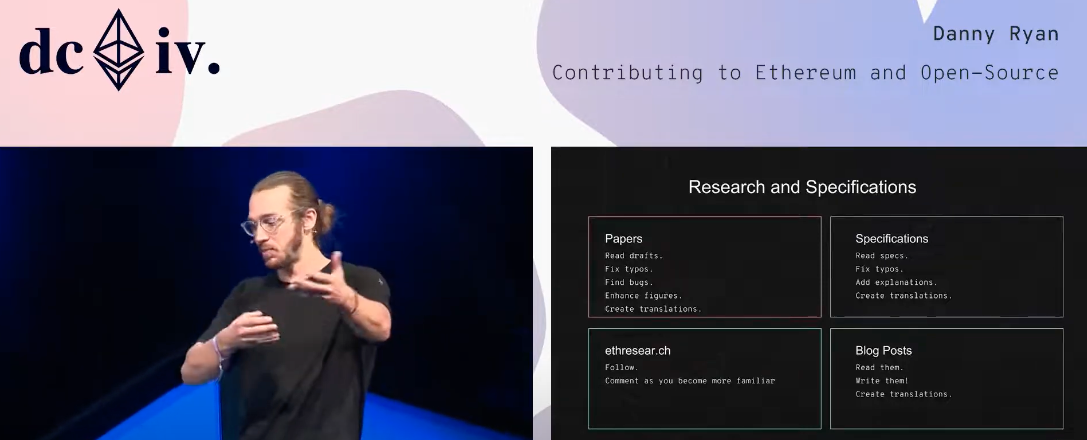
Research sounds like a daunting word. You might think am I able to propose new topics? At first, definitely you won't. But the best way to learn something is by carefully reading.
Read drafts, to understand the initial ideas. Read to fix typos and find bugs. Read and improve the figures. Start reading something you find interesting at ethresear.ch.
So to start contributing to Ethereum and Open-Source, just read and find ways to improve what stumbles on your screen.
Juan David 🚢
2y ago
There are 3 topics I am actively thinking about a lot these days:
Topic #1: Ethereum in simple terms
I’m passionate about explaining Ethereum in easy-to-get terms because that’s the type of content I would have loved to read when I first started.
My goal is to make complex topics accessible for everyone, especially newcomers. Over the next five years, I hope to publish interesting essays and long blog posts that simplify these concepts and make them entertaining.
Topic #2: Open source
I first got interested in open source contributions in Ethereum since the beginning of 2024.
Austin Griffith with Scaffold-eth introduced me to it. Since then, I have learned a lot about the importance of open tools for developers, the culture of open source, and UBI to contributors. We have won some battles, but the war of having products is still going.
Topic #3: Education as a public good
I also have an interest in learning more about education as a free and open resource.
It's one of those never-ending rabbit holes I find myself exploring because I think is the most important topic I can work on. I firmly believe education should be a public good. That's one of the missions we have at ETH Kipu.
It would be great to connect with other people who are interested in these same topics. So if any of the above resonates, feel free to reach out.

Juan David 🚢
♦️Understanding Ethereum
2y ago
Depict yourself on a living room, a remote control and a TV. The remote control is in your hand, changing channels. The TV responds to these signals. This is how Externally Owned Accounts (EOAs) and Contract Accounts work in Ethereum. Let me explain.
Externally Owned Accounts (EOAs): Remote Controls
An EOA is like a remote control, powered by a private key (the battery). You use it to send signals (transactions). EOAs are controlled by you. When you send Ether or interact with a smart contract, you’re pressing buttons on your remote.
Each transaction is signed by your private key, ensuring only you can use it.
Contract Accounts: TVs
A Contract Account is like your TV. It doesn’t act on its own but responds to signals from EOAs. When an EOA sends a transaction to a Contract Account, it’s like pressing a button to change the channel. The Contract Account executes the actions defined in its smart contract, like the TV following commands.
Contract Accounts have code that defines their behavior, similar to a TV’s internal circuitry.
The Living Room
EOAs (remote controls) and Contract Accounts (TVs) rely on each other. Without EOAs, Contract Accounts wouldn’t receive commands. Without Contract Accounts, EOAs’ signals would be pointless.
Together, they create a functional Ethereum ecosystem, much like the interaction between a remote and a TV in your living room.