Matthew Pough

/moduseffectivus

Matthew Pough

Welcome to Modus Effectivus. This is the Effective Way. 20+ years as specialist SME in reducing complexity, solving problems and communicating effectively.

User Avatar

Matthew Pough

2y ago

image
Matthew Pough
Want to improve your clarity or creativity? Try writing for an audience

Two curious side effects occur when you write for an audience.

Clarity of explanation and creativity both improve - becoming more effective and productive over time. You don't even need to publish. It's the intent - writing for another - that's the key.

Why is this?

Focus plus repetition. The more you write for a third-party, the more you practice and the more time you devote to the practice. It's the class of experience.

Why does clarity improve?

Seneca, the Roman Stoic philosopher, said, "While we teach, we learn." Assembling your thoughts for consumption forces you to find the weak points in your thinking. And also refine the explanation that we think makes sense - before we try to explain.

Why does creativity improve?

Let's assume Steve Jobs was right: "Creativity is just connecting things." The more you focus on an idea and then try to explain, the more connections occur. More connections spur new thoughts, new ideas and more creativity.

And the biggest bang for buck?

Increasing the time you practicing spend helps, but the gains are likely incremental. The biggest step-change comes from feedback. Learning where you explained well or poorly will give you insight you can't get elsewhere.

And the feedback might trigger connections you hadn't considered, leading to...

User Avatar

Matthew Pough

2y ago

image
Matthew Pough
Productivity apps won't help you - until you've done this

Productivity apps can actually decrease your effectiveness.

Apps allow you to manage more with less. Manage more information. Perform more tasks.

But to be effective overall, the goal must be to have less to manage.

Do less with more. Consume less information. Perform fewer tasks.

So productivity apps send you in the wrong direction.

Apps help you manage the last 10%. An app to manage all those email subscriptions you never read compounds the underlying problem. It's cataloguing more useless information.

It's like wiping around the bench when the sink is flooding.

Try an alternative - turn the tap off first. Start with a small habit and work out what you need. As James Clear has said, "Standardise before you optimise."

So when the system is working, then and only then, optimise.

Instead of finding an app to manage the deluge of data coming at you, manage the flow. If you haven't read of those emails, that means you didn't really want to. So by deleting them you haven't lost anything.

You can always find them again if you need to.

User Avatar

Matthew Pough

2y ago

image
Matthew Pough
The addiction of mindlessness

The urge is strong.

It really hits me after sickness. Unable to think, I mindlessly binge-watch. So easy to do these days.

Such a trap.

Most addiction is habit related. Some - like caffeine - have external chemical components, but all have psychological factors - like internal chemical components. The mind wants to keep doing anything that releases certain hormones.

That's one reason why slot machines are so addictive.

After the third go, you almost have to lift yourself by the nape of the neck and relocate your body. Physical distance from the stimuli helps and eventually the body overcomes the urge. But with twenty-four hour access to anything virtual the distance is never more than a mouse-click.

That's why we have to be so vigilant.

One benefit of a single movie or book over a series is that it ends. That defined point allows the mind to stop and regroup. But like an all-you-can-eat buffet, with a series there's always more - just waiting for you to stuff yourself.

Half - maybe even most - of the time, what we're shoving down our throat or senses isn't even that good. At the point addiction hits us, we barely need to experience a high - or whatever hormone is being released - once every ten turns of the wheel. That's the slot machine effect. Win once, lose ten times. But we still come back.

Strangely enough, everyday routine is a tool against the addiction. Try this - instead of the morning caffeine hit, force yourself to have a glass of water.

Do that for a week.

Like many, you may well find that the coffee addiction wanes.

Sure there are pitfalls. Restarting an old addiction is far too easy. Have another coffee, enjoy it, then repeat the next day and you're back into it - but the routine can help you fight that.

Like right now. I binged-watched yesterday. Had to pull myself away after a few hours. But there's still more episodes - I feel the urge tugging at me. And yet today I'm well enough to write.

Writing is effortful. The urge is to revert to mindlessness - to procrastinate - is strong. The only thing stopping me is the routine.

Write three hundred words a day.

This article has saved me from addiction. I can still feel it there, tugging at the back of my mind. So easy to click the mouse and once again fall into a trance.

You have a mindlessness addiction too - what's yours?

User Avatar

Matthew Pough

2y ago

image
Matthew Pough
Great news! It's not you. Ranking your End-Product Values doesn't make sense.

What do you value more - health or wealth?

Both are End-Product Values. Both require effort over time. Both feed each other - health allows for wealth, and wealth allows for health.

Have trouble deciding?

My bad. I've messed with your head. On purpose.

If you've been feeling lost - that identifying and using your values just doesn't work for you - I have great news: it's not you.

The question is flawed.

It assumes that every value is relevant at all times. But life doesn't work that way - nor do we. Not all values are used equally and nor should they be.

We can only focus on one thing at a time.

When I'm becoming fit or eating well - that's my focus. When I'm working or paying bills, my priority - the object of my focus - switches. We aren't able to do everything at once and there's no need to.

For me, health and wealth are both equally important.

Without health, I soon won't have any wealth - or life. Without wealth, I'll soon run out of health - I'll do whatever I need to do to survive, including working horrendous hours and eating junk. Assuming that we should determine which value is more important is pointless.

It's also a recipe for disaster.

Should you focus on wealth for the 112 hours you're awake each week? Not if you don't want to go insane. What about exercising every hour of the day?

There is a better way.

Identify your values. Rank them when it helps you, don't when it doesn't. Then choose which value you wish to focus upon right now.

Don't be duped by what the "experts" tell you. The exercise is flawed - not you.

User Avatar

Matthew Pough

3y ago

image
Matthew Pough
The other name for End-Product Values: ill-defined goals

I bet you set a lot of goals.

We all do. Ultimately, we set goals for what we value. That means End-Product Values - such as achievement, wealth, health, learning or wisdom - are a type of goal.

Just an ill-defined one.

That's because End-Product Values, or EPVs, don't come with specificity or deadlines. Winning a gold-medal at the Olympics isn't an EPV. Achievement is.

So goals are refined EPVs.

We take the EPV and set a specific target and timeframe. Not just wealth - but start a business in the summer. Not just health - but eat less potato chips every day.

We make our EPVs real in two ways - Big-Bang Goals and Designed Routines.

Big-Bang Goals are the ones you stick on the wall, like running a half-marathon. Designed Routines - like running every day for twenty minutes - might not seem like a goal, but meet the requirement of a specific target (run for 20 minutes) and timeframe (everyday). In fact, Designed Routines more often help Big-Bang Goals - the Olympian doesn't win the gold-medal without a day-in day-out struggle.

So without a Big-Bang Goal or Designed Routine, that End-Product Value...

Well, it's not really something you value, is it?

As Kristoffer says, "Actions speak louder than values." If I spend more than I earn, then I don't really value wealth. Or, at the least, I value spending or surviving more.

So one test of what you really value is how you behave.

If you design your EPVs into your routines, you live your EPVs every day. If you set a Big-Bang Goal but don't work towards it - well, that says something about the EPV. Or at least the expression of that EPV in your Big-Bang Goal.

How are you living your End-Product Values?

User Avatar

Matthew Pough

3y ago

image
Matthew Pough
Conflicting priorities? Start small

Priorities spiralling out of control?

We've all been there. But what to do when those priorities are all equally important? Normally, starting with the greatest return seems best - but let's try approach from left field.

We'll use the Debt Snowball.

It's used when your credit cards are spiralling out of control. Rank the cards by balance due, keep paying the minimum monthly payment (ongoing maintenance), and focus all your attention on removing one card at a time. The key twist?

Start with the smallest balance, not the largest.

With this, you'll quickly pay off the card with the smallest balance. That's a huge step forward - a key victory. But you've also released the minimum payment.

Which gives you more money to pay off the second card quicker.

This approach has three fundamental assumptions:

1 - the challenge is large and requires continual motivation.

2 - every card requires maintenance - the minimum payment - so the more of those you have, the more your funds are dispersed.

3 - removing the largest debt takes the most work

How does that relate to priorities?

The assumptions are identical. With too many priorities we risk becoming overwhelmed and procrastinating - so motivation is important. And every task requires ongoing maintenance.

Any unfinished task is a burden - and the larger the task, the more maintenance.

It needs reminders, explanations, justifications, negotiations - there's even the weight of knowing you still have to do it. But if the task is small and you complete it, you avoid all that maintenance. You'll also feel better and have a sense of progress which adds motivation.

User Avatar

Matthew Pough

3y ago

image
Matthew Pough
Too many bad meetings? Just say 'no'.

Ding!

You receive a meeting invite. What's your automatic response? Most will accept.

Why?

One of the most common complaints is too many bad meetings. Followed closely by too many meetings. Let me empower you:

You can say 'no'.

In most cases, you don't actually have to go to that meeting. Want proof? Then ask yourself one question:

Would I have to go if I were double-booked?

If no, then why go if your calendar is free? You are giving your time to someone else. And your time is your most valuable and limited asset.

Have to go?

Happens to all of us. But you don't have to live with a bad meeting. Here's a simple question you can ask to make every meeting effective:

What's the purpose?

There either is a purpose or not. And if there's no purpose, it's a chat. If the purpose is unclear, then help the meeting organiser clarify the purpose.

User Avatar

Matthew Pough

3y ago

image
Matthew Pough
Struggling with a new situation? Don't think - apply core principles.

Try this next time you eat: decide whether to pick up the fork or the knife first.

Most people will freeze - madly remembering which one they do first - and no matter which one you pick, you'll be uncomfortable. That's because thinking is hard. And if thinking is hard, why try to think in each new challenge?

Here's an alternative: apply core principles.

Ralph Waldo Emerson said it best: “As to methods there may be a million and then some, but principles are few. The person who grasps principles can successfully select their own methods. The person who tries methods, ignoring principles, is sure to have trouble.”

Principles are few - even better, they're unchanging.

Because principles are few, you don't need to learn as much. Because principles are few, you can learn what you need to, when you need it. Because principles are few, you can cut out most of the noise.

If Elon Musk, Derek Sivers and Shane Parrish can start with first principles, so can you.

User Avatar

Matthew Pough

3y ago

image
Matthew Pough
Do you want Collaboration or Confirmation?

Collaboration is an exchange of ideas.

That seems a simple notion. Except that many aren't open to new ideas. Which means a lot of 'collaboration' is… not.

Not Invented Here (NIH) Syndrome is everywhere.

If we didn't think of it, the idea has less merit. Or should be ignored completely. We've all had great ideas discarded for no other reason than the person making the decision didn't come up with it.

Until they create the same idea by themselves later.

NIH can appear in the most unlikely places. We're all human, and humans make up their mind before talking to another.

We might not even realise we've made a decision. But often what we seek is not the best answer to a challenge, but confirmation of our opinion.

So want collaboration?

Then exchange ideas.

User Avatar

Matthew Pough

3y ago

image
Matthew Pough
Shipping? Don't gulp, sip!

The scientific evidence is compelling.

The mind retains information better if you absorb small amounts that are repeated after a time.

Which suggests information overload is like gulping too much water - it goes straight through leaving no trace. And if memory is like that, then awareness is too.

Spaced repetition - shipping small amounts frequently - is more likely to retain awareness than a weekly tome.

Is daily too much? For some it might be. But research suggests that the more often engaging content is produced the more positive the reaction. Weekly is better than monthly. Bi-weekly is better than weekly.

But that's just the benefits for the audience.

The Theory of Constraints - as well as Agile, Lean and who knows how many other approaches - all focus on the minimum viable product. Produce the smallest amount you can that's a viable product. Then ship, and move to the next.

Try this test: start now and write 2100 words.

How did you go? If you're like me, that's a gulping challenge - one I'll fail at more often than succeed. And even if I succeed the quality won't be high without a lot of work.

Now let's try the sipping alternative.

Write three hundred words, and do the same thing for the next seven days. Many find that much easier. For me, the quality improved out of sight.

And with a little further work, I can even stitch those seven articles together to create the long-form version.

Sipping. It's the new gulping. Try it out for yourself.

User Avatar

Matthew Pough

3y ago

image
Matthew Pough
Sipping is better than gulping - the case for memory

The medical evidence is compelling.

The body rehydrates in particular ways. It's optimised for small, frequent amounts of water. If you gulp down a bottle of water all at once, there are few benefits. In fact, most of the water passes straight through leaving you as dehydrated as before.

Memory is like that too.

Heard of spaced repetition? The mind seems to retain information better if you absorb small amounts that are repeated after a time. That suggests information overload is like gulping too much water - it goes straight through leaving no trace.

That book you read last year - how much of it do you remember? If you are like many - not much, if any. Tiago Forte went as far as to change his whole approach.

Rather than read lots of books, he now reads few. And he uses the extra time to synthesise them so he can make the case better than the author to teach others. Seneca, a Stoic philosopher, argued that unless one can teach a subject, one does not know it.

The stars align.

Sipping. It's the new gulping. Try it out for yourself.

User Avatar

Matthew Pough

3y ago

image
Matthew Pough
Interacting? Plan with SPIFFY

Interacting is an engagement.

It's a contract between you and your customer - boss, colleagues, audience... The interaction is the product you promise. You might not specify expectations for that engagement, but your customers will.

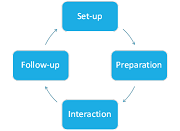
Any engagement needs a framework - I use SPIFFY.

Set-up, preparation, interaction, follow-up. You need to do every step. And, in general, you're probably spending too much time on the interaction itself.

Any interaction is time-bound because you've set when it will happen.

That means you have little leeway or slack, and you need a buffer to ensure your commitment. That also has consequences for follow-up.

Because follow-up is only useful unless it's too late.

Which means follow-up is time-bound as well.

That's important because set-up and preparation aren't time-bound. You can do them at any time in advance. And you can spend the time you need - without taking time from the interaction and the follow-up.

What happens when you don't set-up and prepare in advance?

You put pressure on your commitment. And the time and focus that you should be giving the interaction and follow-up just isn't there. Which leads to one thing.

An unhappy customer.

SPIFFY helps you plan. Allows you to make sure you're focussing on the right areas at the right time. And points out where you need help from your systems.

So you can keep your commitments and your customers happy.

User Avatar

Matthew Pough

3y ago

image
Matthew Pough
Why productivity must be third

Definitions matter.

The meaning of 'execute' depends on whether the subject is software, a project, or a person. To execute software, press 'run'. To execute a project, use project management skills to complete many tasks - otherwise, get a gun.

Same with productivity.

Productive is defined as producing or able to produce large amounts of goods or other commodities.

Note there's no requirement to actually do the right thing. You can be productive by doing a lot of the wrong thing. Hence, Peter Drucker's quote, "The most useless thing of all is doing something that didn't need to be done."

You can also be productive doing the right thing, but in the wrong way.

Even seen photos of a bridge built from two ends that didn't meet in the middle? Building the bridge was the right thing, and they beavered away each day. But the end result was a total waste.

Productivity can also be a hindrance.

Edison found ten thousand ways not to create a lightbulb. Was any of that productive? Only in hindsight.

Try telling your boss you're going to find ten thousand ways not to write a report.

Levity aside, when solving problems, focusing on productivity will make you choose the easy problems - but the hard problems will create greater value. So don't start with productive. Start with effective.

Effective is successful in producing a desired or intended result.

And to work out what's effective you need to identify the intended outcome - that is, the right thing. Only then can you consider being productive. This is Kristoffer's Golden Rule: Be effective in the most productive way.

To do this:

1. Identify the intended outcome

2. Identify the activities that would achieve the intended outcome.

3. Identify how to complete those activities in the least time, at the least cost, or with the least effort.

Productivity comes third.

User Avatar

Matthew Pough

3y ago

image
Matthew Pough
Effectiveness decreasing? Check what you think of the task.

You've been there.

It started out easy. You were motivated by the bigger picture. But then tasks dragged out, becoming harder and harder.

You lost interest.

What happened? At the start you were interested - why not now? Here's a check.

Two simple questions:

• Can you remember what was interesting?

• (And if so) Is that still interesting now?

And here's what to do about it.

Can't remember

Remind yourself (this is one reason why journaling is a good idea).

Still interesting

You've lost the connection between the task and the reason. Regain the connection. Or else focus on the bigger picture (this always helps).

Not interesting

The way you think about the bigger picture has changed. Check whether you still want to do it at all. If you do (or it's a priority set by someone else), take a step back. Zoom out until the bigger picture becomes interesting again. Hold onto that.

Interest always increases effectiveness. So now you know two simple questions and three simple tactics to combat drudgery. What's stopping you using this right now?

User Avatar

Matthew Pough

3y ago

image
Matthew Pough
Sad but true: most decision theory won't help your work. Do this instead to get better decisions.

Ever come across a great new approach on how to make a decision?

Chances are when you tried it at work it fell flat. Happened to me all the time. Took me ages to realise why.

No one wants anyone else to tell them how to make a decision.

Odds are everyone higher up the food chain suffers from Not Invented Here syndrome while your colleagues are too busy to try any new idea they didn't come up with themselves. And most people just don't think about personal development until the need hits them in the face (by which time it's often too late). All of which means...

Introducing new ways of decision-making seldom succeeds.

So your great decision-making process will be used by a grand total of one. You. We need another way, so...

Learn how to navigate meetings.

Most decisions of import happen in meetings. So if you can work out how to get an outcome from your meetings, you'll get better decisions. From that point, you can use your new decision-making process or approach, but not by getting everyone to agree to it.

Try stealth instead.

Just do it. Use it to provide a recommendation. Use it to actually get a decision in a meeting.

But don't explain the theory.

If it works, then you'll get a better decision. If it doesn't work - well, you were unlikely to get a decision from that meeting anyway. Chalk it up as an experiment.

But the key is learning how to navigate meetings first.

User Avatar

Matthew Pough

3y ago

image
Matthew Pough
No idea what that meeting was about? Here's the reason and how to stop it happening ever again.

You've been there.

After the meeting ends, you ask yourself, "What the heck was that about anyway?" You can even see it as it happens. Eyes glaze over as people check out of a meeting that would otherwise have been interesting, because no one knows what we're talking about.

It doesn't have to be that way.

Save yourself pain. Become the unrecognised hero that gets a meeting back on track. Ask one simple question.

Why are we here?

Or, if that's too existentialist for you, "What's the purpose of this meeting?" Meetings get off track for many reasons. But the main one is a lack of purpose.

Purpose provides clarity.

And without purpose, everyone's just making noise. Responding to the last person. No longer heading to port, but drifting wherever the winds take you.

Stop drifting!

Remind yourself (and everyone else) why you're meeting. And if you don't know, ask. And if no one knows, exit.

Because a meeting without a purpose is just a chin-wag.

And a confusing one at that.

User Avatar

Matthew Pough

3y ago

image
Matthew Pough
Stop tearing your hair out: take a step back.

You're not alone.

It started easy. But now you spend half your time ruminating on the task - trying to force yourself to do it. And wondering what's wrong.

It happens to all of us at some point.

Yes, it's normal. And no, you're not doing anything wrong. You've just lost your connection to the bigger picture.

It happened to a colleague of mine - let's call her Sandy.

The counsellor told Sandy she was on the path to burnout. And yet - she loved the industry and enjoyed her job in general. She just couldn't face this particular task.

And it had almost pushed her to the breaking point in a matter of weeks.

It took 10 minutes to set her back on the right path. Five minutes exploring how this task connected to the bigger picture she loved. And the reminder resetting her expectations of what was needed based on that picture.

My role was just to open the door and get out of her way.

Now she's back to loving her job again. Sometimes it is actually simple. It's just we can't always see it ourselves.

But you can certainly try: take a step back.

User Avatar

Matthew Pough

3y ago

image
Matthew Pough
Don't have energy for the task? It's the way you think about it.

Ever trudged through a high school text, only to find it fascinating years later?

Many do. I'm guessing you did too. But the text was the same, so what happened?

The way you thought about it changed.

The second time was much easier and more enjoyable - and you read it in half the time. Did you have more energy that time round? Maybe.

But what about that book you loved, but can't get through a page anymore?

There can be many explanations. But here's one you'll find useful: actual energy and perceived energy is not the same.

The task is easier when it's interesting.

That is, for the same levels of actual energy, the same task can be a slog or a breeze. Depending on how interesting you find it. And we've already proved you can change how you think about it.

Even better, the time spent on the task will halve.

Interest is a mind set. It's an easy power up anyone can use. Level up your energy today - for free.

User Avatar

Matthew Pough

3y ago

image
Matthew Pough
Same old! Same old! How to get new ideas.

Ever found your thoughts stuck in a groove?

Most aren't aware. Because you have to think about what you're thinking. (Recursion)

But if you have noticed, you might wonder what you can do to get a new tram line?

Here's an easy way: find new people or new experiences. After a new experience, our perspective changes. Which means we think differently.

And when we think different, we get new ideas.

It's generally easier to find new people than new experiences. But there's a catch. You see...

They need to be the right people.

Who are the right people? Anyone with a different background or experience. We seldom notice, but the people we're closest to - in terms of experience and background - tend to have the same thoughts we do.

Same, same.

Which means that if you're stuck in a groove, chances are they are too. The only difference might be that they're not aware of the groove. Or maybe don't care.

But you do, so...

Diversity - your new buzzword for ideas.

User Avatar

Matthew Pough

3y ago

image
Matthew Pough
You need to collaborate. Here's why.

This is the tale of two Matthews.

The first Matthew beavered away in private, writing thousands of words. Then hired an editor to fix grammar. Result: a book full of Matthew's ideas that few understood and didn't capture any interest.

The second Matthew learnt from the first and collaborated.

Found some of the right people. Asked for feedback. Identified ways to express the same thought in a way they understood.

Result: writing that was much more relatable.

But here's the key question: did the ideas change?

Yes and no. No, because the core of any idea remains unchangeable. But yes - because every expression of that core idea is a new thought.

So collaboration led to new ideas.

Or at least a new expression of the same core idea. Same, same but different. And the more expressions of an idea, the more the idea becomes understood. And sparks new ideas.

Collaboration also led to a new Matthew.

Because if our ideas change, then we change with them.