19 Newsletter Ideas For Writers, Plus How To Start A Newsletter And Fill Your First 10 Issues
Dickie BushNovember 12, 2026
19 newsletter ideas for writers, sorted by where they come from, plus 5 steps to start a newsletter, name it and write your first 10 issues.
I published the first edition of my weekly newsletter in January 2020.
I didn't have a plan. I picked a platform by Googling "best platform to start a newsletter" and clicking the first result, and every week I wrote about whatever was on my mind. That newsletter still runs today. Since then, Nicolas Cole and I have started a few more. Start Writing Online has gone out twice a week for 5 years. Our paid newsletter, Write With AI, has kept the same pace for almost 3. So I've had to come up with a lot of newsletter ideas.
Here's what I wish I'd known in 2020: the hardest part of a newsletter is knowing what to write about every single week.
So this guide starts with 19 newsletter ideas, sorted by where they come from, so you never open a blank draft again. Then it walks through the 5 steps I'd follow to start a newsletter from scratch today: the name, the offer, the first 10 issues, the platform and the habit. (If you're starting on Substack, read what Substack is and how it works first. And once you're writing, Typeshare can publish and schedule your newsletter to Substack. You do the writing; the robots do the rest.)
19 Newsletter Ideas For Writers (Sorted By Where They Come From)
Stop looking for ideas and start looking for problems.
That's the single best piece of advice I can give you on newsletter ideas. A newsletter that solves a reader's problem gets opened, forwarded and remembered, while a newsletter that shares "what I've been thinking about" gets skimmed. Every idea below is a problem in disguise. And every problem comes from one of four places: your niche's biggest problems, problems you've solved before, problems you solved this week, and what you read and make. Each issue still needs a strong first line, so pair these with a hook that earns the second sentence.
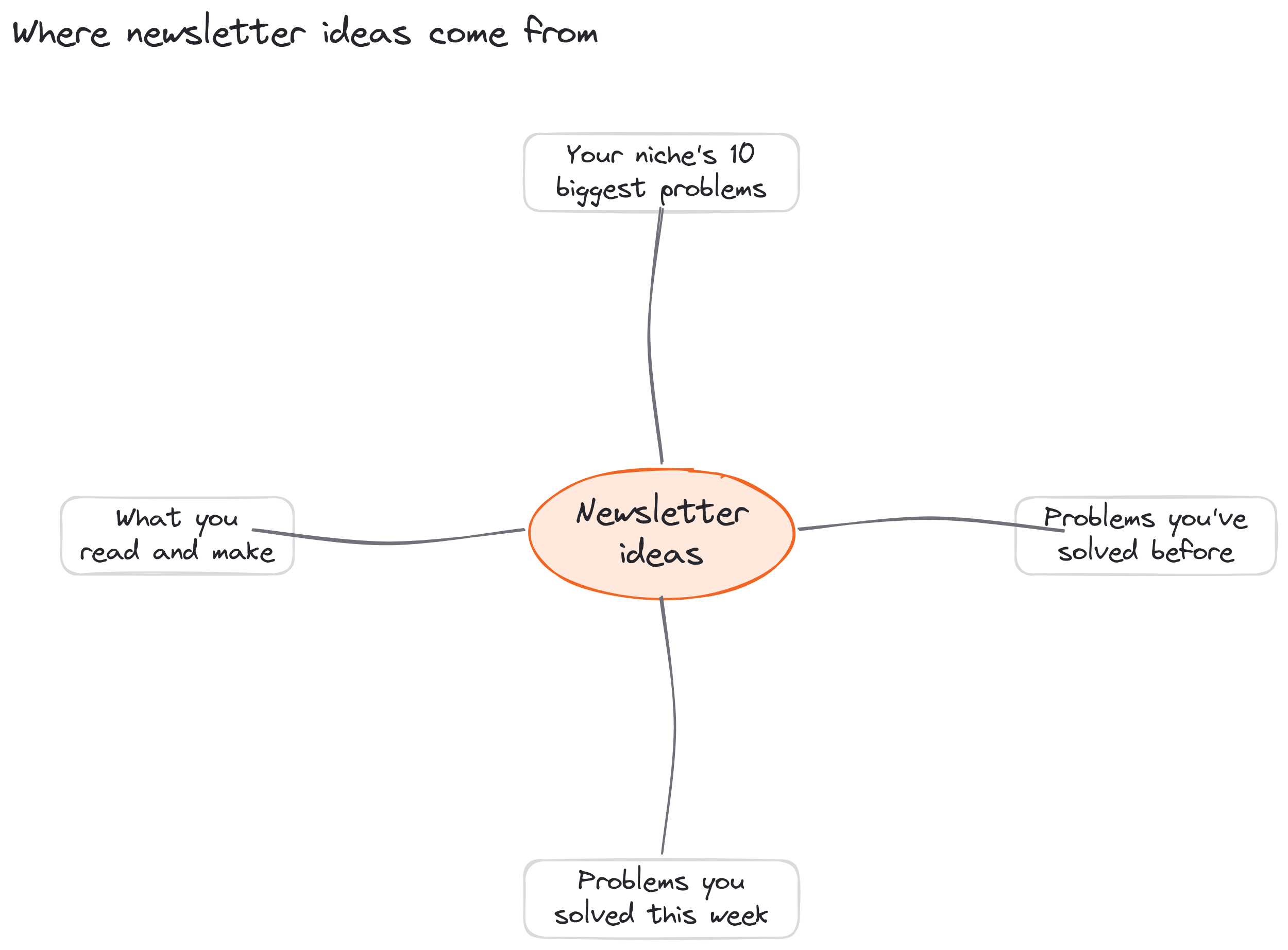
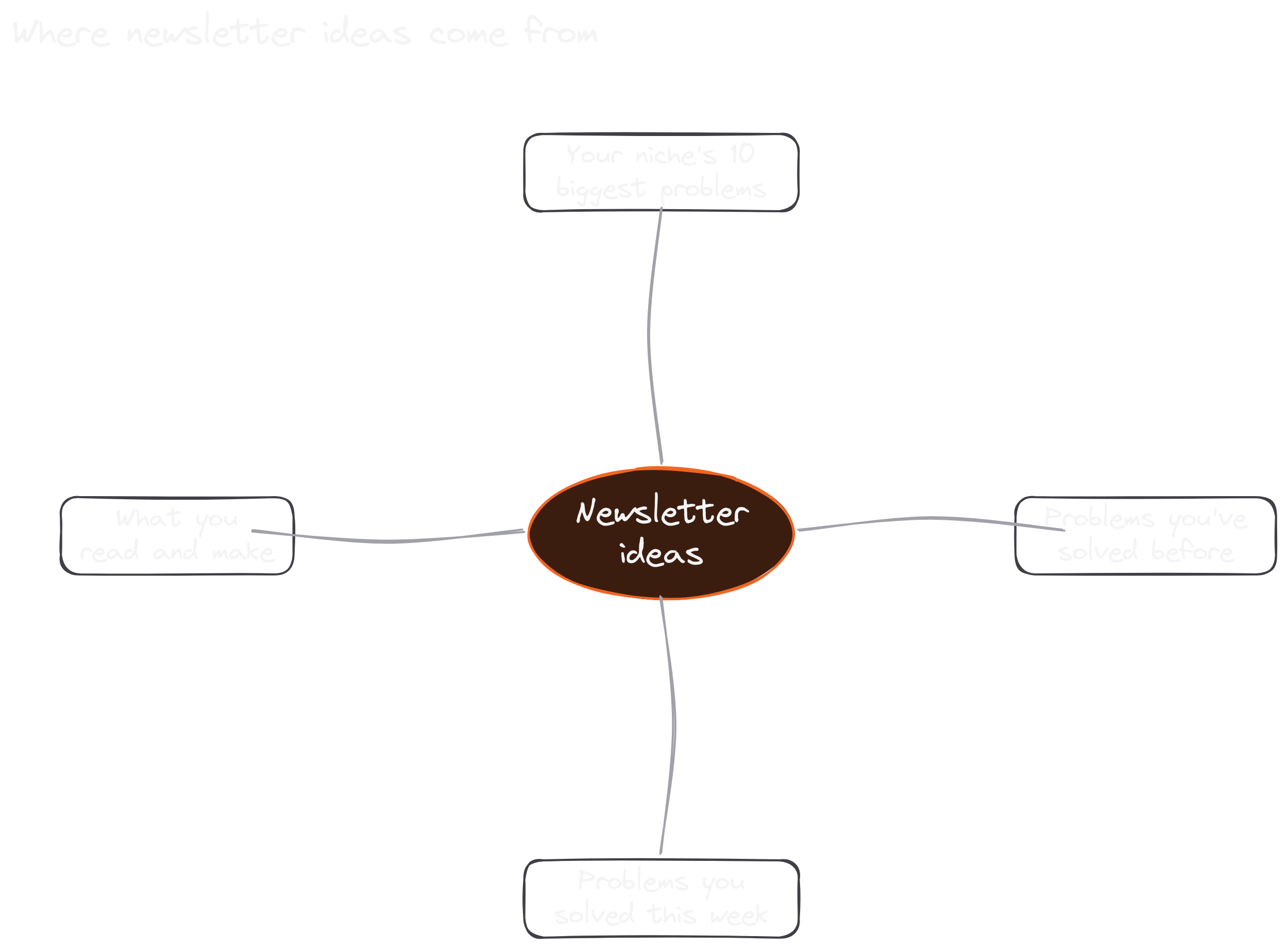
From the 10 biggest problems in your niche
Start Writing Online has run twice a week for 5 years on one list: the 10 most common problems beginner writers face. Write yours down, then turn each one into an issue:
- The mistakes issue. "3 mistakes every new [your reader] makes with [the problem]," and what to do instead.
- The one-fix issue. One problem, solved step by step, from start to finish.
- The FAQ issue. The question you get asked most, answered in full, so you can send the link next time.
- The myth issue. Something your niche believes that isn't true, and what works better.
From problems you've solved
Every struggle you had while you got good at your work is a problem someone else has right now. Don't underestimate how useful it would have been to know what you know now back when you started:
- The day-one letter. What you'd tell yourself on your first day in this field.
- The before and after. What your work looked like then, what it looks like now and what changed.
- The lessons issue. "7 lessons from [N] years of [your work]."
- The post-mortem. Something that failed, why it failed and what you'd do differently.
- The stack. The tools you use and why, down to the settings.
From problems you solved this week
This is the source I use most. Every Sunday, open last week's calendar and to-do list. For each meeting and task, ask: would someone else want to know how I solved this?
- The weekly fix. One problem you hit this week and how you got past it.
- The numbers breakdown. A real number that changed (a sign-up rate, a price, a deadline) and what you did about it.
- The experiment. Something you're trying, and what happened. (Mine right now: no phone for the first hour of the day.)
- The launch breakdown. How you shipped something, with the plan you followed.
From what you read and make
Some weeks the best issue is a recommendation or a tool the reader can use today:
- The roundup. The best things you wrote, read, listened to and learned this week. (This was my first newsletter's whole format.)
- The teardown. Someone else's post, launch or email, broken down line by line.
- The guest issue. Hand the issue to someone in your niche who solved a problem your readers have.
- The asset issue. A prompt, template or checklist the reader can copy. Write With AI is built on this: every prompt or workflow we use to write is an issue.
- The expanded post. Take your best short post of the month and give it the full treatment.
- The reader question. Answer one reply you got last week, by name if they're happy for you to use it.
Pick 10, and you've planned your first 10 weeks.
That's where newsletter ideas come from.
Step #1: Start A Newsletter With A Name Strangers Can Find
Your newsletter's name decides more of its growth than anything you write in it.
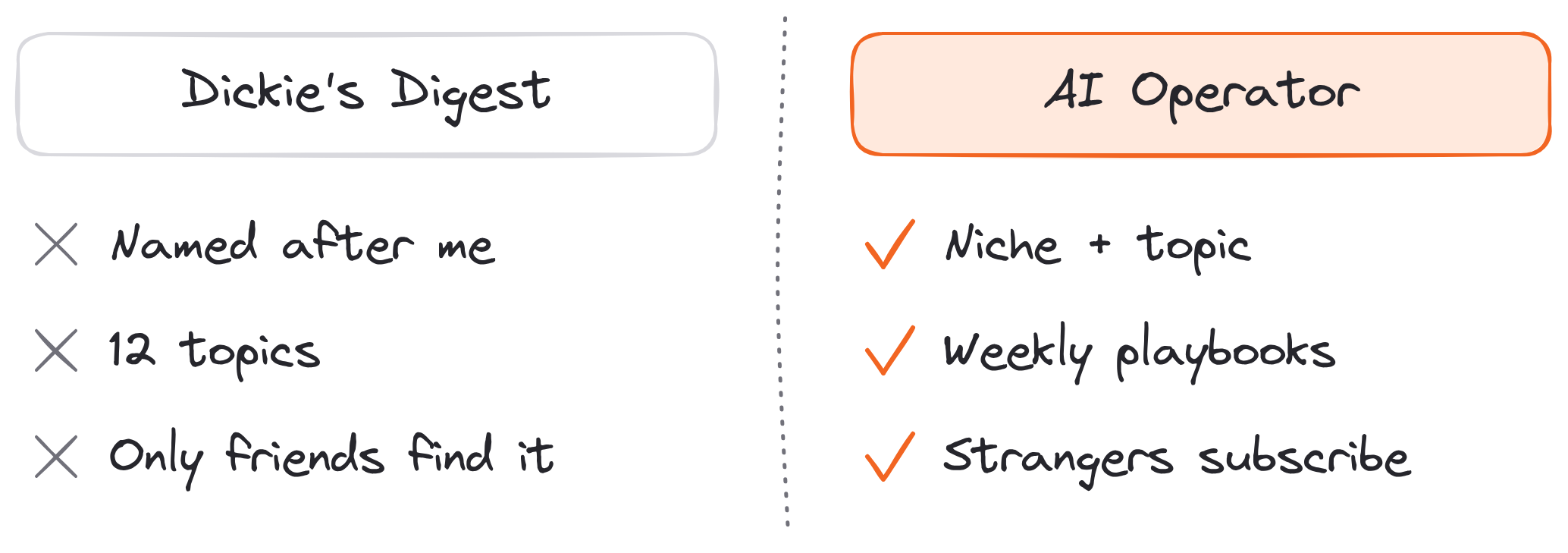
Pick the right one and growth takes care of itself. Pick the wrong one and you'll climb uphill for as long as you write it. I know because I picked the wrong one. My first newsletter is called Dickie's Digest. Its subtitle hasn't changed since 2020: "Every week I share a recap of the best things I wrote, read, listened to, and learned." It did its job: it gave me a place to practice. But it makes all three of the naming mistakes I see most often:
- Naming it after yourself. Only people who already know you will subscribe. A stranger scrolling past "Dickie's Digest" has no idea what it is.
- Going too broad. When you write for everyone, you end up writing for no one. Mine covered (no joke) 12 different topics.
- Being clever. A pun you love in the mirror means nothing to someone deciding in 2 seconds whether your newsletter is for them.
So when I started a new newsletter in 2026, I used a formula:
- Main title = niche + topic. The more obvious, the better.
- Subtitle = the tangible thing you deliver, how often, and who it's for.
The new one is called AI Operator. Its subtitle reads: "Weekly Playbooks & SOPs from inside a $25m internet business portfolio — steal it, install it, run leaner by Friday." A reader knows what they get (playbooks), how often (weekly), why to trust it (it comes from a real business) and what happens next (they run leaner by Friday). Write With AI follows the same rule, and it's become a top education newsletter on Substack.
Here's the test: could someone read your title and subtitle in 5 seconds and know whether it's for them?
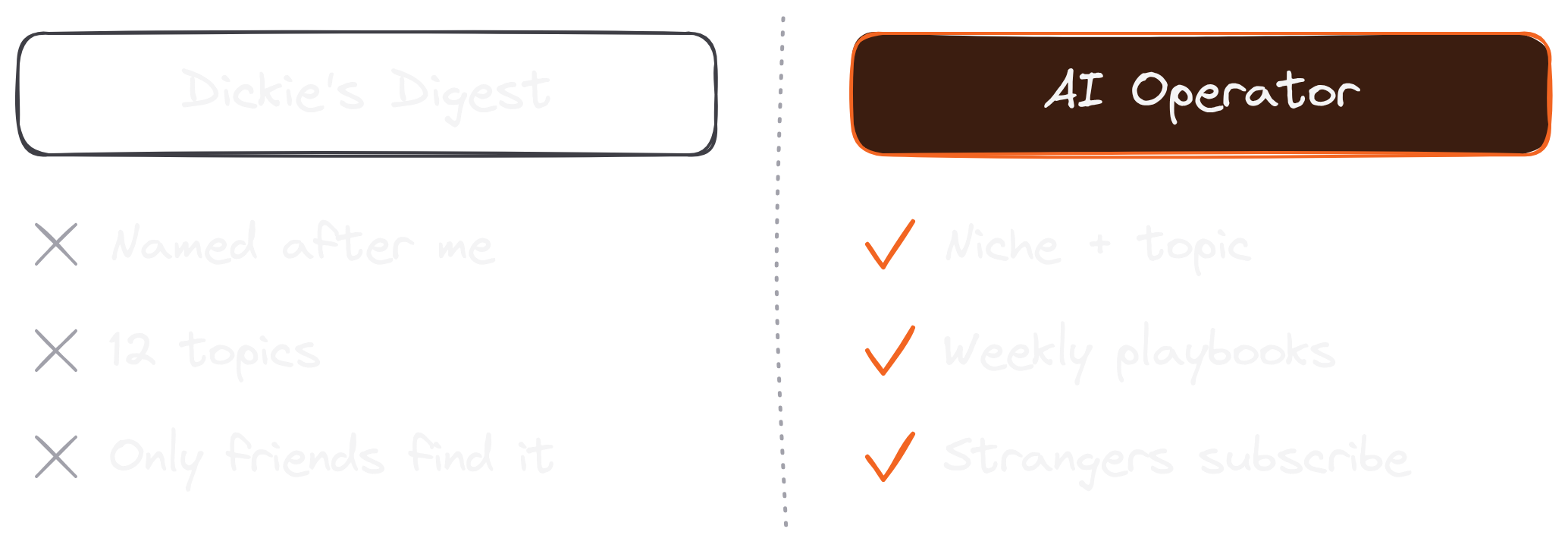
If the answer is yes, you've started a newsletter people can find.
Step #2: Create A Newsletter Offer Readers Remember
Your newsletter is the delivery mechanism.
The product is what changes for the reader: the problem you solve, the outcome you unlock and the tangible thing you hand them each week. If you never tell people what that is, they won't subscribe. Or worse, they'll subscribe and forget why.
That's what an offer does. Write it once, in two or three sentences, then repeat it everywhere a new reader meets you. On Substack, that's four places:
- A welcome post, pinned to the top. It's your newsletter's home page. Say who it's for, the 10 biggest problems you solve, what you deliver every week and who you are. Then point to your best posts and tell readers what to do next.
- Your About page. Same text as the welcome post. Copy and paste it, because some visitors click About first.
- Your welcome email. It's the most-opened email you'll ever send, and most writers leave it on Substack's default. Welcome them, say what to expect and when, and give them one next step.
- A short line at the top of every issue. One paragraph, every week: what this is, who it's for and where to subscribe if someone forwarded it.
I'll admit I got all four wrong with Dickie's Digest. It has no welcome post, the About page hasn't changed since 2020 and the welcome email is a copy of the About page, which means thousands of views a month with no clear reason to stay. For AI Operator, the line at the top of every issue reads: "AI Operator is the weekly newsletter for integrating AI into every vertical of your internet business — one SOP, system, or honest breakdown every Tuesday that you can steal, install, and run by Friday."
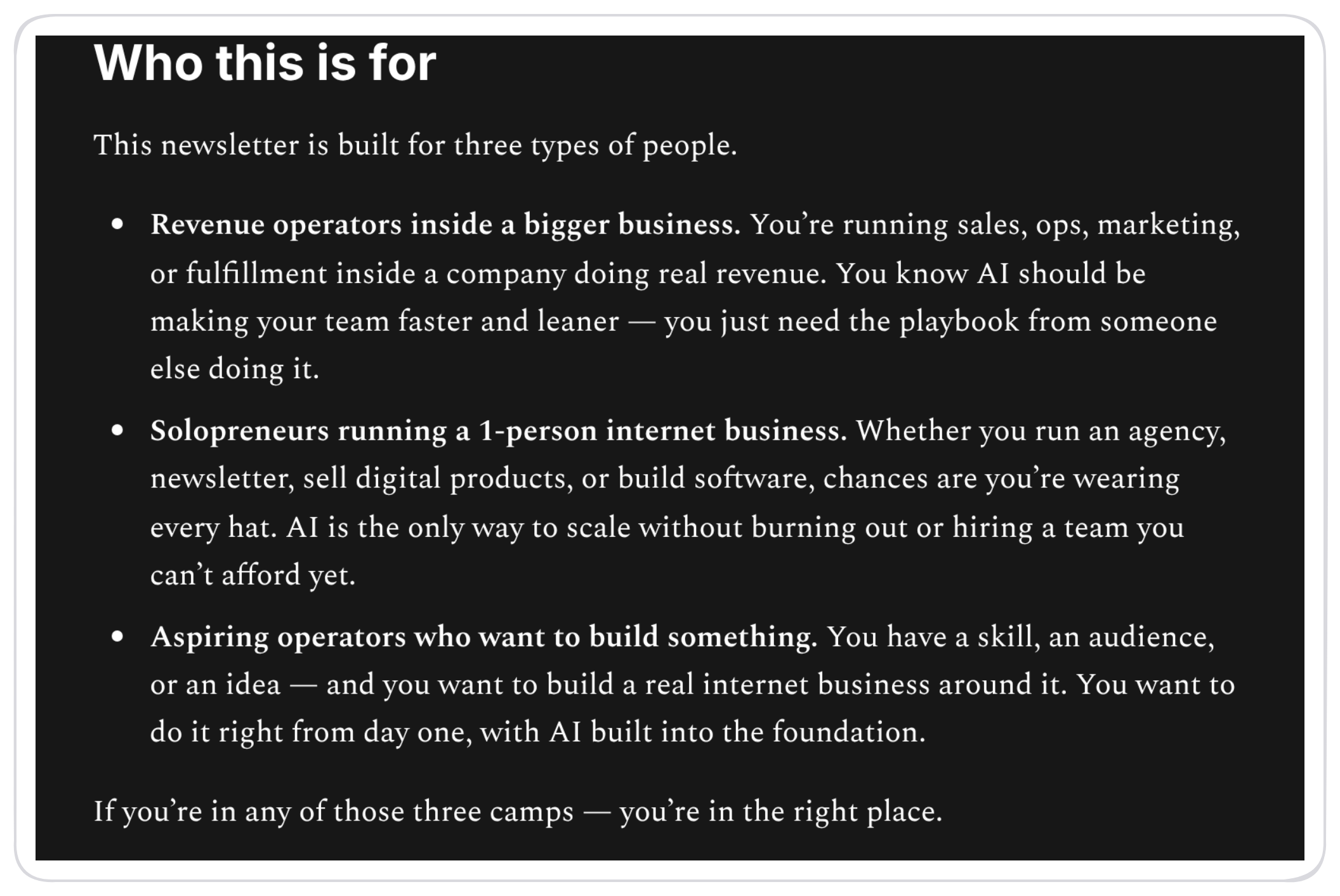
Same offer, four places, every week.
That's how you create a newsletter readers remember.
Step #3: Write A Newsletter Issue With The PISA Framework
What do you do once you've picked an idea and opened the blank draft?
You need a shape you can reuse every week, so you're never deciding how to write and what to write at the same time. The one I use is PISA. It has four parts, and every issue follows them in order:
- Problem. Start with a moment where the reader feels the problem. Describe the surface problem and the frustration underneath it.
- Insight. The "aha": why the problem happens, or the mistake that causes it.
- Solution. The fix, one step at a time.
- Asset. Something the reader can use right away to put the solution to work: a checklist, a prompt, a template.
Here's the first issue of AI Operator, outlined with PISA in about five minutes:
- Title: How To Generate Endless Business Content Ideas
- Problem: Every week I sit down to write a newsletter and stare at a blank screen.
- Insight: I have plenty of ideas. They're hiding in the problems I've already solved.
- Solution: Every Sunday, go through last week's calendar and ask of each meeting and task: would someone want to know how I solved this?
- Asset: An AI prompt that interviews you on what you solved this week and outlines the most useful one with PISA.
Notice that the issue is about idea #10 from the list above. That's the point: the list gives you the topic, and PISA gives you the shape. Do it 10 times, one for each idea you picked, and your first 10 issues are outlined before you've written a full sentence. (If your sentences come out stiff, our writing tips for beginners help with the drafting.)


Problem, insight, solution, asset.
That's how you write a newsletter, every week.
Step #4: Pick Your Newsletter Maker (And Don't Overthink It)
Picking a platform is the most common way to put off writing your first issue.
When I started in 2020, there weren't many options. Today there's Substack, Kit, Ghost, Brevo, beehiiv, MailerLite, Mailchimp and plenty more. Every email newsletter company has its fans. All of them can work. Every newsletter maker does the same three things at its core. It sends your issues by email, hosts them on a simple website and gives new readers some way to find you.
For a beginner, I recommend Substack, for three reasons:
- It's free. Substack has no upfront costs, no monthly fees and no subscriber limits on the free tier. It only takes 10% if you charge, and writers keep 90% minus card fees.
- It takes under 30 minutes to set up. You can publish your first issue the same day, with no technical skills.
- Its network finds you readers. Substack Notes, its short-form feed, puts a subscribe button one click from every post. Over 60% of our subscribers now come from inside Substack. In 2024 and 2025 I sent only 10 issues of Dickie's Digest. But I posted on Notes every day, and that alone brought in 10,000 subscribers.
(I'm not paid by Substack. If you already have a list somewhere else, stay there. The right platform is the one that gets you writing this week.)
One more piece of the setup: where you write. You can draft your issues in Typeshare's Long Form editor and publish them to Substack from there. You can post now, schedule an issue for later or send it to your Substack drafts, and choose whether it's emailed to subscribers. The Substack page shows how it works.
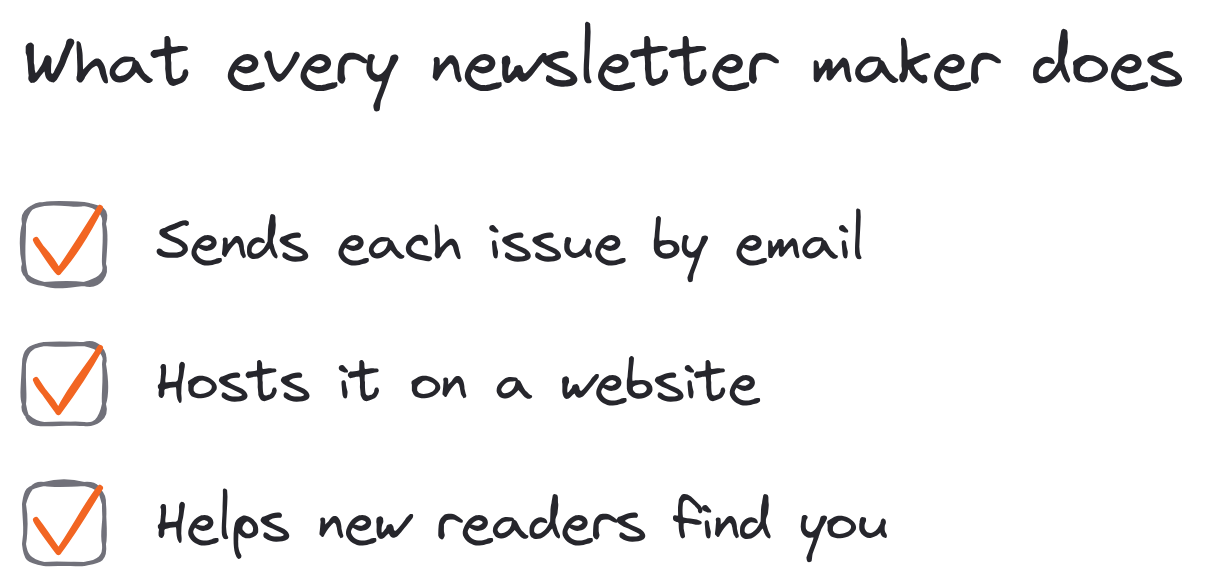
Pick one this afternoon and move on.
That's how you choose a newsletter maker.
Step #5: Make An Email Newsletter Every Week For 52 Weeks
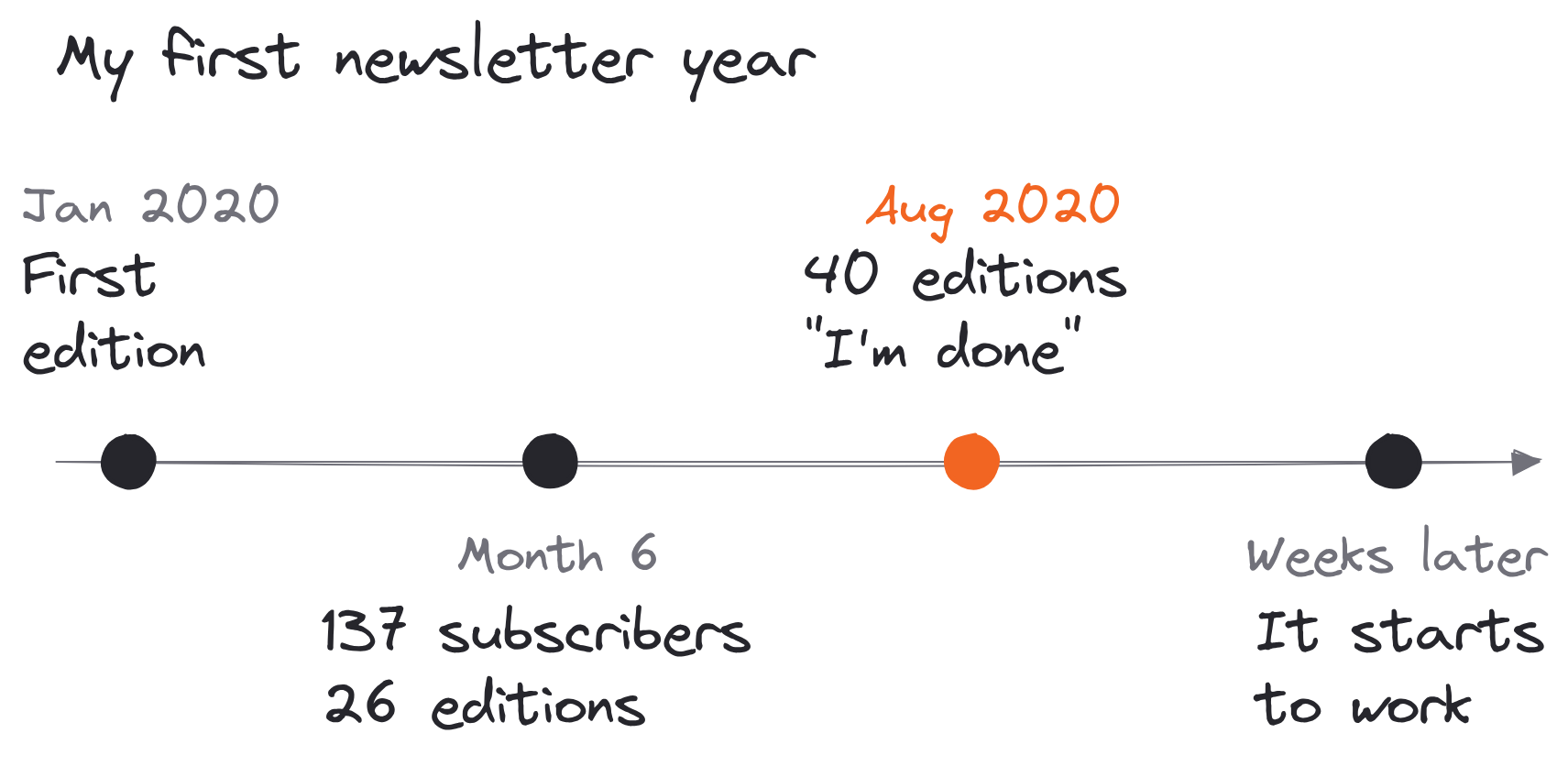
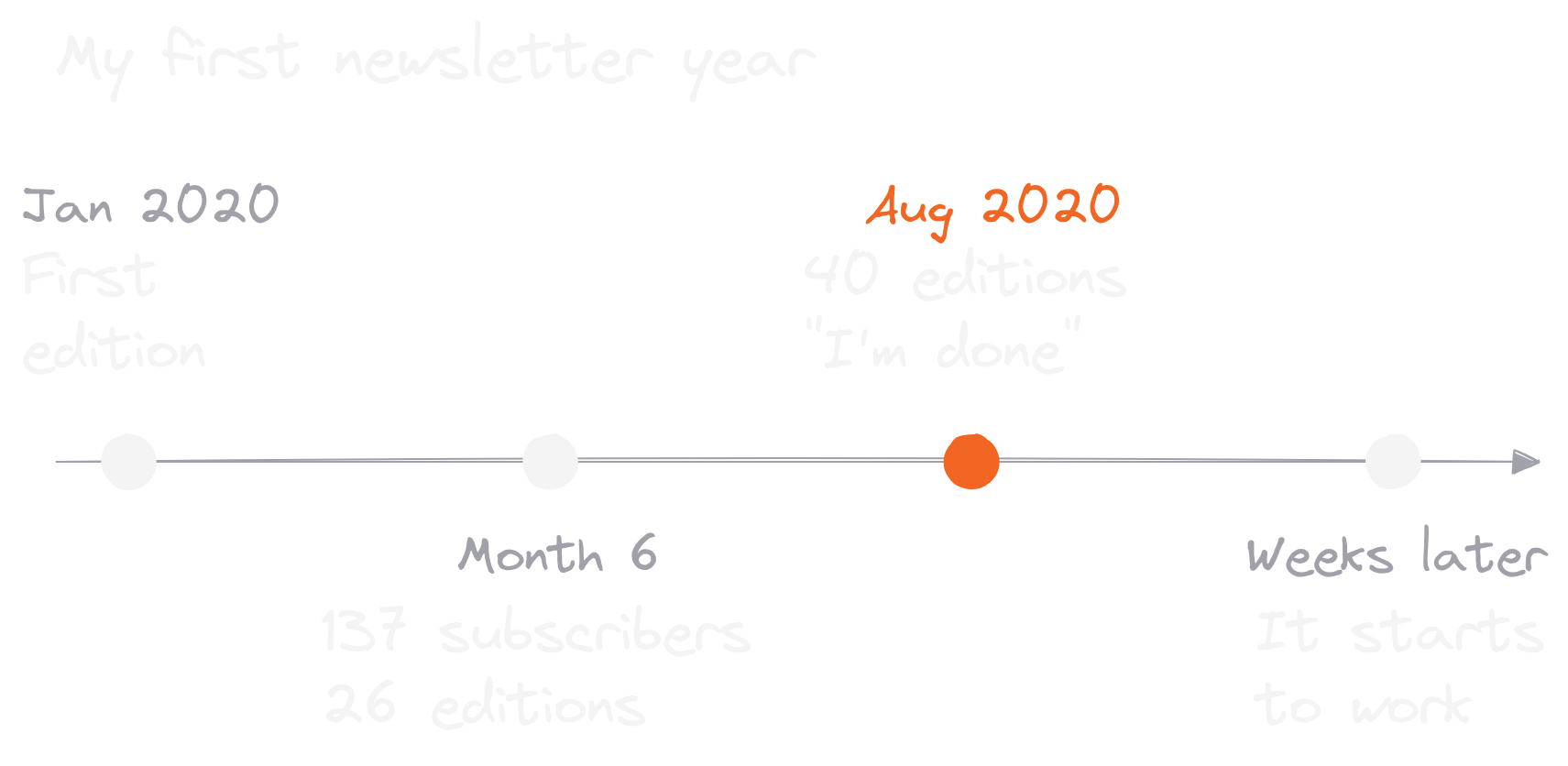
In August 2020, I almost quit.
I was 8 months into my weekly newsletter and 40 editions deep, and I'd barely cracked 200 subscribers. At the 6-month mark I had 137 subscribers after 26 editions. That's about 5 new subscribers per issue, or fewer than 1 a day. I couldn't help thinking the whole thing was a waste of time. But at the start of that year I'd made myself a promise: one newsletter a week for 52 weeks, no matter what. A few weeks later, things started to work, and the chart has climbed ever since.
That promise is the real step five. If you write a newsletter every week for 52 weeks, one of two things happens. In the worst case, you have no readers but 52 published pieces that sharpened your thinking. In the best case, you have loyal readers who see you as someone who makes their life better.
Both are worth a year.
You'll still want to quit at some point, so here are the reframes that kept me going (and still do):
- You get to practice in an empty gym. No one reads your first 20 newsletters. That's your advantage: you get the reps without the pressure.
- Think in percentages. Going from 10 subscribers to 100 means 10 times as many readers. Celebrate it that way.
- Progress over perfection. You'll look back on your early issues and laugh at how bad they are. That's how it's supposed to go.
- No one is thinking about you as much as you think. The wave of criticism you're bracing for never comes, because everyone's busy with their own life.
- Don't compare your step 1 to someone else's step 9. Find out what they did at your stage, and model that.
A weekly newsletter also pays you back in places you don't expect. It forces you to clarify your thinking on one topic, and every issue becomes a library you can reuse, including as posts on other platforms. Typeshare can even turn your newsletter into LinkedIn posts and tweets in your own words.
So when I started AI Operator, I made the same promise: publish every Tuesday for at least 12 months before judging it.
That's how you make an email newsletter last.
FAQ
How do you start an email newsletter?
Name it like a category (Step #1) and write a short offer (Step #2). Then choose a platform such as Substack (Step #4) and publish your first issue the same week. You can start before you have a single subscriber.
How often should you send a newsletter?
Once a week is the best place to start. It's often enough that readers remember you and rare enough that you can keep it up for a year. Pick a day and send on that day every week.
How long should a newsletter be?
Long enough to solve one problem, and no longer. A short issue that solves a problem beats a long one that doesn't, so write the four parts of PISA and stop.
What is the best email newsletter company for beginners?
Any of the big ones work (Substack, Kit, Ghost, beehiiv, Mailchimp). Substack is the easiest to start on, because it's free until you charge and its network sends you readers.
How do you make a newsletter email from posts you've already written?
Take your best short post from the month and expand it with the PISA framework (idea #18). It works the other way too: Typeshare can turn each issue into posts for X, LinkedIn, Threads and Substack Notes.