15 Signs Of AI Writing That Make Readers Scroll Past (And How To Make Your Writing Sound Less Like AI)
Nicolas ColeNovember 11, 2026
The 15 signs of AI writing readers spot in seconds, why AI detectors flag human writing too, and a 6-step edit that makes your draft sound like you again.
You can feel it by the second sentence.
A post opens with "In today's fast-paced digital landscape," and your thumb is already moving. Nobody wrote that line on purpose. A language model wrote it, the writer pasted it, and now every reader who has spent a year online can spot it from across the room.
How do I know what these signs of AI writing look like? Over the past 10 years, I've written and ghostwritten thousands of pieces online: tens of thousands of tweets, thousands of newsletters, thousands of articles and a dozen books. That's a lot of pattern recognition, and the patterns below are the ones I see most in drafts that come back from AI.
Below are the 15 signs, grouped by words, sentences and structure. After that: how to spot AI writing fast, why AI detectors flag human writing too, and how to make your writing sound less like AI. If you want the basics first, read how to write better and find your tone of voice. And if you'd rather write with AI that starts from your own ideas, try Typeshare: you do the writing; the robots do the rest.
Signs #1-#5: Word Signs Of AI Writing
The fastest tell is the vocabulary.
Language models reach for the same words because those words show up everywhere in what they were trained on. Wikipedia's editors keep a field guide, Signs of AI writing, and its word list reads like the first paragraph of every AI-written blog post. Here are the five word-level signs I flag most:
Sign #1: AI Vocabulary
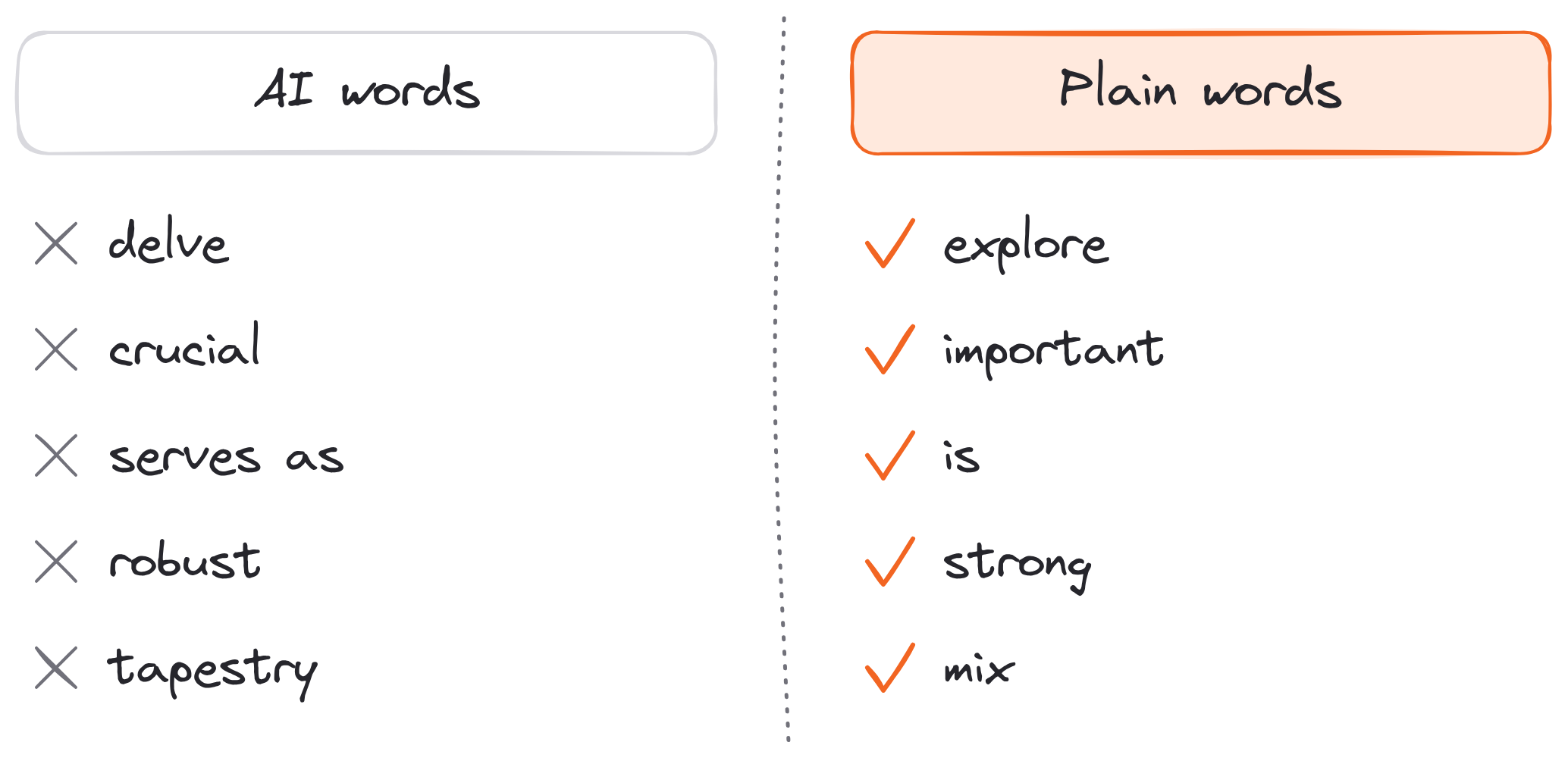
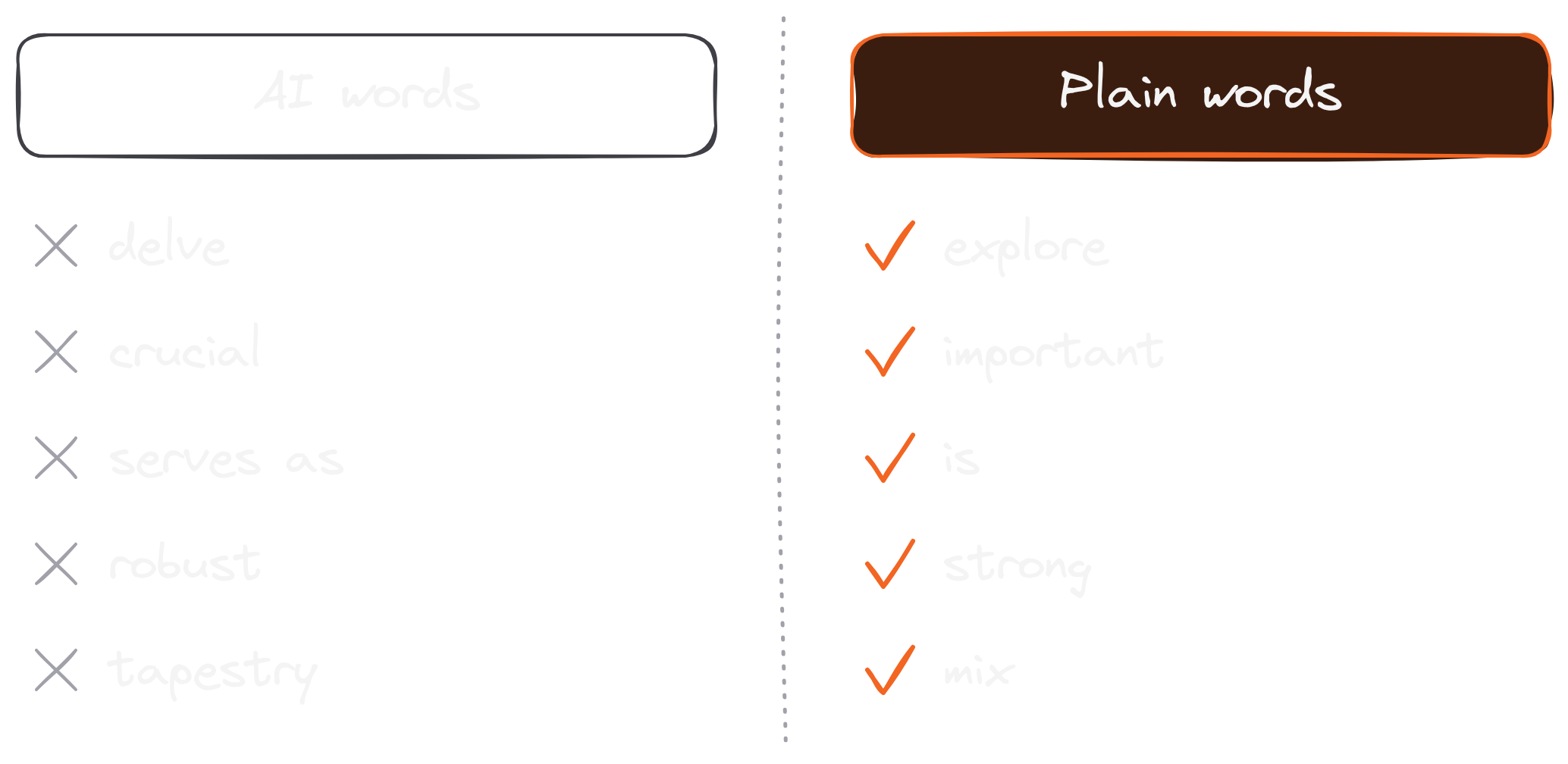
Delve, tapestry, realm, landscape, crucial, robust, pivotal, foster, navigate, seamless. One of these in an article is a coincidence. Five in a paragraph is a fingerprint. Swap each for the plain word you'd say out loud: explore, mix, area, field, important, strong.
Sign #2: Puffery
"Stands as a testament to." "Plays a vital role in." "Leaves a lasting impact." These phrases inflate a claim without adding a fact. Replace each one with the specific thing that makes the subject matter: a number, a name, a result.
Sign #3: "Serves As" Where "Is" Would Do
AI avoids the word "is." It writes "serves as," "functions as," "boasts" and "features" instead. "The newsletter serves as a hub for creators" is AI. "The newsletter is a weekly email for creators" is a person talking.
Sign #4: Throat-Clearing
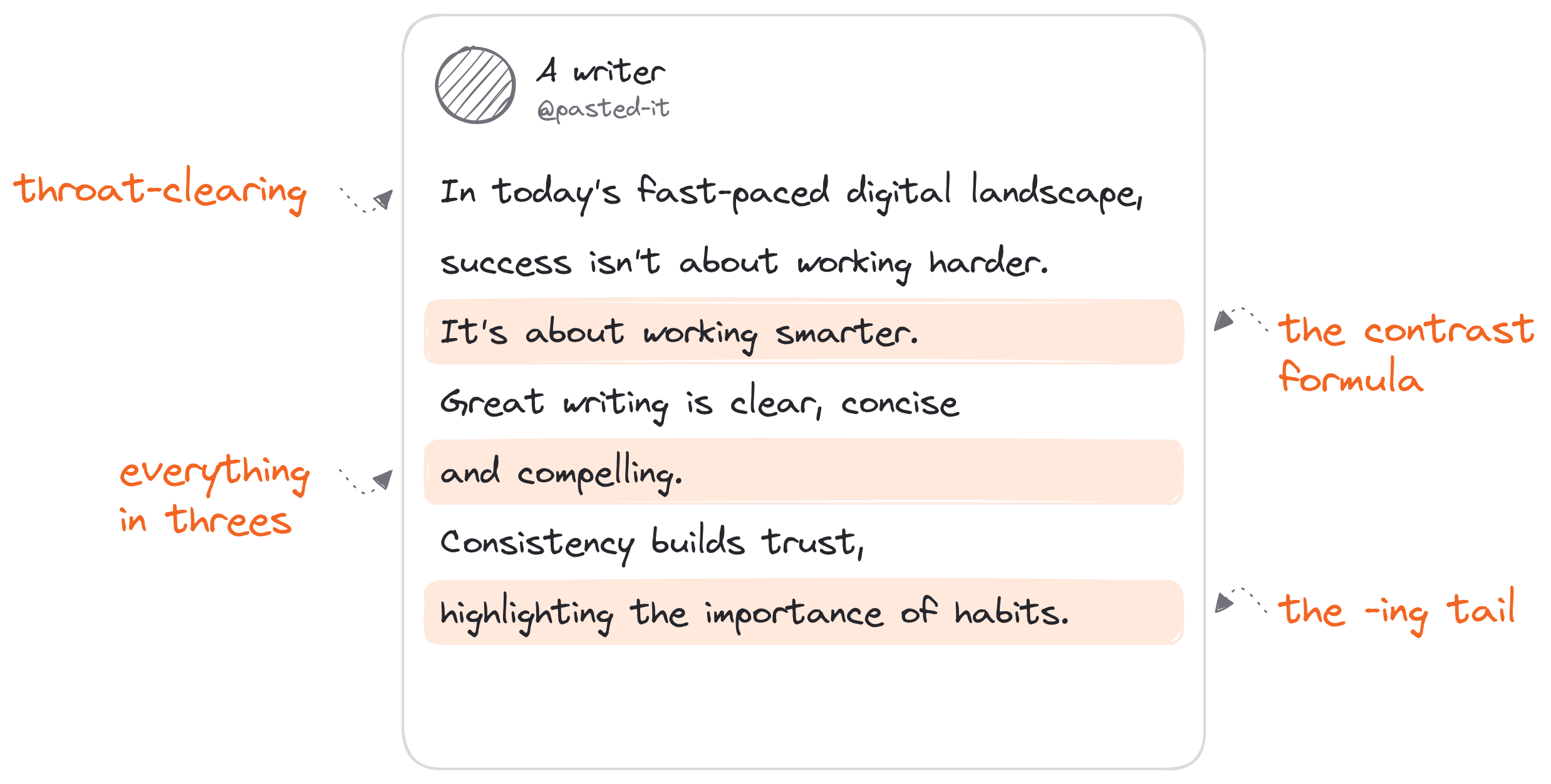
"It's important to note that." "In today's fast-paced world." "When it comes to." These openers announce a point and delay it. Delete them and start with the point.
Sign #5: Chatbot Leftovers
"Great question!" "I hope this helps." "Certainly! Here's a LinkedIn post about…" The laziest sign of all is text that was written for a chat window and pasted straight into a post.
Each word on its own proves nothing. Stacked together, they tell the reader nobody edited the draft.
Those are the word signs of AI writing.
Signs #6-#10: Sentence Signs Of AI Writing
Swap out every AI word and a draft can still sound like a machine, because of how the sentences are built.
Sign #6: The Contrast Formula
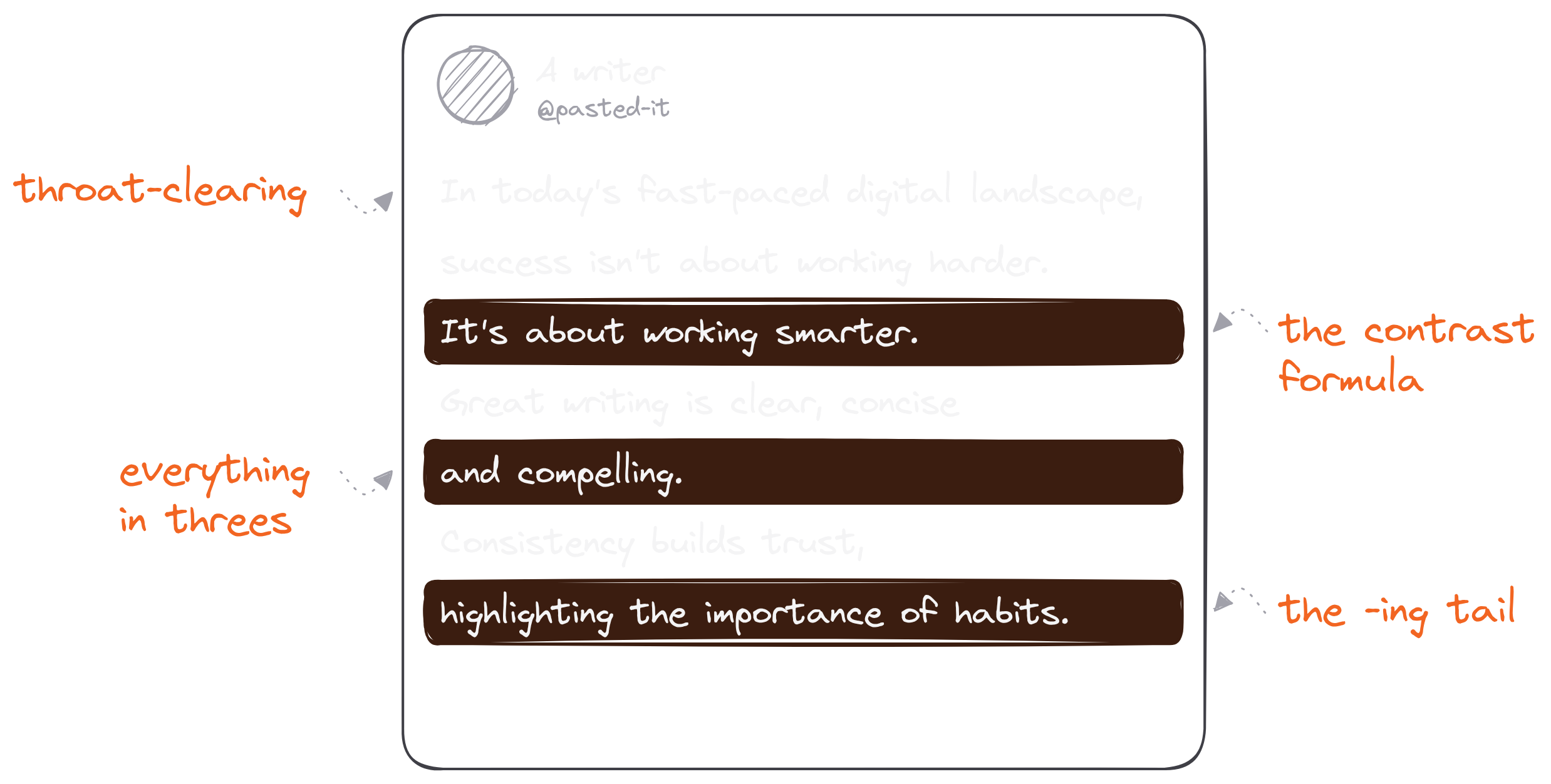
"It's not about the money. It's about the freedom." "This isn't a tool. It's a revolution." AI defines things by what they aren't, over and over. Once you notice it, you'll see it all over your feed. State what the thing is, and let it stand on its own.
Sign #7: Everything Comes In Threes
"Fast, reliable and secure." "Clear, concise and compelling." Three adjectives in a row is the model filling a rhythm, and each one is vaguer than the last. Keep the one that's true, or swap all three for a specific fact.
Sign #8: The "-ing" Tail
"Sales grew 20%, highlighting the importance of customer focus." The fact comes first, then a participle tacks on an analysis nobody asked for. Cut the tail, or turn it into its own sentence with an actual claim in it.
Sign #9: Em Dashes Everywhere
The em dash is a fine piece of punctuation. AI uses it three times a paragraph to fake drama ("The answer was simple — and it changed everything"). Wikipedia's guide lists heavy em dash use among its signs. Use commas, colons or a full stop instead, and keep the dash for when you need it.
Sign #10: Every Sentence The Same Length
Read an AI paragraph out loud and you'll hear it: medium sentence, medium sentence, medium sentence. Human writing has rhythm. Short sentences land a point. Longer ones carry the reader through an idea, building as they go, until a short one closes it.
None of these sentence shapes is wrong once. The tell is the repetition: the same five moves, used in the same order, in every post.
Those are the sentence signs of AI writing.
Signs #11-#15: Structure Signs Of AI Writing
The last five signs live in how the whole piece is put together.
Sign #11: The Summary Ending
"In conclusion." "Overall." "Ultimately." AI ends paragraphs and articles by repeating what it said. A human writer ends on the most important new thing, or just stops.
Sign #12: "Challenges And Future Prospects"
You'll know this one from a hundred AI-written explainers: three paragraphs of praise, a paragraph that starts "Despite its success, X faces challenges," and a closing line about how "the future looks promising." It's a template, and readers can feel the template.
Sign #13: Vague Experts
"Experts agree." "Studies show." "Many believe." AI leans on unnamed sources because it rarely knows the real ones. A human writer names the study, links it, or says what they saw with their own eyes.
Sign #14: No Specifics At All
This is the biggest sign of AI writing, and the hardest to fix with an edit. When I ghostwrote for Silicon Valley founders starting in 2016, two clients in the same industry would both tell me "the key to marketing is knowing your customer." Anyone could have said that sentence, so it belongs to no one. I call it Commodity Content, and as I put it in the right way to write with AI, large language models are Commodity Content machines. When people point at a piece of writing and call it "AI slop," Commodity Content is what they're spotting.
Sign #15: Bold And Bullets Everywhere
A wall of bolded phrases and three-word bullets, with every second line a header. It looks organized, and it reads like a slide deck nobody presented. Bold a term once, when it's new, and save lists for real lists.
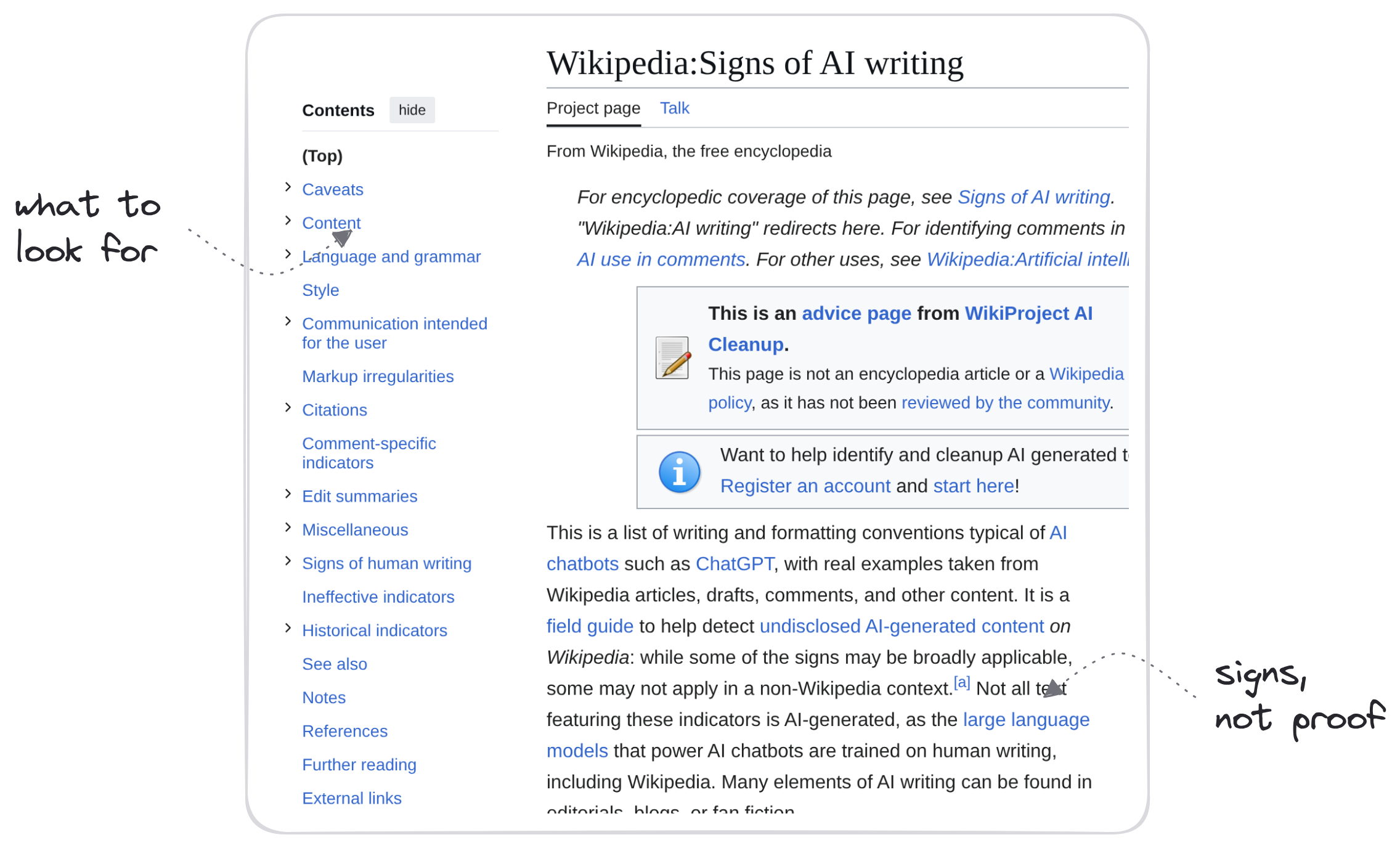
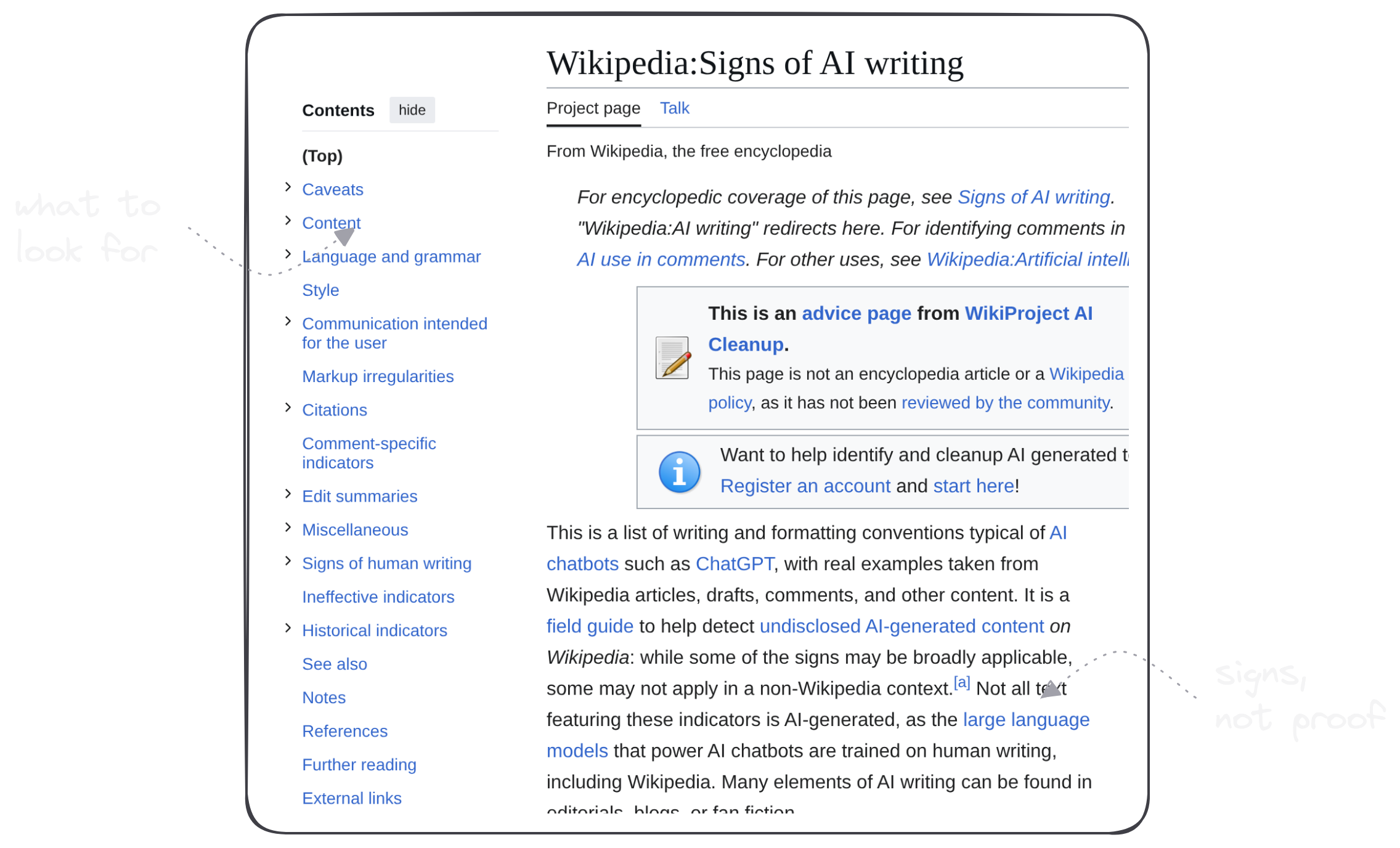
Wikipedia's editors put one caveat at the top of their own guide, and it applies to every list like this one: these are "only potential signs of a problem, not the problem itself." Plenty of humans write "in conclusion." What gives AI away is all of them at once, and nothing underneath.
Those are the structure signs of AI writing.
How To Spot AI Writing In 60 Seconds
All you need to spot AI writing is a minute and four questions.
- Does the first line say anything? "In today's world" and "Let's dive in" are filler. A human hook makes a claim or drops you into a moment.
- Is there one detail only this writer could know? A name, a number, a date, a mistake they made. AI can't invent your lived experience (or when it tries, it makes something up you can check).
- Count the tells. Run through the 15 signs above. One or two is a human with habits. Six or more in a short post means nobody edited the draft.
- Read it out loud. If every sentence is the same length and every paragraph ends on a summary, your ear will catch it before your eye does.
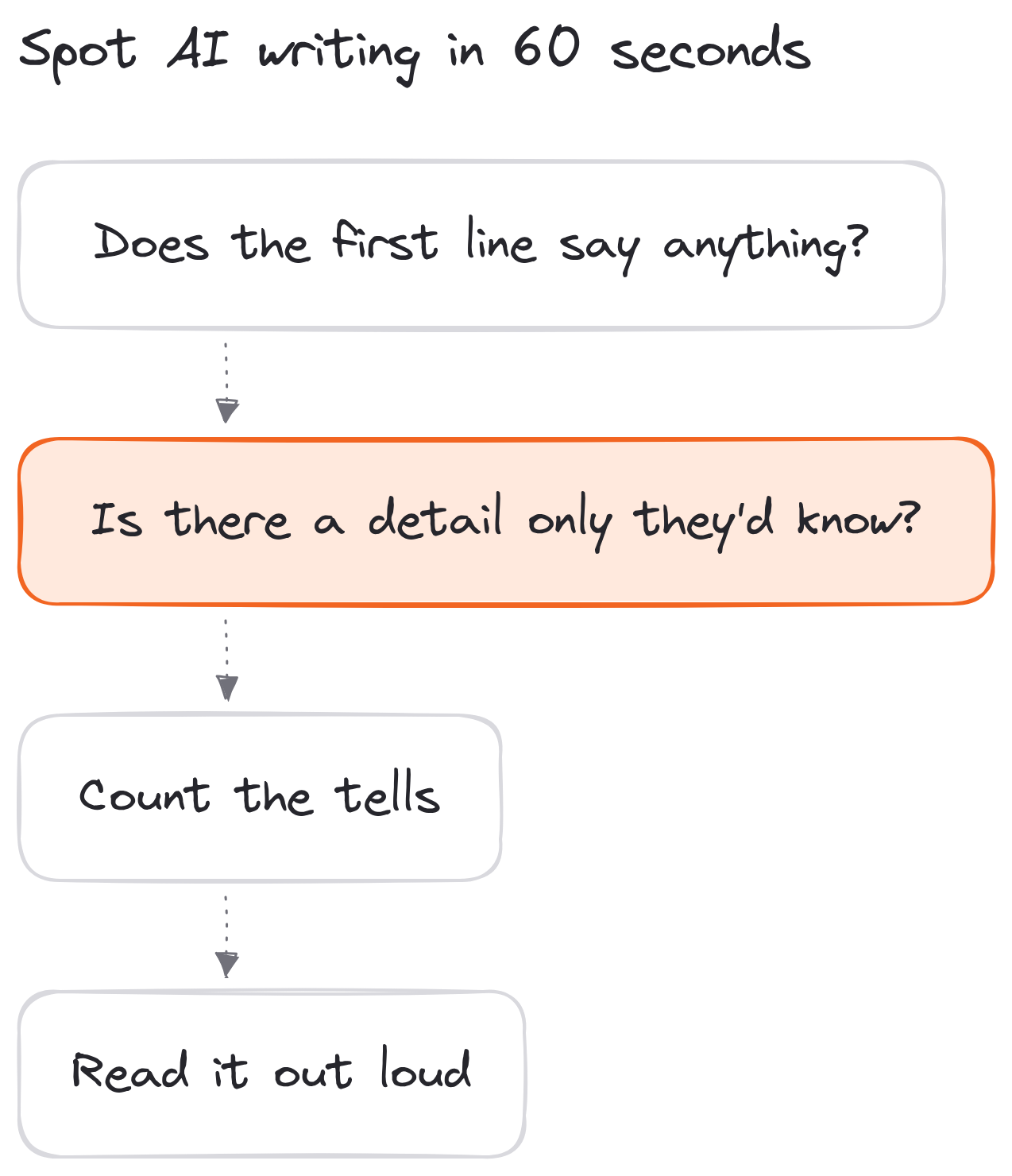
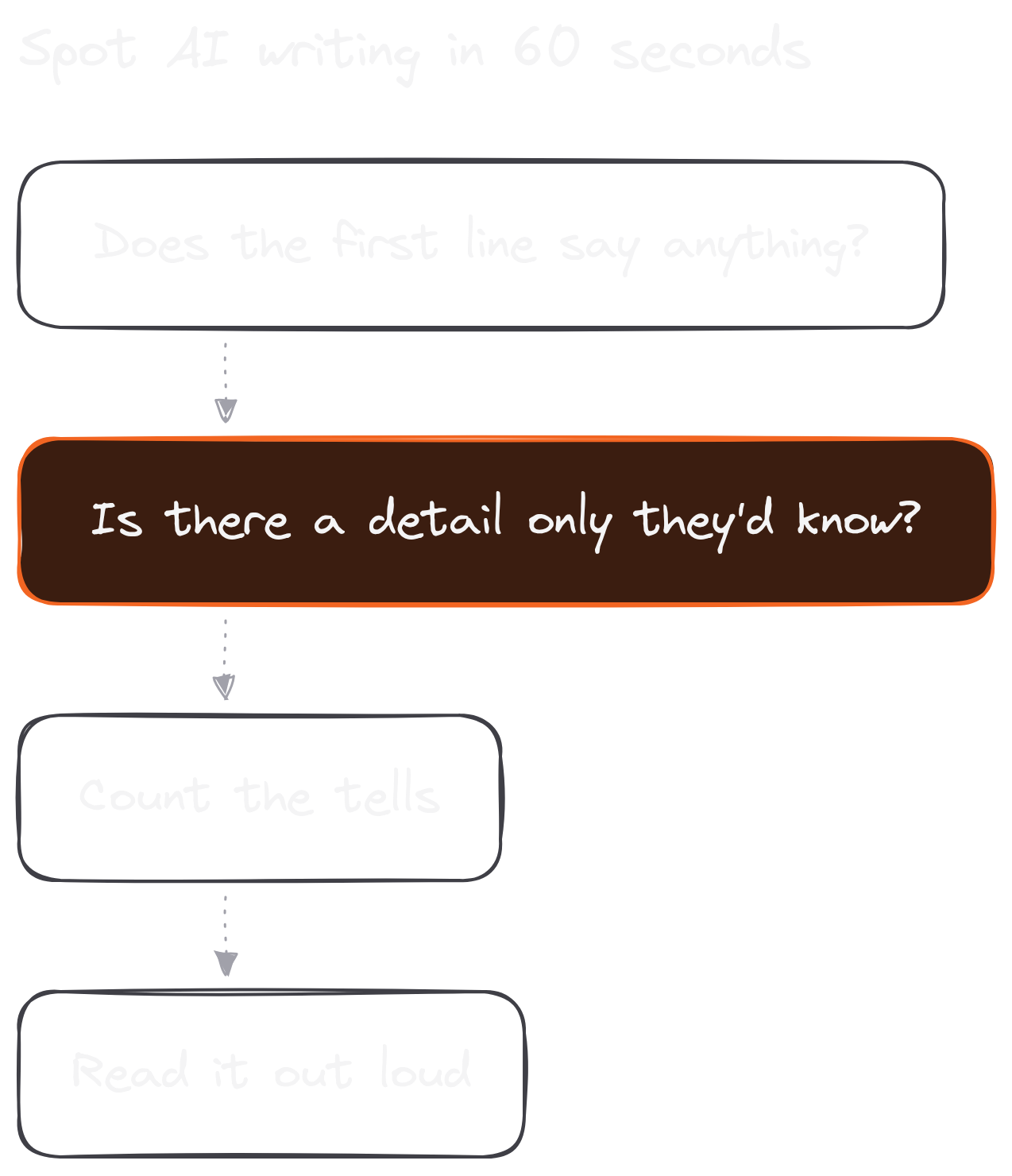
The second question does most of the work. A piece with real specifics can survive a few AI words. A piece with none can't be saved by swapping them out.
That's how to spot AI writing in 60 seconds.
Why Do AI Detectors Flag My Writing?
AI detectors flag human writing all the time, and the company that made ChatGPT gave up on its own.
OpenAI launched an AI text classifier in January 2023 and pulled it six months later. The note it left on the announcement said: "As of July 20, 2023, the AI classifier is no longer available due to its low rate of accuracy" (The Register). If the people who built the model couldn't reliably tell its writing from ours, be careful trusting a tool that says it can.
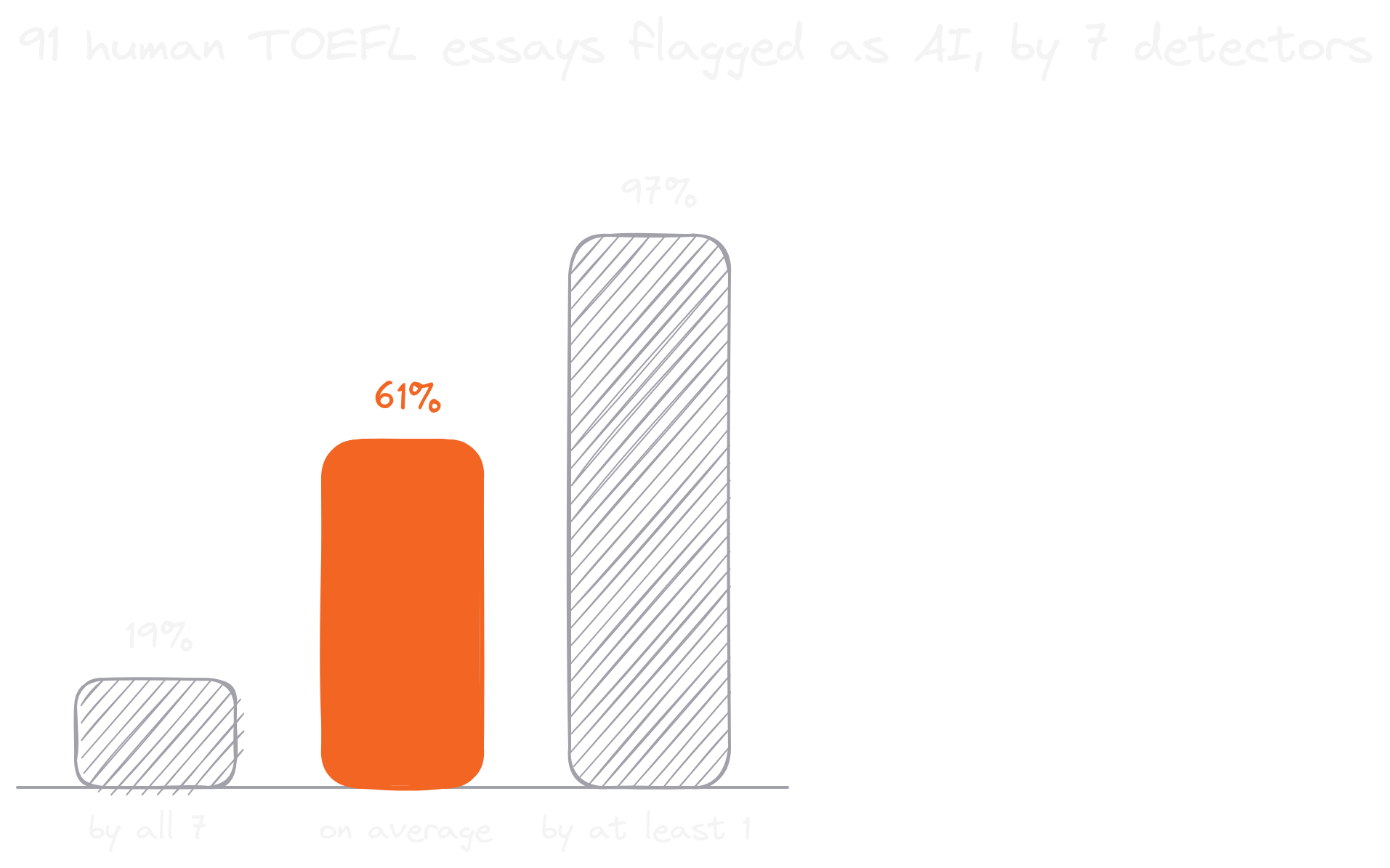
The detectors that are still around have a known blind spot. A Stanford team tested seven of them on two sets of essays. They were near-perfect on essays by US eighth-graders, but they labeled 61% of essays written by non-native English speakers for the TOEFL as AI-generated, and 97% of those essays were flagged by at least one detector.
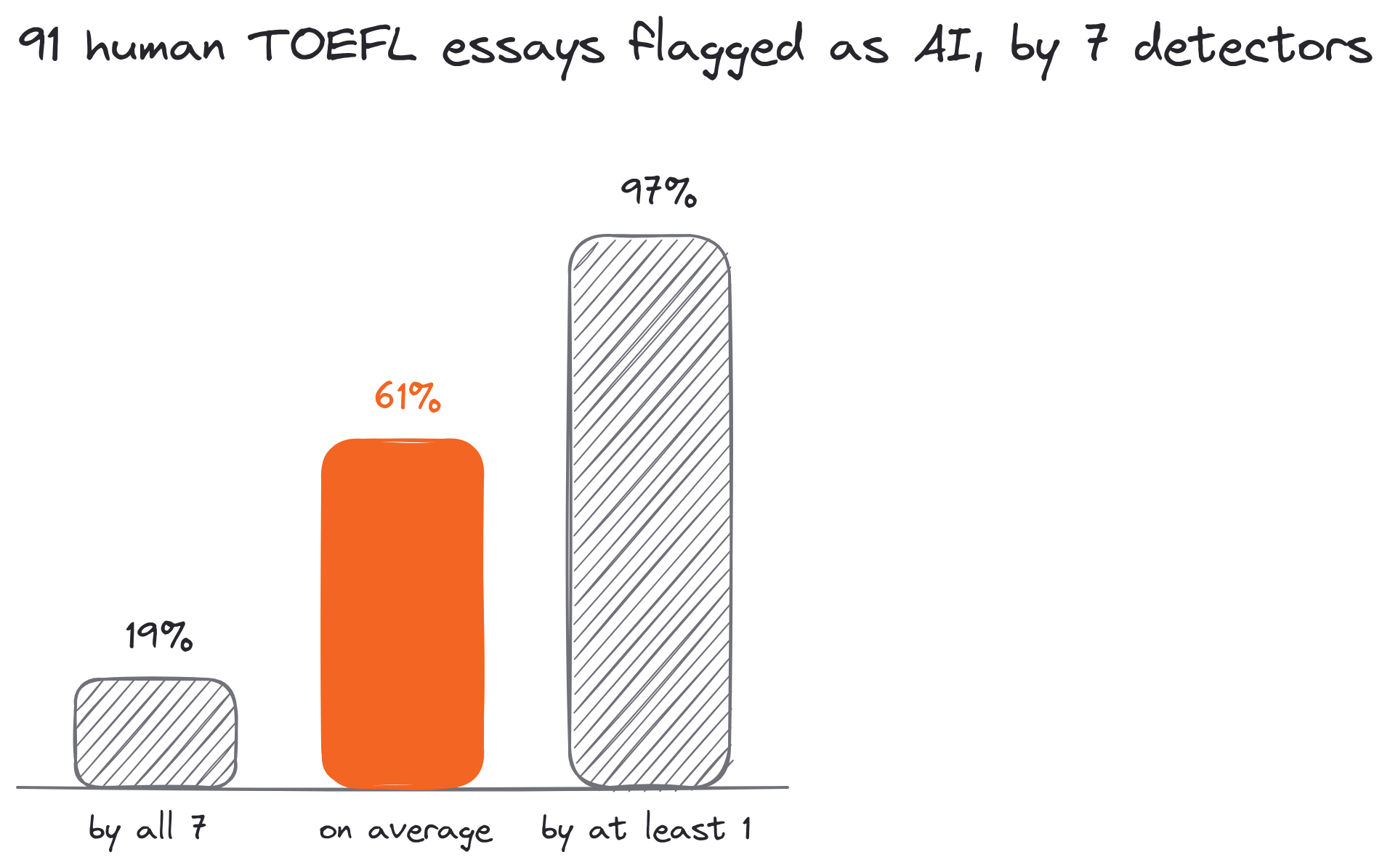
The reason is how detectors score text. Most use a measure called perplexity, which tracks how predictable your word choices are. Plain and predictable writing scores low, and low scores look like AI. So if you write clearly, use common words or write in your second language, a detector may flag your writing for the same habits a good editor would praise.
My bigger problem with detectors is what they do to our judgment. When we outsource our taste to an AI detector, we skip the part where we ask what's working in a piece of writing and what isn't. "It's flagged as AI, so it must be bad" skips the whole job of an editor. Read the piece, look for the 15 signs, and decide for yourself.
That's why AI detectors flag your writing.
How To Make Writing Sound Less Like AI
The fix starts before you edit a single word: write about what only you know.
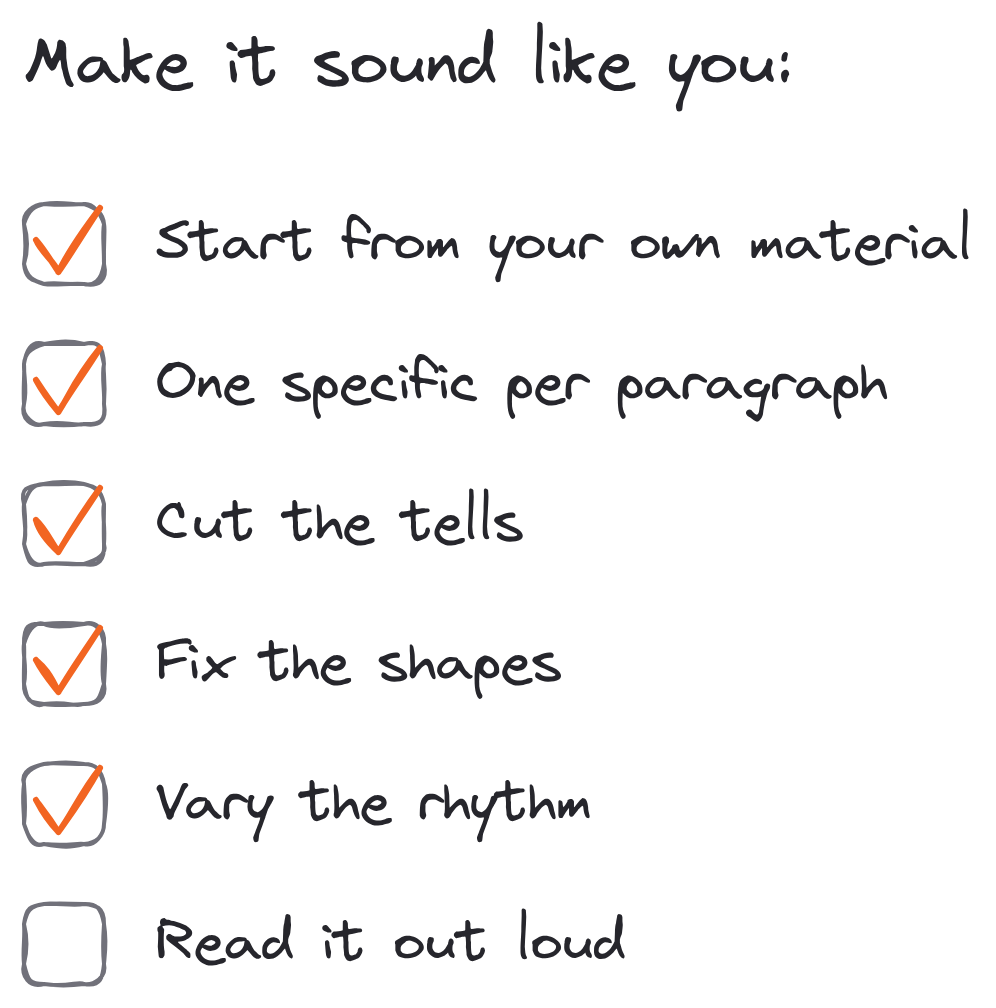
Here's the edit I'd run on any draft, whether a model wrote it or you did:
- Start from your own material. Your stories, your numbers, your opinions: what I call Personality Content. AI is good at the commodity parts (explaining a known idea, formatting, outlining). Your experience is the data set it doesn't have.
- Add one specific per paragraph. A name, a number, a date or a moment. This is the single biggest move from AI-sounding to human.
- Cut the tells. Search the draft for the words and phrases in signs #1-#5 and delete or replace every one.
- Fix the shapes. Rewrite every contrast formula as a plain claim, break up the threes and cut the "-ing" tails.
- Vary the rhythm. Follow a long sentence with a short one. Let a single line stand on its own when it matters.
- Read it out loud. Anywhere you stumble or wouldn't say it that way to a friend, rewrite it the way you'd say it.
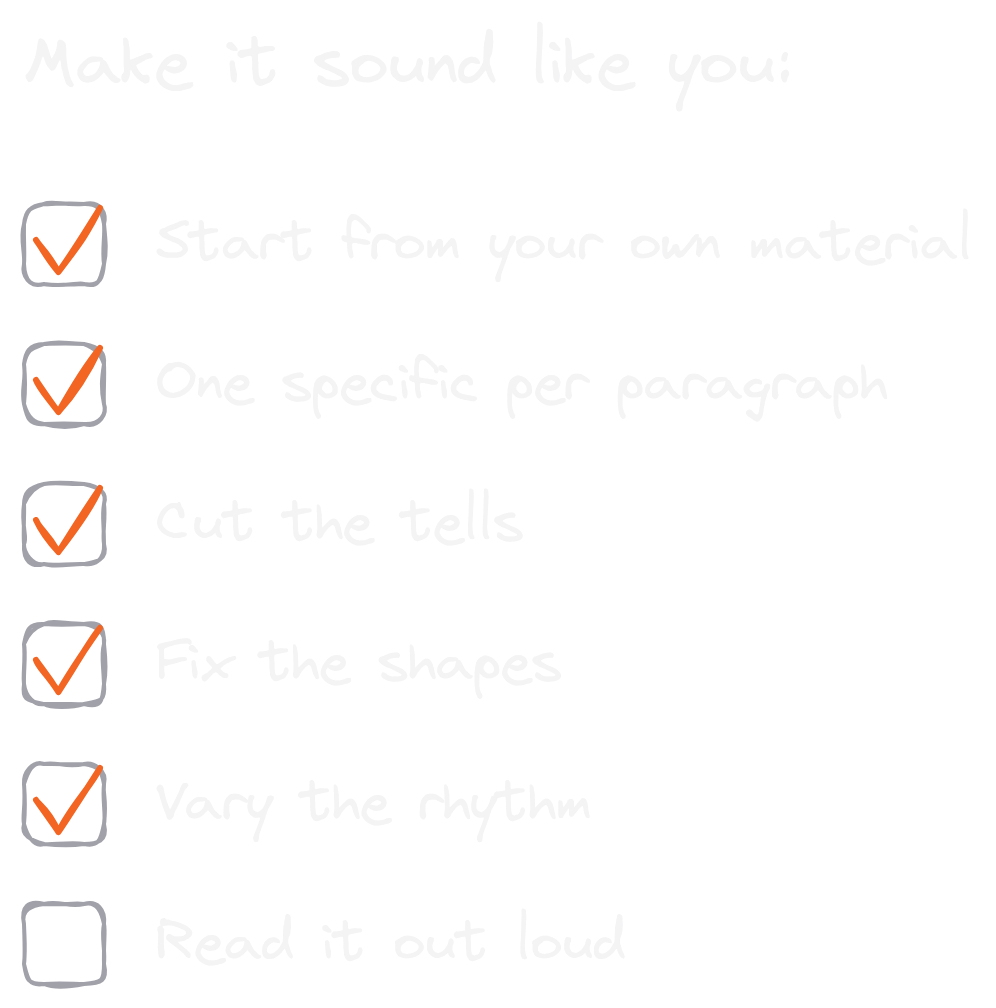
Step 1 is the one most people skip, and it's the one that matters most. We built Typeshare around it: your Digital Brain collects what you've already written and marks each idea as personality (something only you could have said) or commodity (something anyone in your field could say), and the agents write only from your own writing. For the longer version of this idea, read our chapter on Personality Content.
That's how to make writing sound less like AI.
FAQ
Can you tell if something was written by AI?
Often, yes, but never with certainty. A piece with several of the 15 signs and no specifics is likely AI-written or heavily AI-assisted. A single sign proves nothing, because people picked up these habits long before language models did.
Are AI detectors accurate?
Not accurate enough to decide anything that matters, like a grade or a job. OpenAI shut down its own classifier for low accuracy, and Stanford researchers found detectors flagged most essays by non-native English writers as AI-generated.
Is using AI to write bad?
No. Using AI for the commodity parts of writing (research, outlines, formatting, a first pass at an explanation) saves hours. The problem is letting it write the parts that should be yours: your stories, your opinions and your voice.
Why does AI writing all sound the same?
A language model predicts the most likely next word, based on everything it was trained on. The most likely word is the most common one, so its drafts drift toward the average of the internet: the same safe vocabulary, the same sentence shapes, the same structure. Your edge is everything that isn't average about you, starting with what you've lived through and what you believe that most people in your field don't.
Do em dashes mean something was written by AI?
On their own, no. Writers used em dashes long before AI did. Heavy use, especially the "claim — dramatic twist" pattern several times in one post, is one of the signs worth checking.
How do I make ChatGPT sound less like AI?
Give it your own material to work from (notes, stories, past posts) and ask for plain language and short sentences. Then edit the output with the 6 steps above. The edit matters more than the prompt.