Tone Of Voice In Writing: What It Is, 12 Examples, And How To Find Your Writing Style
Nicolas ColeNovember 6, 2026
Tone of voice, defined in plain words, with 12 examples of one idea written 12 ways, so you can name your writing style and choose it on purpose.
I have ghostwritten for billionaires, Silicon Valley founders, Grammy-winning musicians and Olympic athletes.
Every one of them sounded different. Some spoke in stories. Some spoke in strong opinions. Some couldn't finish a sentence without a statistic. My job was to make every article sound like the person whose name was on it, which meant I had to learn to hear a tone of voice, name it and then write in it on purpose.
That's how I learned the most useful thing I know about voice. As I wrote in Writer Career Path #6:
You don't "find" your voice. You create it.
I've been teaching writing for over a decade, and I've helped tens of thousands of people start writing through Ship 30 for 30. Below are the 6 questions I'd answer about tone of voice and writing style, with 12 examples of the same idea written 12 different ways. (If you want to go deeper, read why AI doesn't sound like you, see how Typeshare writes in your voice, or start writing in Typeshare. You do the writing; the robots do the rest.)


Question #1: What Is Tone Of Voice? (A Plain Definition)
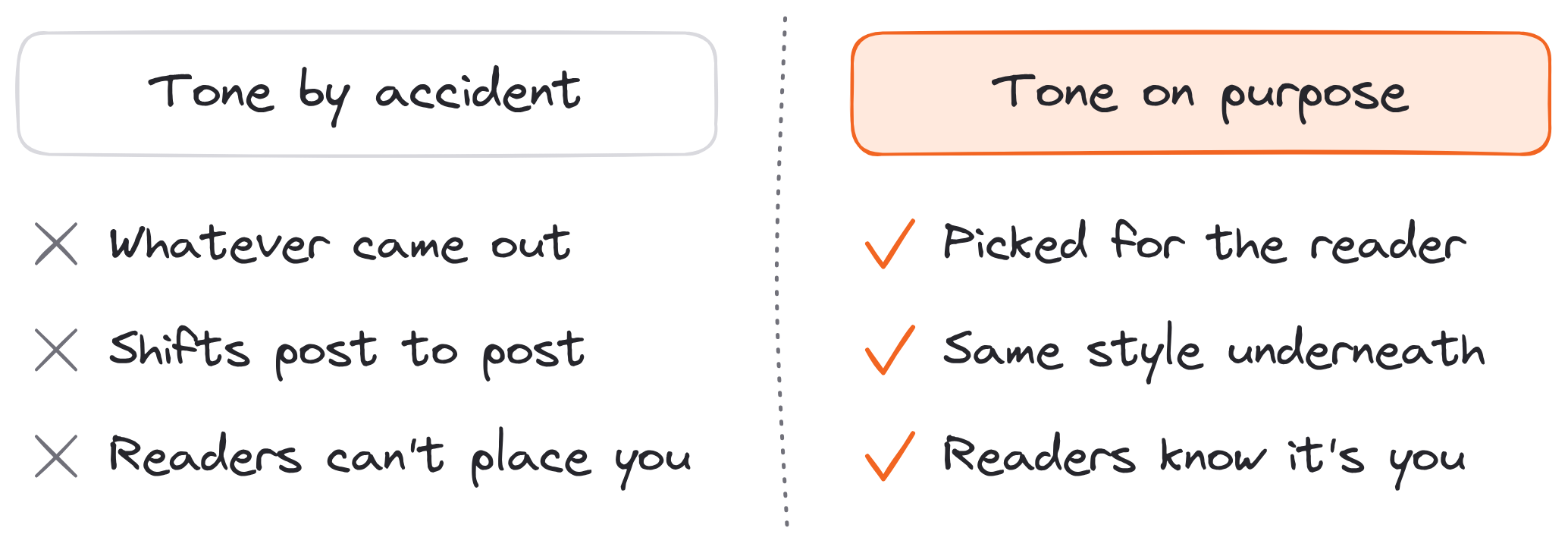
Tone of voice is how you say something.
Here's the simplest tone of voice definition I can give you. Two writers can make the exact same point, with the exact same facts, and one will sound like a friend at dinner while the other sounds like a textbook. The point didn't change. The words, the length of the sentences and the attitude behind them did. That difference is tone.
Readers feel it within a sentence or two.
Say you pick up a book a friend swears is their favorite, and you can't get past the first page. When you tell them, you'll probably say, "It just wasn't for me. I didn't like the voice." Most of the time, that's a mismatch between the tone the writer chose and the tone you like to read.
For a writer, the tone of voice meaning comes down to one idea: every piece you publish has a tone, whether you picked it or not.
The writers people remember pick it.
That's what tone of voice is.
Question #2: What Is Writing Style? (And How Is It Different From Tone?)
Writing style is the set of habits that shows up in everything you write.
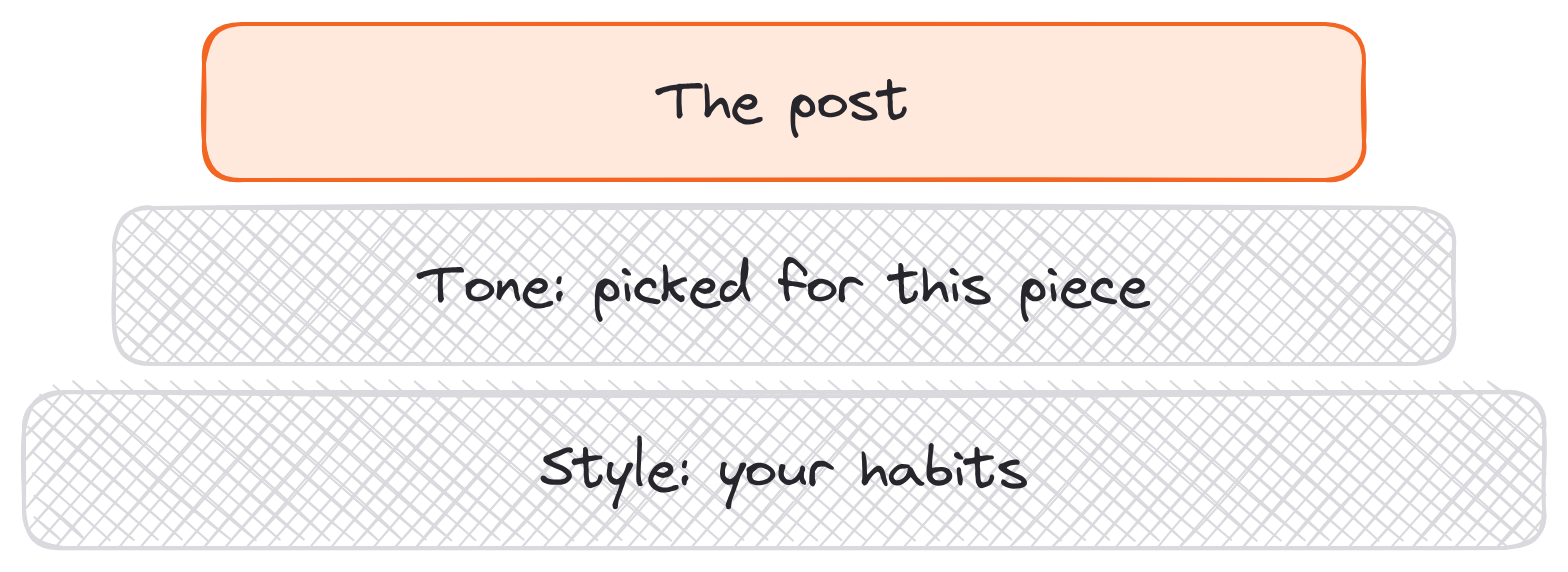
Tone can change from piece to piece. You might write a heated post on Monday and a vulnerable one on Thursday. Your style is what stays the same underneath: the words you reach for, how long your sentences run and how you like to make a point. If tone is the outfit you pick for the day, style is your taste in clothes.
So here's a working writing style definition: the choices a reader would recognize as yours with your name taken off.
Two famous writers make the difference easy to see.
William Faulkner wrote in long, winding sentences. Ernest Hemingway wrote in short, plain ones. Hand a reader a paragraph from each without the names, and most can tell you who wrote which. That's how distinct a style can be.
When someone asks what style in writing is, that's the answer. It's the fingerprint you leave on every page.
Your tone is a choice you make for each piece. Your style is what you build over hundreds of them.
That's what writing style is.
Question #3: What Makes Up A Tone Of Voice?
Ask most writers what makes their voice their voice, and you'll get a shrug.
"It sounds like me." "It's to the point." "That's how I'd say it." None of those tell you anything you could repeat on purpose. When I break a voice down, it comes out of three smaller parts:
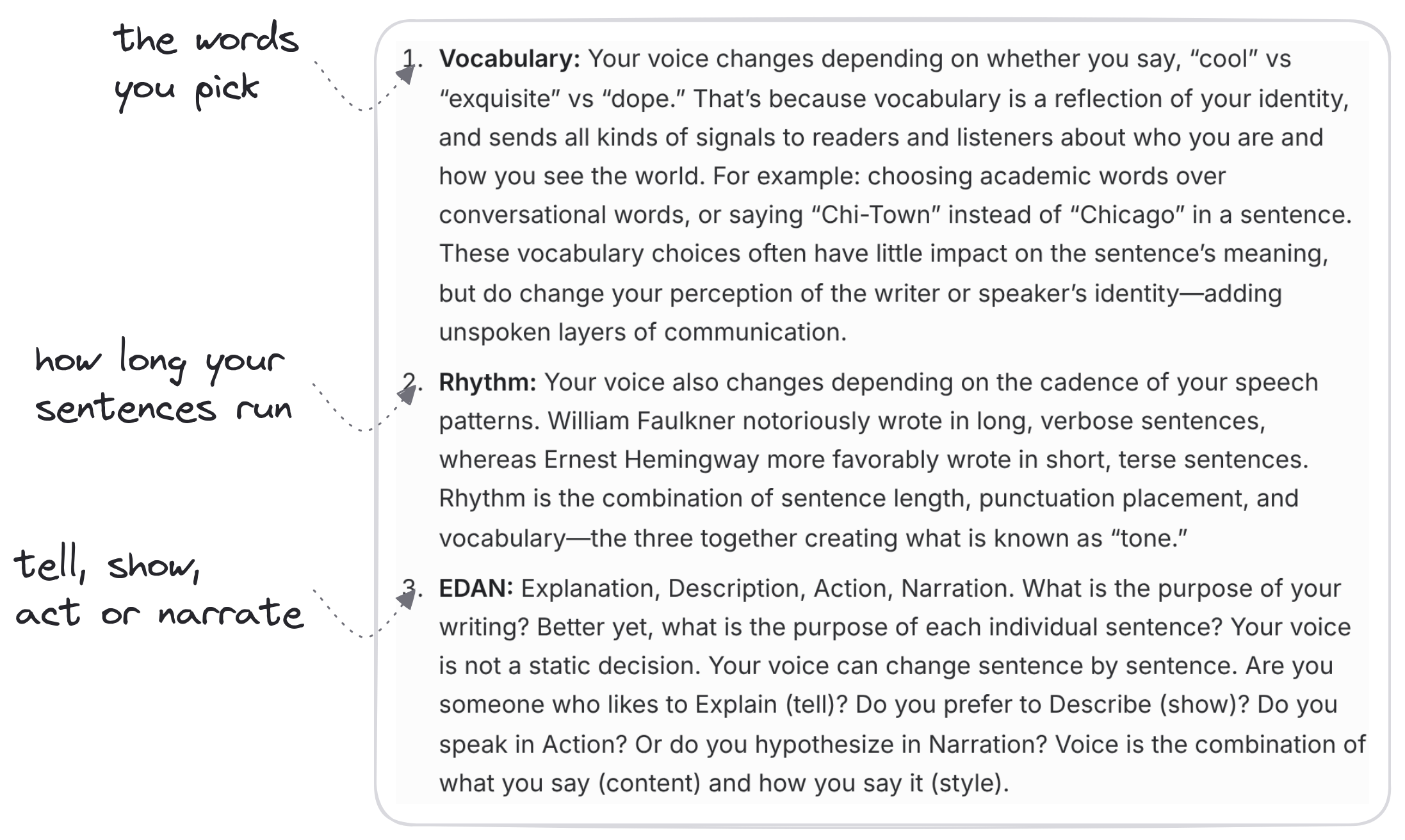
- Vocabulary. "Cool," "exquisite" and "dope" mean about the same thing. Each one tells the reader something different about who you are. Saying "Chi-Town" instead of "Chicago" changes the voice without changing the meaning.
- Rhythm. The length of your sentences, where your punctuation falls and how often you break a line. This is the Faulkner and Hemingway difference from Question #2.
- EDAN. Explanation, Description, Action and Narration. Do you like to explain (tell)? Do you describe (show)? Do you write in action, or tell a story in narration? Your answer can change sentence by sentence.
Put those three together and you get a tone of voice. Change any one of them and the tone changes with it.
This is why I say you create your voice. You can turn each of these dials yourself, the same way a painter mixes new colors from a handful of paints. I wrote more about this in Your Writing Voice, the chapter of our Write With AI guide where the screenshot below comes from.
Vocabulary, rhythm and EDAN make up a tone of voice.
Question #4: What Are The Types Of Tone Of Voice?
There are as many tones as there are writers, but nearly all of them fall into a few families.
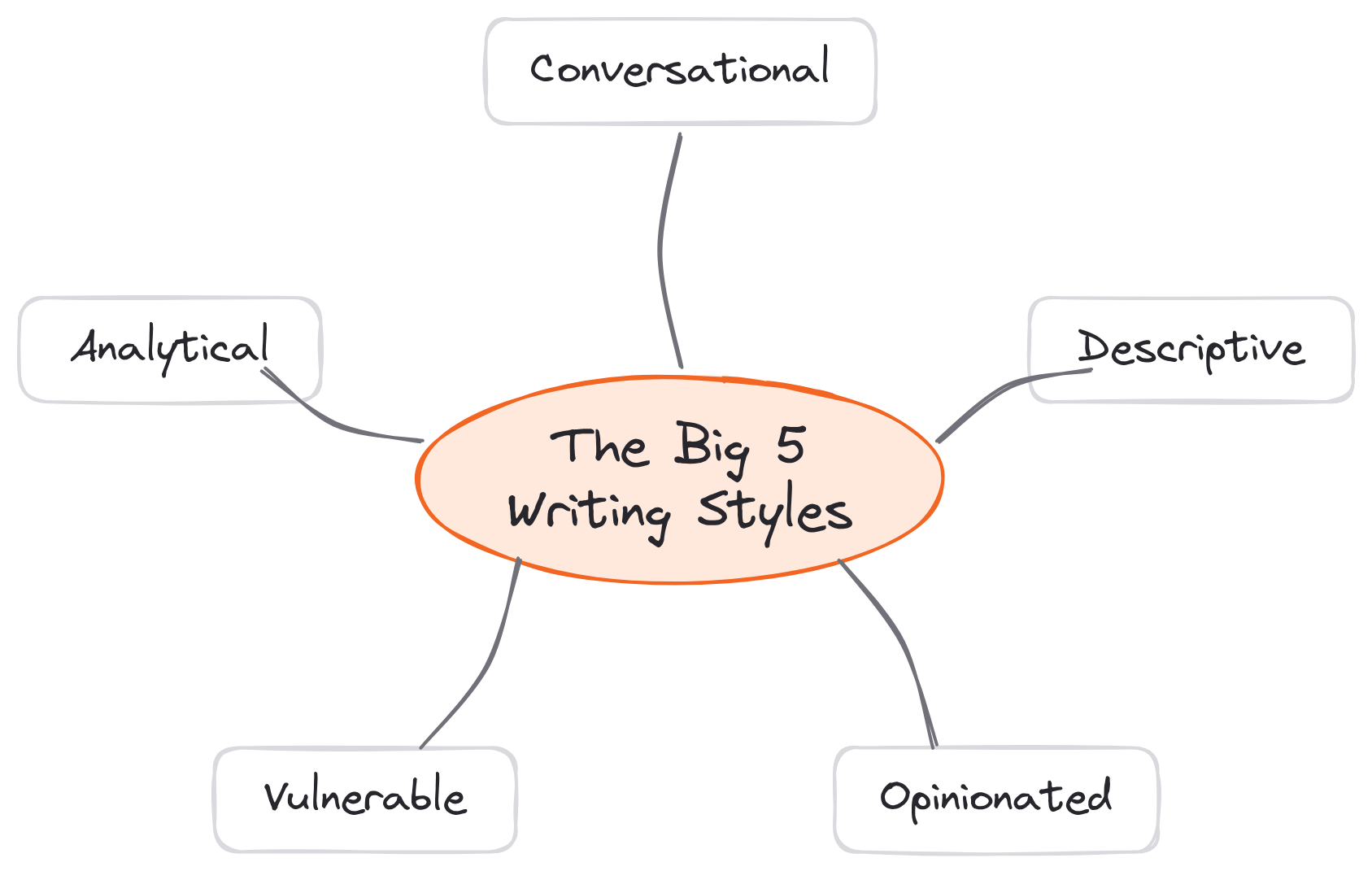
The one I use most is what I call The Big 5 Writing Styles. They're the types of tone of voice you'll see on any platform, any day of the week:
- Simple & Conversational. Short words, short sentences, reads like a text from a friend.
- Verbose & Descriptive. Long sentences, rich detail, takes its time.
- Heated & Opinionated. Strong claims, a clear enemy, no hedging.
- Personal & Vulnerable. First person, admits mistakes, tells you how it felt.
- Factual & Analytical. Numbers, research and breakdowns.
The second family comes from how you approach an idea. I call it the 4A Framework. Take four best-selling books about money. Ramit Sethi's I Will Teach You To Be Rich is Actionable (here's how). Ray Dalio's The Changing World Order is Analytical (here's a breakdown). Robert Kiyosaki's Rich Dad Poor Dad is Aspirational (yes, you can). Morgan Housel's The Psychology of Money is Anthropological (here's why). Same topic, four different voices.
Each A pulls in its own kind of material. Actionable writing runs on tips, tools and frameworks. Analytical writing runs on trends, numbers and teardowns. Aspirational writing runs on lessons, mistakes and personal stories. Anthropological writing runs on fears, struggles and observations about why people do what they do. Change the material and the tone follows.
The approach you pick sets the voice.
Those are the types of tone of voice.
Question #5: What Do Different Tones Of Voice Look Like? (12 Examples)
The fastest way to understand tone is to watch one idea change clothes.
Below are 12 tone of voice examples, and every one of them makes the same point: you should write every day. Read them in a row and notice how different each one feels, even though the message never moves. (I wrote these as samples of each tone, so the stories in them aren't from my life.)
The Big 5 Writing Styles
1. Simple & Conversational
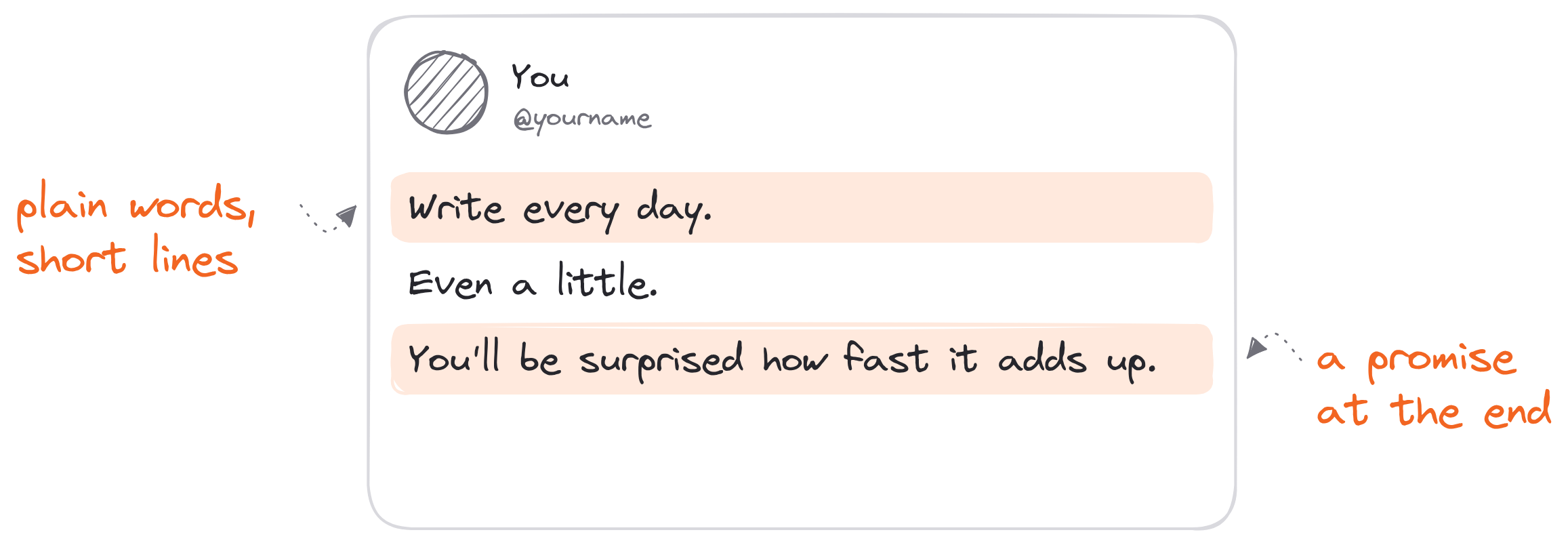
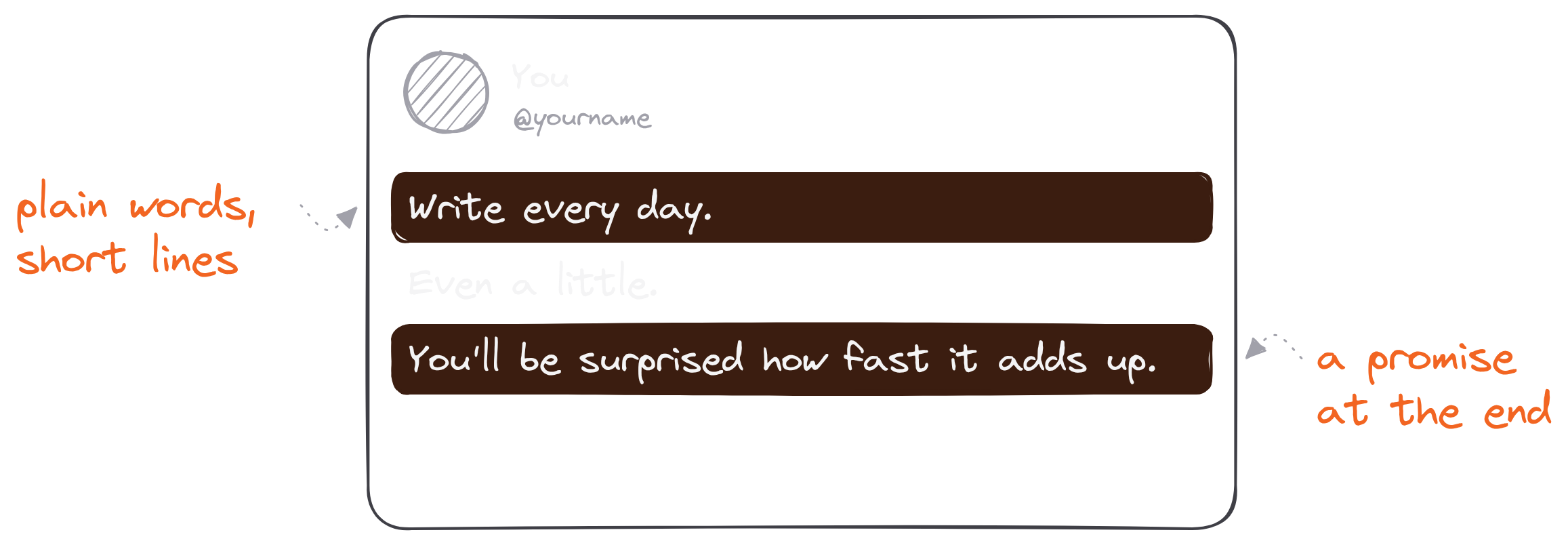
Write every day. Even a little. You'll be surprised how fast it adds up.
Everyday words, three short sentences and a promise at the end. It's the tone most people can read on a phone at a red light, which is why it does so well on social platforms.
2. Verbose & Descriptive
There's a particular quiet in the first ten minutes of a morning writing session, the coffee still too hot to drink, the cursor blinking on a white page, and it's in that quiet, repeated day after day, that a writer slowly gets built.
One long sentence, stacked with sensory detail (the coffee, the cursor, the white page). The rhythm slows the reader down on purpose. It works in essays and newsletters, where readers have chosen to sit with you.
3. Heated & Opinionated
"I'll write when I'm inspired" is the biggest lie in the writing world. Inspiration is for amateurs. Pros write every day.
It names an enemy (the inspiration myth), takes a side and doesn't hedge. A heated tone earns attention fast. Use it when you believe the claim, because readers can tell when you're performing.
4. Personal & Vulnerable
For years I called myself a writer and wrote maybe twice a month. I was scared that if I wrote every day, I'd find out I wasn't any good.
First person, a confession and a feeling. Vulnerable writing builds trust faster than any other tone, because the writer goes first. When you use it in your own writing, it has to be true, or it reads as a trick.
5. Factual & Analytical
One 400-word post a day is 2,800 words a week and 146,000 words a year. That's longer than most novels.
Numbers carry the argument, and the writer stays out of it. This tone persuades readers who don't trust opinions. It's also the easiest one to check, so the numbers have to hold up.
The 4A Framework
6. Actionable
Set a 30-minute timer every morning. Write one idea in 400 words or fewer. Publish it before the timer ends.
Three commands in a row. Actionable writing tells the reader what to do next, which is why how-to guides and tips posts lean on it.
7. Aspirational
I built a writing career one post at a time. If I could do it, so can you.
The writer is the proof. Aspirational writing works when you've done the thing, and it pairs well with a personal story.
8. Anthropological
We put off writing because we're scared of being judged. Writing every day works because the fear shrinks with every post that doesn't end the world.
It explains the human reason behind the behavior. Anthropological writing makes readers feel understood, and they share it because it names something they couldn't.
Voices I Learned As A Ghostwriter
9. The Storyteller
Let me tell you about the first time I hit publish two days in a row.
The Storyteller opens with a moment and makes you wait for the point. You recognize this voice by cues like "back when I was" or "the first time I."
10. The Frameworker
If I were starting over, I'd do three things: pick one topic, write at the same time every day and publish before I felt ready.
The Frameworker speaks in steps and numbers. You'll recognize it by "three things I'd do" and "here's a framework."
Rhythm On Its Own
11. Short And Terse
Write. Publish. Repeat. Every day.
Four words, two of them repeated. This is Hemingway's end of the rhythm dial, and it hits hardest as a closing line.
12. Long And Flowing
The habit of writing every day doesn't announce itself, it accumulates, one small post after another, until you look back after a year and realize the person who started is not the person who's writing now.
One sentence that keeps unrolling. This is Faulkner's end of the dial. It rewards a patient reader and loses a skimming one.
Every one of these writing style examples is "correct." The question is which one sounds like you, and which one your reader wants to hear.
Those are 12 tones of voice.
Question #6: How Do You Find Your Own Writing Style?
Ghostwriting taught me more about voice than anything else I've done.
As a ghostwriter, you learn to recognize five client voices fast: the Storyteller, the Opinionator, the Fact Presenter, the Frameworker and the F-Bomber. Once you can name a voice, you can write in it. The same goes for your own. Here's how to do it:
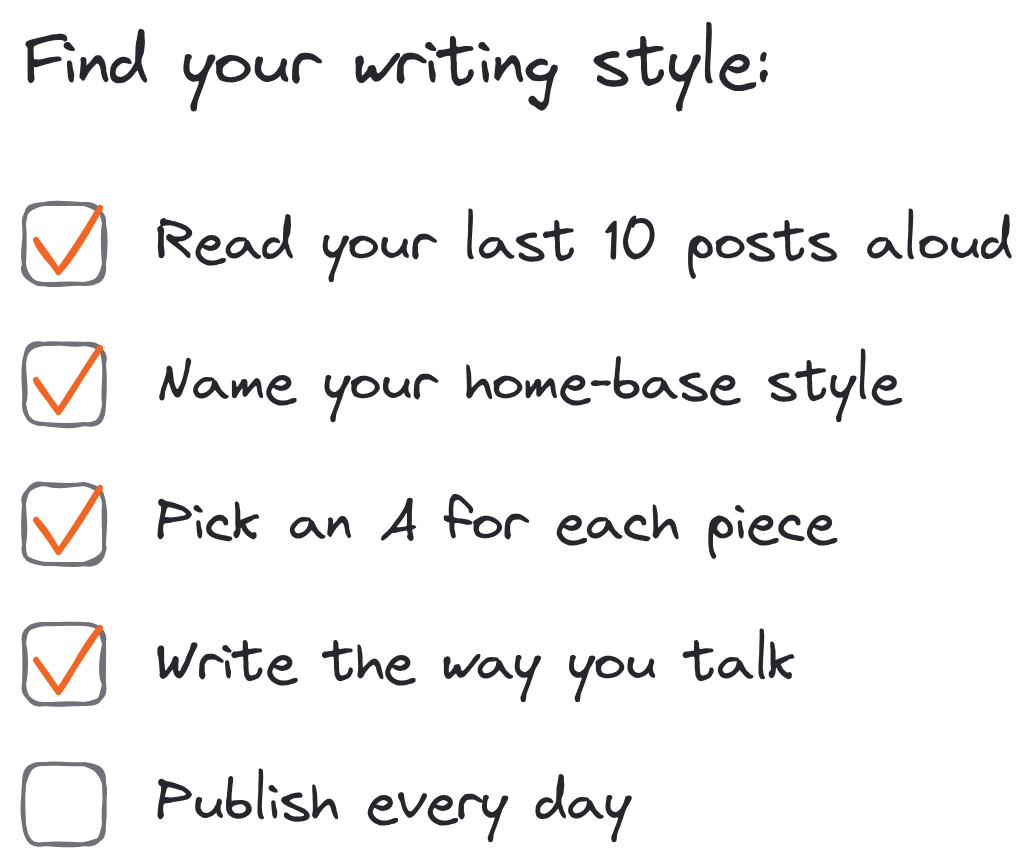
- Read your last 10 posts out loud. Mark the words you use over and over, and notice whether your sentences run long or short.
- Name your home base. Which of the Big 5 Writing Styles do you fall into most often? That's your default tone.
- Pick an approach for each piece. Before you write, ask which of the 4As you're using. The approach will set the voice for that piece.
- Write the way you talk. Dickie Bush quotes David Ogilvy's rule from a 1982 memo to his staff: write the way you talk, naturally. Your speaking voice is the closest thing to a voice you already own.
- Publish every day and keep what lands. The pieces readers respond to tell you which tone is working.
Typeshare can help with the first step. When you import what you've already published into your Digital Brain, Typeshare pulls out the separate ideas in each piece, sorts them into topics and marks each one as personality (something only you could have said) or commodity (something anyone in your field could say). The personality ideas are your voice on the page, and they're the ones worth writing more of.
The fifth step matters most. You won't create a voice in a week. You build it over hundreds of posts, and each one is a small test of which dials you like.
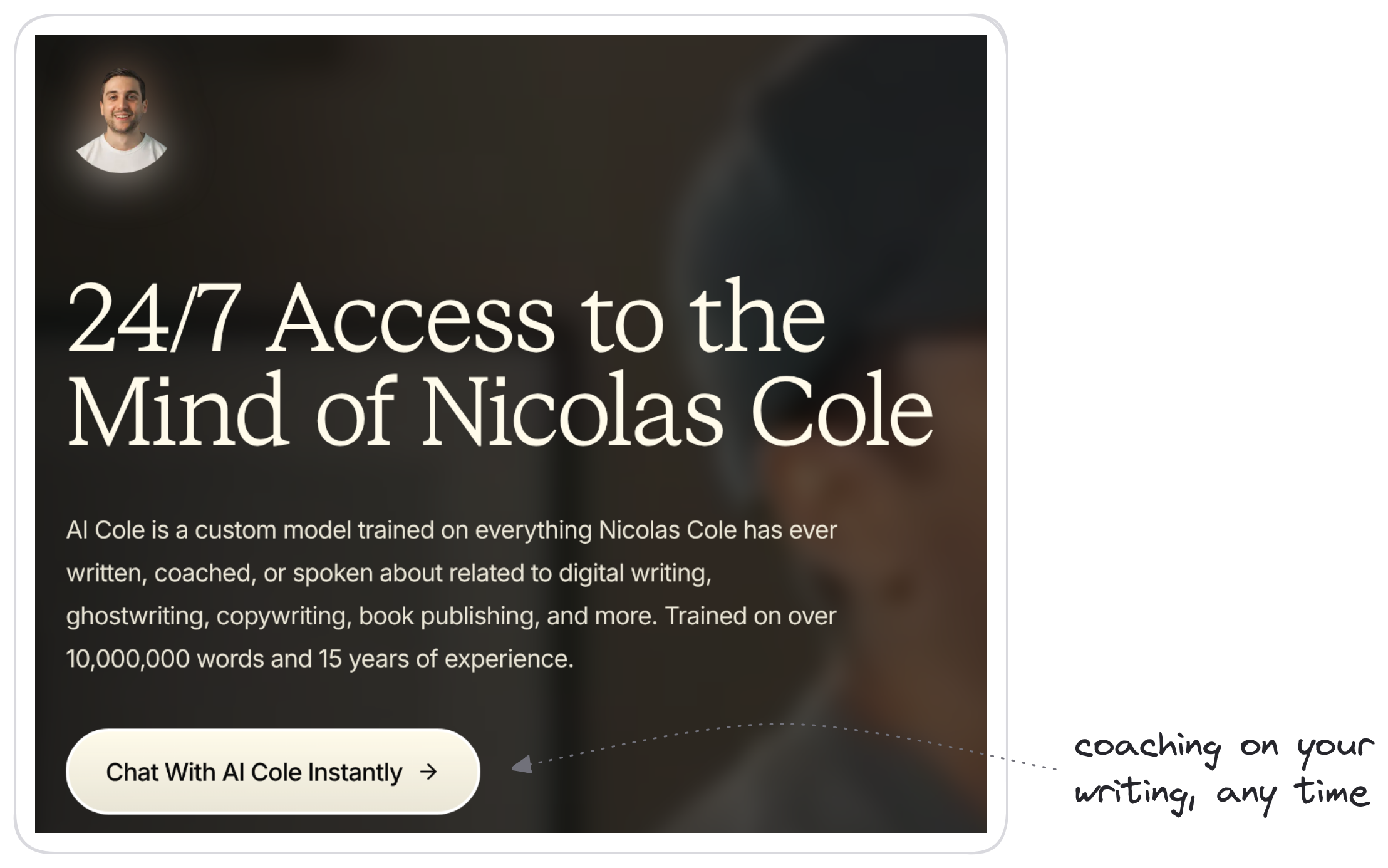
If you want feedback while you do it, AI Cole is my digital clone, trained on what I've written and taught about writing. It coaches you on voice and structure, grounded in your own writing, and it never publishes for you.
That's how you find your own writing style.

FAQ
What are some words to describe tone of voice?
Start with the Big 5: conversational, descriptive, opinionated, vulnerable and analytical. Other common words include formal, casual, playful, urgent, warm, blunt, witty and serious. Pick two that describe how you want readers to feel.
How do you describe a tone of voice?
Name its vocabulary (plain or fancy), its rhythm (short sentences or long) and its approach (how-to, breakdown, story or the reason behind it). "Plain words, short sentences, mostly how-to" describes a tone better than "it sounds like me."
What's the difference between tone and voice?
Voice is the personality that stays the same across everything you write. Tone is how that voice adjusts to one piece or one moment. You can keep the same voice and write a heated post one day and a vulnerable one the next.
What is tone of voice in communication?
It's how a message comes across apart from its words. In writing, tone comes from word choice and sentence length. In speech, it comes from pitch, pace and volume. The same sentence can sound friendly or cold depending on tone.
Does Typeshare write in my tone of voice?
Typeshare's agents only use your own writing. Your Digital Brain collects what you've published, and the agents turn it into new posts without inventing stories or opinions. See Does Typeshare write in my own voice?