How To Make Money On Substack: 6 Income Streams, What To Charge And How To Turn Free Readers Into Paid Subscribers
Nicolas ColeNovember 19, 2026
How to make money on Substack: what Substack takes, what to charge, and the weekly system that turns free readers into paid subscribers who stay.
Plenty of writers on Substack never earn a dollar from it.
They write for months. Their free list grows to a few hundred people. Then they flip on paid subscriptions, send one announcement and wait. Nobody upgrades, and the writer decides Substack "doesn't work for my niche."
Substack works fine. The writer skipped the system.
I've built two paid newsletters to six figures on Substack: Category Pirates to $150k a year and Write With AI to $300k a year, with zero ads. Write With AI now does over $300,000 in annual recurring revenue, and my fiction newsletter, Commercial Fiction Club, reached $13k a year in March 2026 on its way to a $100k goal. So I've done this at the top and from scratch.
This guide covers how to make money on Substack from the first free subscriber on. You'll see what Substack takes, what to charge, how free readers turn into paid ones, and the six income streams that sit on top of a paid newsletter. If you're brand new, start with what Substack is and how it works, then pick a topic from these newsletter ideas. And when you're ready to write every week, Typeshare for Substack keeps your newsletters and Notes in one place. You do the writing; the robots do the rest.
Can You Make Money On Substack? Yes, And Here's The Math
Yes, you can make money on Substack, and the platform's own numbers prove it.
Substack says it has passed 5 million paid subscriptions (checked November 22, 2026). Its earnings calculator does the math for one writer: 800 subscribers paying $7 a month comes out to $4,638 a month after fees. That's a full-time income from 800 people. You don't need a million readers. You need a few hundred people who care about one specific problem you can help them solve.
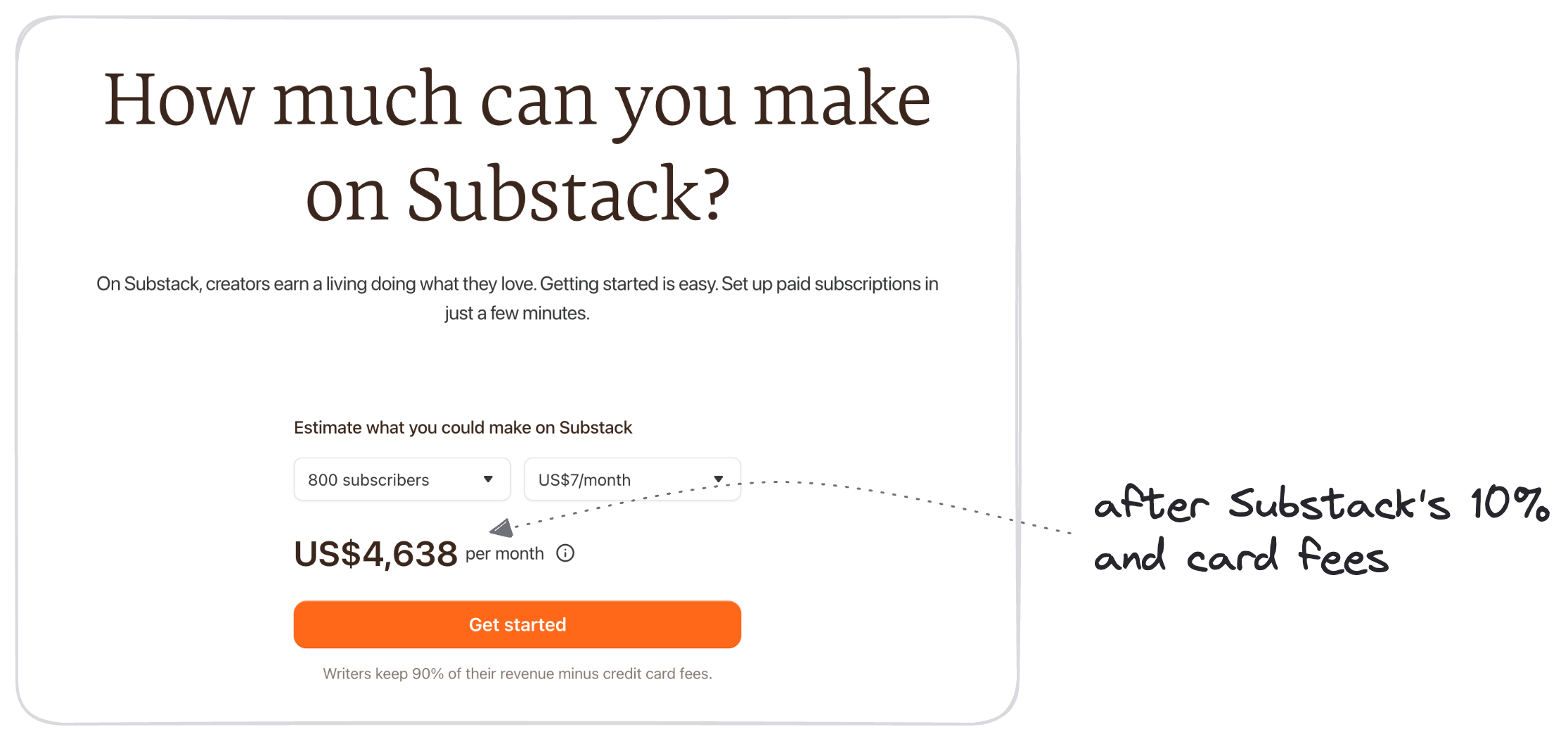
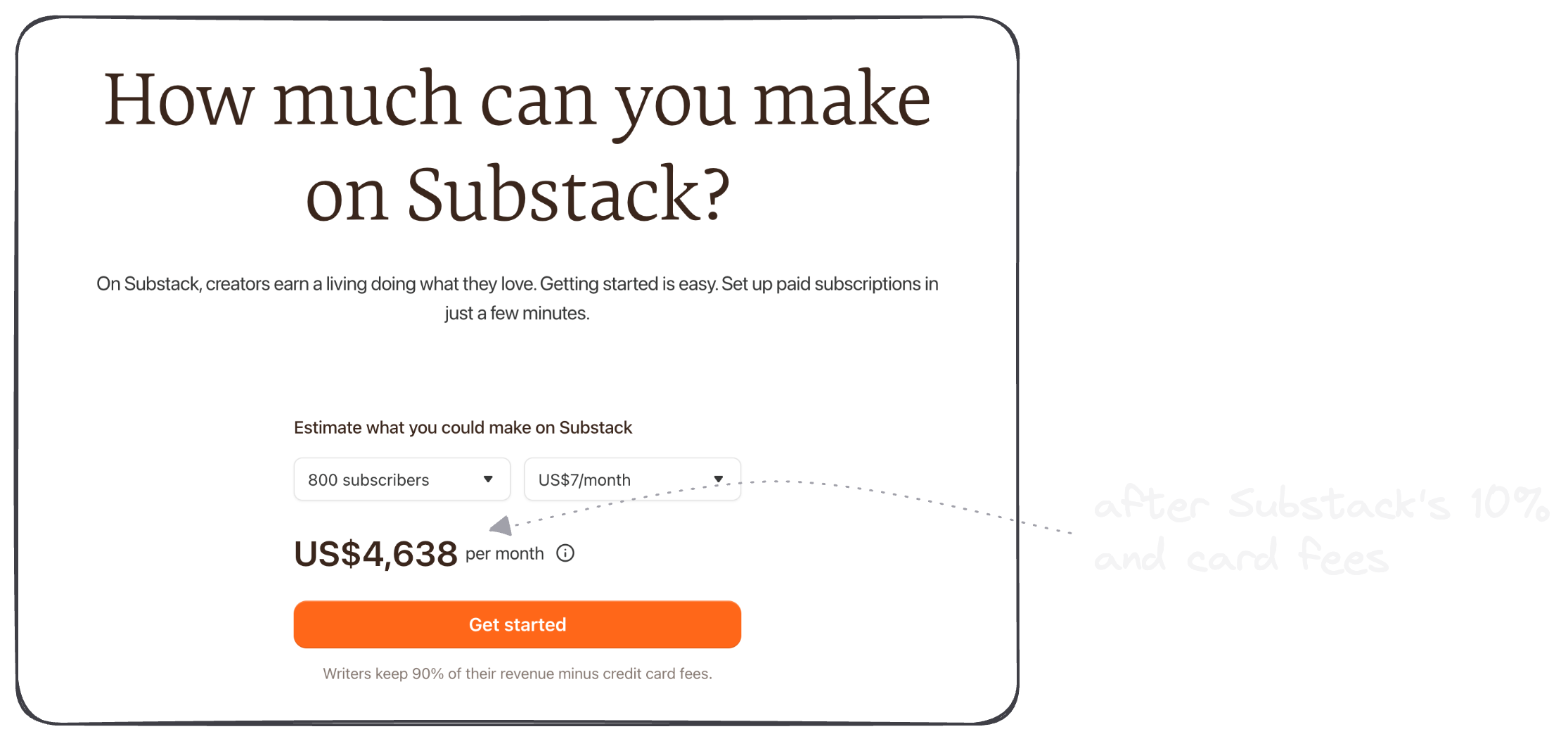
Here's the part the calculator leaves out.
Those 800 people are paid subscribers, and paid subscribers come from a much larger free list. Most of them read your free writing first, decided it was good, then decided the paid version was worth more than its price. That decision is the whole game. Everything in the steps below exists to make it easy.
So the honest answer has two parts:
- Can you make money on Substack? Yes. The tools are free, and the payments are built in.
- Will you? Only if you give free readers a reason to pay and a steady stream of moments to do it.
Can you make money on Substack? Yes, once you treat it like a business.
How Does Substack Make Money? What It Takes And What You Keep
Substack makes money when you do, and only then.
Starting a Substack is free, and so is sending a free newsletter to any number of readers. When you turn on paid subscriptions, Substack keeps 10%: writers keep 90% of their revenue minus credit card fees. Stripe processes the payments and charges its own fee per payment, listed on Stripe's pricing page. When a reader subscribes inside Substack's iPhone app, Apple takes a cut too, which is why I send readers to subscribe on the web.
Here's how the calculator's example breaks down:
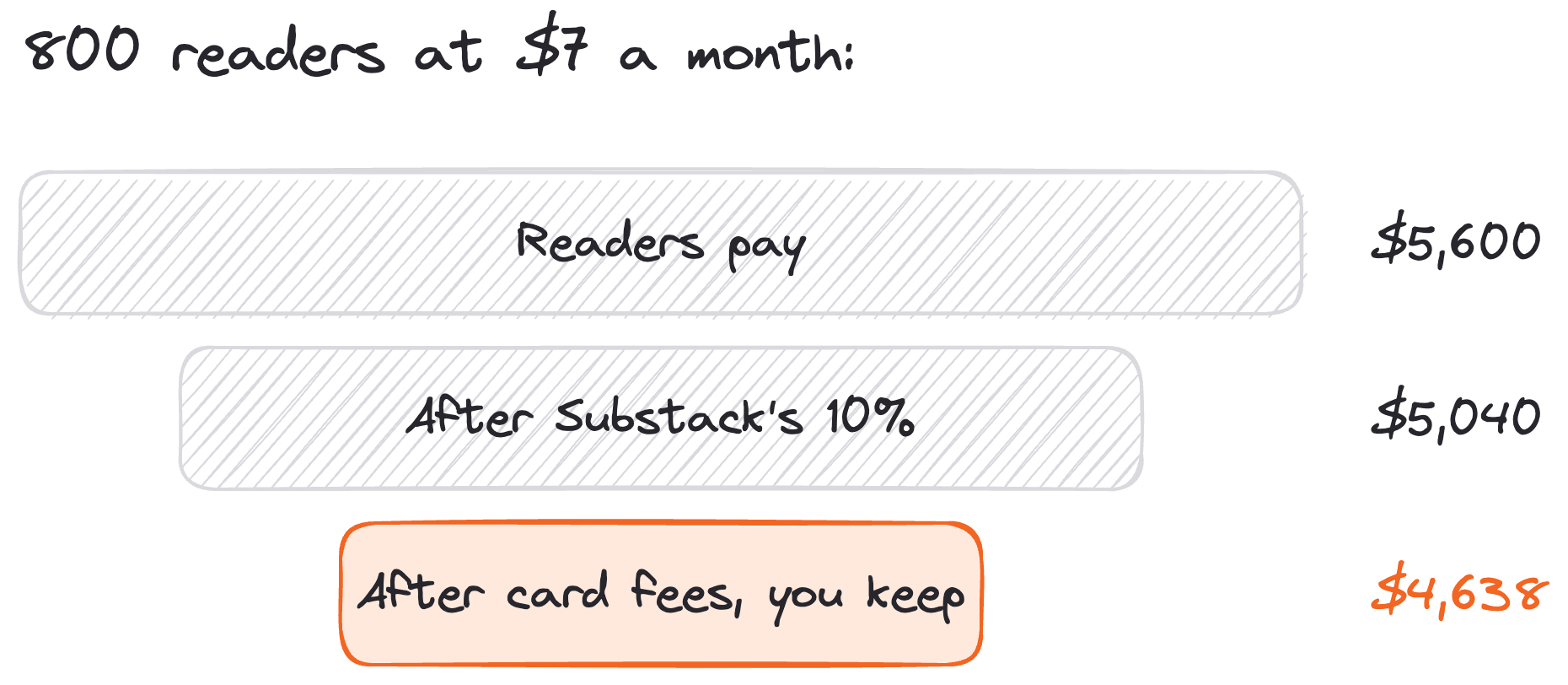
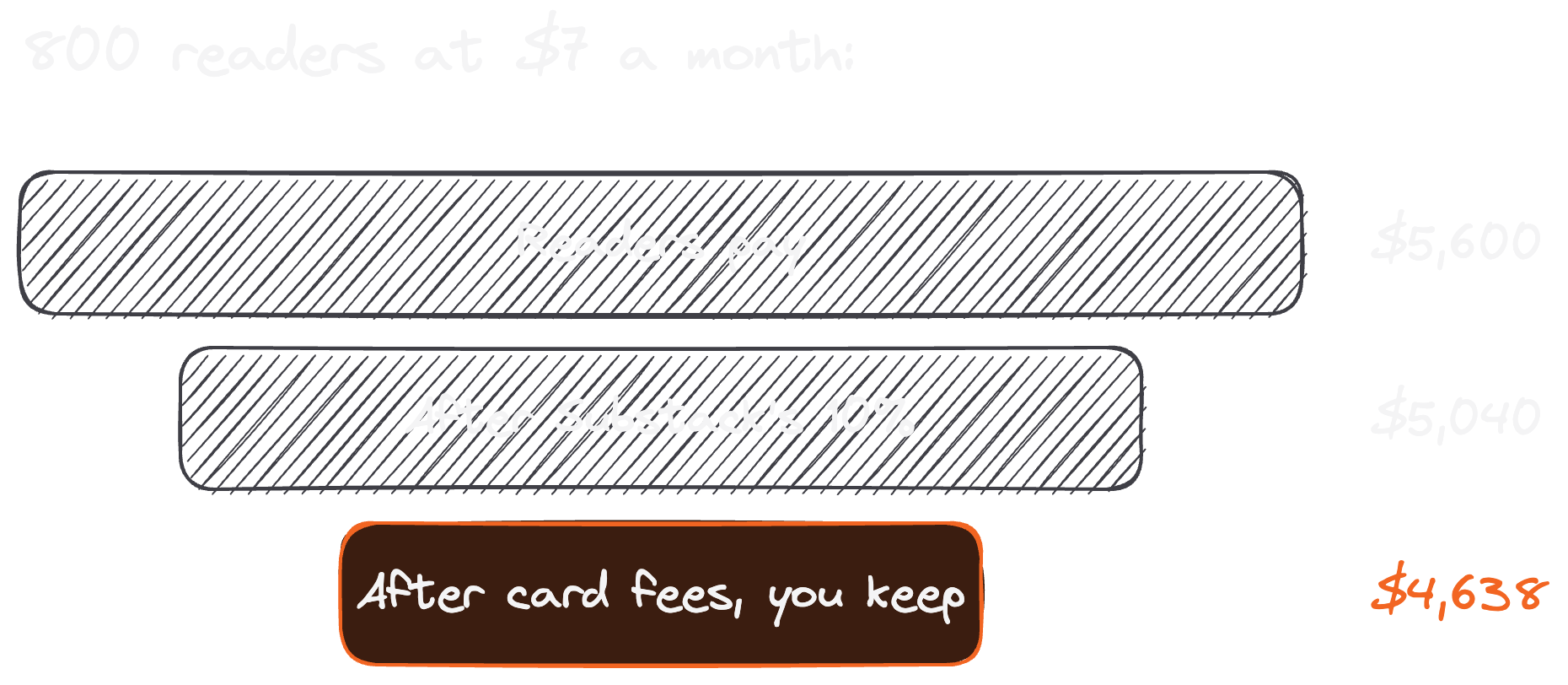
Eight hundred readers at $7 is $5,600 a month. Substack's 10% is $560. Card fees take roughly another $400, and you keep $4,638, about 83% of what readers paid.
Is 10% steep? It can feel that way at scale. But think about what it buys. You get hosting, email delivery, payments, an app and a network of readers that sends you new subscribers for free. Substack says more than half of new subscribers come from that network, plus over 30% of paid subscriptions.
That's how Substack makes money, and it's a deal that pays you first.
Step #1: Pick A Topic Readers Will Pay To Solve
Free newsletters can be about anything, but paid newsletters have to be about something.
This is where most writers get stuck. They write about "productivity" or "life lessons" or "thoughts on tech," and none of it is specific enough to pay for. Nobody pulls out a credit card for general interest. They pay to solve a problem, reach an outcome, or get access to something they can't find anywhere else.
When we built Category Pirates, it became a top 10 paid business newsletter on Substack in less than a year. The first two of my seven rules did most of the work: have a radically different point of view, and bring fresh data and frameworks. Readers paid because they couldn't get our thinking anywhere else.
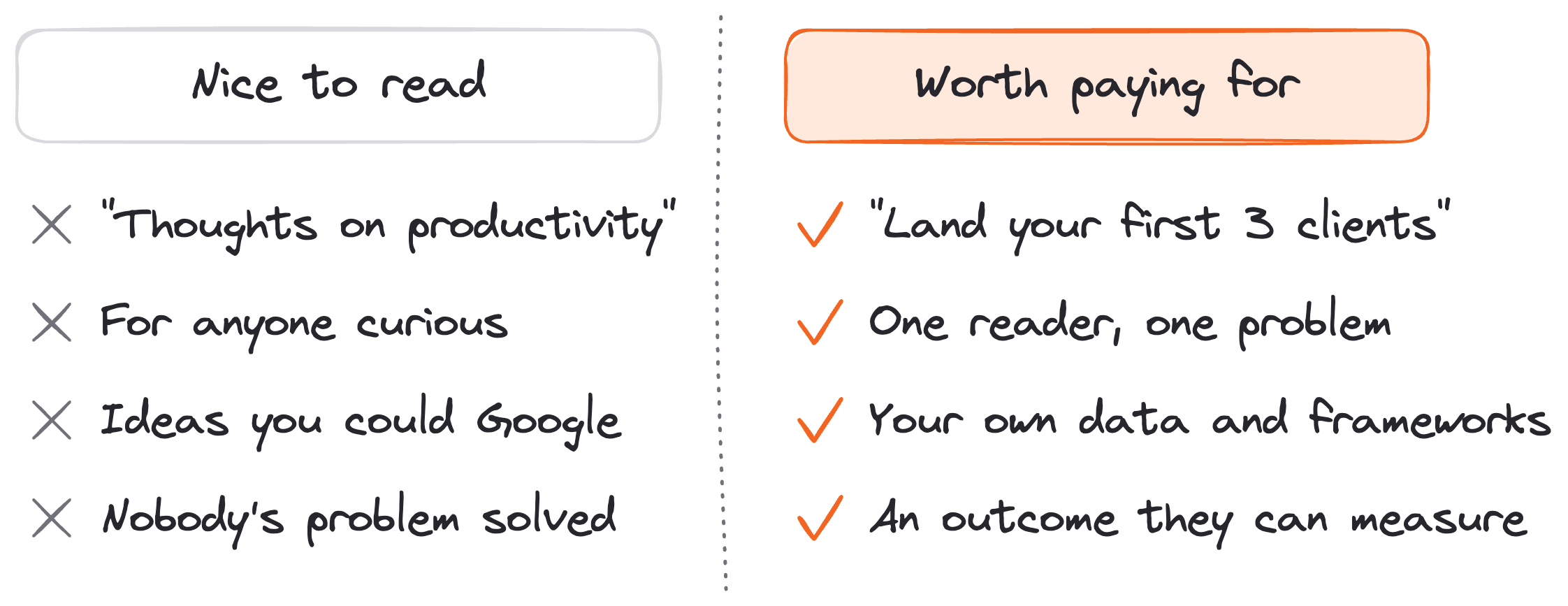
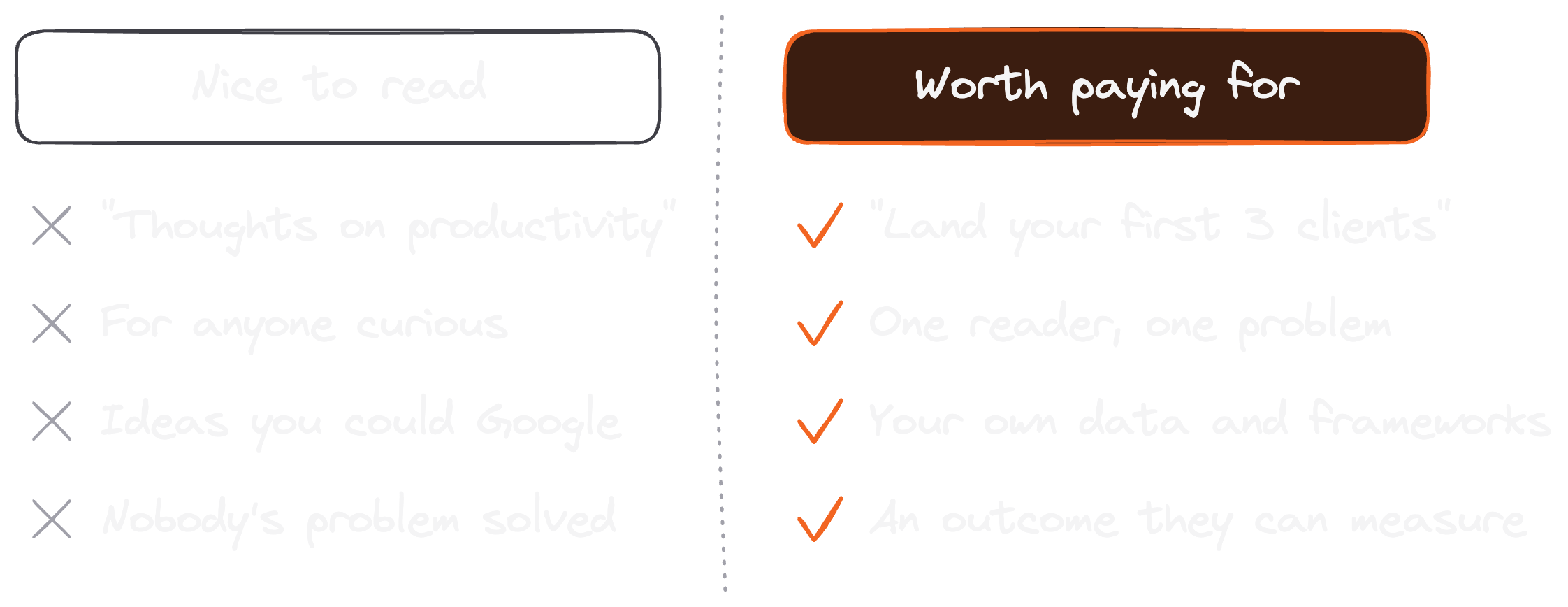
Before you pick your topic, ask yourself three questions:
- What problem do I solve? Name it in one sentence a stranger would understand.
- Who has it badly enough to pay? Freelancers chasing clients will pay. "People who like ideas" won't.
- What do I know that they can't Google? Your data, your frameworks, your mistakes and your results.
Price follows the same logic. Most paid newsletters sit somewhere between $5 and $20 a month. What counts is the price relative to the outcome. Twenty dollars a month to land one extra client is a bargain. The same price for "interesting reads" feels expensive.
Pick a topic readers will pay to solve, and the rest of the steps get easier.
Step #2: Turn On Paid Subscriptions And Set Your Price
Turning on paid subscriptions takes a few minutes; picking the price takes more thought.
In your publication's settings, you connect a Stripe account and choose your plans. Substack gives you three:
- Monthly. The easy yes. Low commitment, so it's where most readers start.
- Annual. A lower yearly price for paying up front. Annual readers churn less: they make the decision once a year.
- Founding Member. A premium yearly tier for your biggest fans, priced above the annual plan.
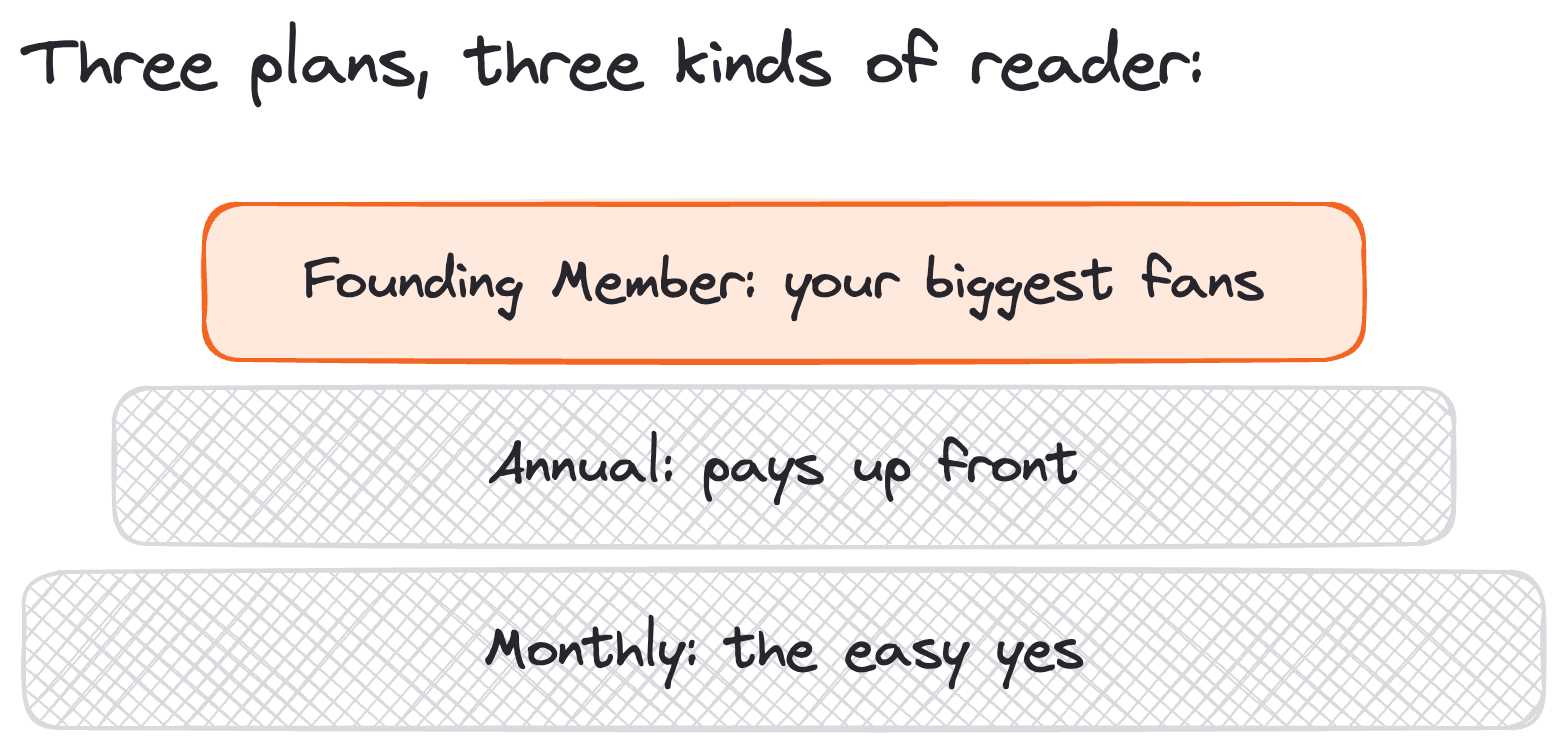
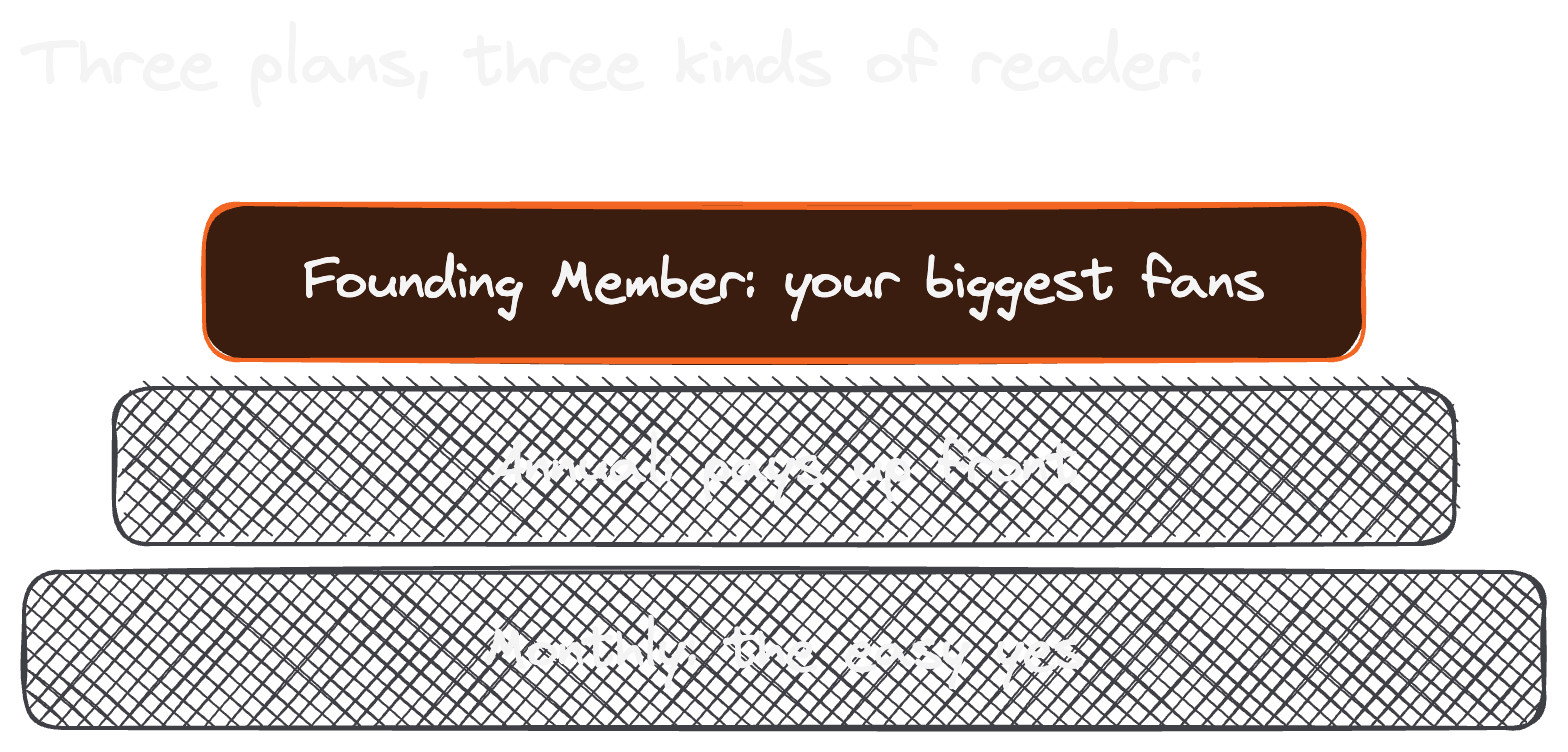
For reference, Write With AI costs $20 a month. That's on the higher end because it's built for people trying to make money writing online, so one good prompt or one framework can pay for a year.
Give the Founding Member tier one benefit worth the premium. Our Founding Members get free access to every digital product we launch, which turns each new product into two offers: buy it on its own, or upgrade and get it along with everything else.
A few pricing mistakes to avoid:
- Pricing low "to be fair" before anyone has asked for the paid version.
- Launching paid with nothing behind the paywall yet.
- Filling the Founding Member tier with perks nobody would pay extra for.
Set your price against the outcome you deliver, and turn on all three plans.
Step #3: Turn Free Readers Into Paid Subscribers
Here's the rhythm that turned our free readers into paid subscribers: one free newsletter and one paid newsletter, every week.
The free issue earns trust and grows your list. The paid issue gives readers a reason to upgrade. As I put it in my 6-step breakdown of a paid newsletter: consistently, forever. Skip a week, and both halves of the engine slow down.
Then make every paid issue sell the next upgrade. Substack has a feature called the paywall preview, where you choose where the paywall falls in a post. Send the paid post to your entire list, free readers included. Paying subscribers get the whole thing; free subscribers read the first 20% to 50% and hit the wall.
Where you put that wall matters more than anything else in this step.


Most writers drop the paywall anywhere. Put it right before the tangible thing you promised, like the template, the numbers or the step-by-step. Now the free reader has to choose: leave as it gets good, or upgrade.
The last piece is new readers, and on Substack that means Notes. Notes are Substack's short-form feed, like tweets inside the app, and every profile there leads with a Subscribe button. Almost 20% of our paid subscribers have come from inside the Substack network. My advice: republish your best short-form posts as Notes, post several times a day, and let the algorithm find your readers. You can schedule Substack Notes from Typeshare so the posting doesn't eat your writing time.
That's how you turn free readers into paid subscribers: a weekly rhythm, a cliffhanger paywall and a steady flow of Notes.
Step #4: Stack The 6 Income Streams On Top Of Your Newsletter
The biggest mistake writers make with paid newsletters is thinking subscriptions are the only way to make money on Substack.
Your paid newsletter is the center. It brings readers in every week and proves you can help them. Then you stack other offers on top, each at a different price, for readers at different stages. Here's the stack I use, with the prices from my own First $1 Roadmap:
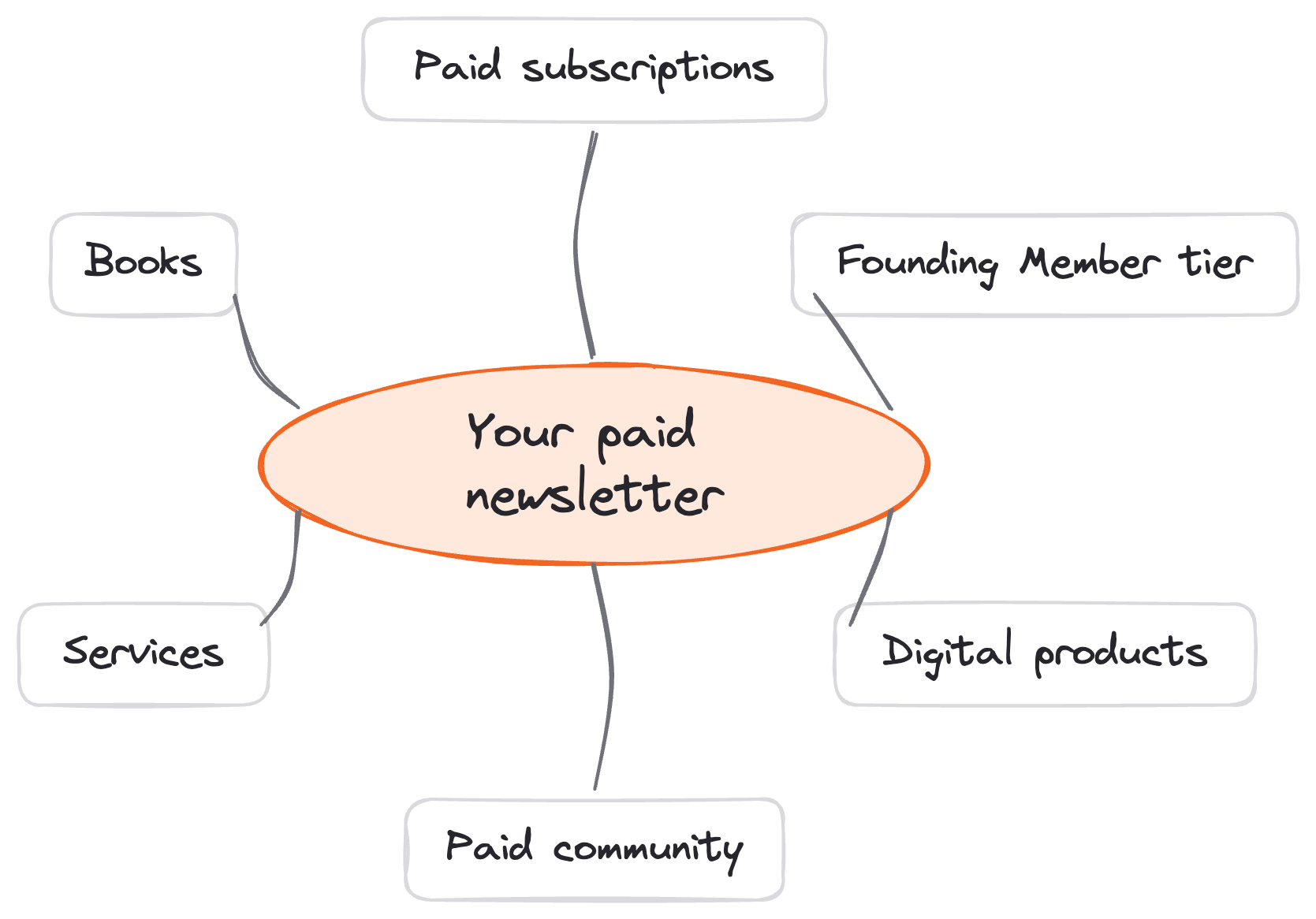
- Paid subscriptions. The base. Write With AI is $20 a month.
- A Founding Member tier. Your highest-value readers pay more for more. Ours unlocks every product we make.
- Digital products. A $99 to $350 text-and-video course that solves one specific problem. Launch one to your list every quarter.
- A paid community. More access, more templates, more of you. Our community, AI Writing Skool, costs $99 a month.
- Services. A $3,000 to $5,000 a month service where you do the work for a client. Your newsletter is the proof you can.
- Books. Your newsletter archive is a book in waiting. My entry-level book costs $9 as an eBook and $19 in print.
You don't need all six on day one. If you're starting from zero, add one: a digital product or a service. Those two make money the fastest, and every other stream is a bigger version of one of them.
Your archive is also raw material for everything else you post. Turn each issue into a week of posts with Typeshare's repurposing, and every platform you're on points back to your Substack. The Substack Agent can draft those Notes for you.
Stack the 6 income streams, and your newsletter becomes the front door to a business.
Step #5: Keep The Paid Subscribers You Get
Getting a paid subscriber is hard work; losing one is easy.
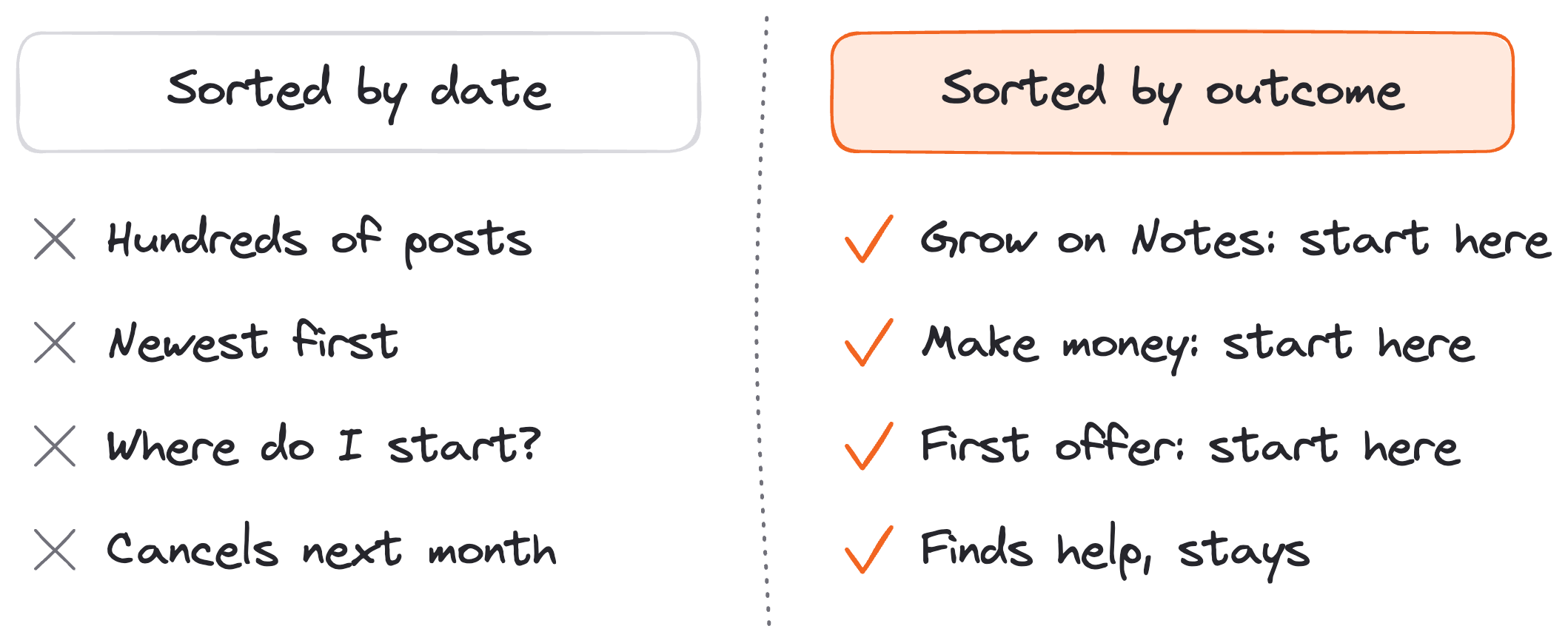
Why do most Substack readers cancel? They get overwhelmed. A new subscriber lands on your archive and sees hundreds of posts sorted by date. They don't know where to start, so they read one, feel behind, and cancel at the end of the month.
The fix is to sort your library by outcome. Substack lets you create sections at the top of your publication, so group your posts around what readers came for:
- Want to grow on Notes? Start here.
- Ready to make money from your archive? Start here.
- Building your first paid offer? Start here.
Then meet every new paid subscriber at the door. Send a short welcome series that links your three best paid posts and asks what they need help with. Their answers tell you what to write next, and readers who get help in week one stay longer.
Last, give readers a reason to stay that compounds. Every product you launch, every template you add and every Founding Member perk makes the subscription worth more the longer someone keeps it.
When readers find exact solutions fast, they pay and they stay. That's how you keep the paid subscribers you get.
How To Make Money On Substack: FAQ
How much do Substack writers make?
It depends on the list and the price. Substack's own calculator shows 800 subscribers at $7 a month earning $4,638 a month after fees. At the top end, Write With AI does over $300,000 a year. Most writers start far lower. My Commercial Fiction Club was at $13k a year in March 2026, and it's built on the same steps as this guide: one niche, one promise in the subtitle, and a paid tier for readers who want more.
When should you turn on paid subscriptions?
Turn them on once you've published enough free issues that readers know what you write about and keep opening your emails. Then launch paid with a few paid posts already written, so the first subscribers get something on day one. Wait for a "big enough" list, and you may never start. The paywall preview lets your free list see what they're missing from the first paid issue.
How many subscribers do you need to make money on Substack?
You can make money with your first paid subscriber. To replace an income, you need a few hundred paid readers, and they come from a free list many times that size. Grow the free list with Notes and a weekly free issue, then give it reasons to upgrade.
Can you make money on Substack without paid subscriptions?
Yes. Keep the newsletter free and sell digital products, services, a community or books to your list. Paid subscriptions are the easiest place to start, because Substack handles the billing.
Is Substack free to use?
Yes, for free newsletters. Substack charges nothing until you charge readers, then keeps 10% of paid revenue plus card fees. See what Substack is and how it works for the full setup.