The Best Time To Post On Twitter: What 3 Studies Say, And Why I Post Twice A Day At 8:30 AM And 8:30 PM
Dickie BushNovember 24, 2026
The best time to post on Twitter (X) by day and hour, from 3 studies of millions of posts, plus a 4-week test to find the two slots your readers show up for.
Most people asking for the best time to post on Twitter want a single hour.
The studies will give you one. Buffer says 9 AM on Tuesday. Hootsuite says 9 to 11 AM, Wednesday to Friday. Sprout Social says noon to 6 PM, Tuesday to Thursday. Each one is built on millions of posts, and each one is printed like it's the answer. You pick one, post there for a week, see no real change, and drift back to tweeting whenever you remember.
The better question: which two times do your readers show up for?
Here's why I'd listen to me on this one. I've been tweeting every day for almost 4 years on the way to a 400,000 following on Twitter, and right now I post 2 tweets a day, at 8:30 AM and 8:30 PM ET, 7 days a week. Before that, I posted 3 or 4 times a day. I've had a lot of mornings and evenings to see what a posting time can and can't do.
In this guide you'll get the short answer first, then what Buffer, Hootsuite and Sprout Social each found and why they disagree, then why I post twice a day, and a 4-week test that settles your own slots. (Once you have them, here's how to schedule tweets so they go out without you, and Typeshare for X queues a whole week in one sitting. You do the writing; the robots do the rest.)
When Is The Best Time To Post On Twitter? The Short Answer
Post on a weekday morning, between 9 and 11 AM in your readers' time zone, and post again in the evening.
That's where the evidence overlaps. Two of the three studies below put their best hours between 9 and 11 AM. All three rank midweek above the weekend. The morning is when people open X with their coffee and scroll before work. The evening is their second scroll of the day, after dinner, when the feed is quieter and there's time to reply.
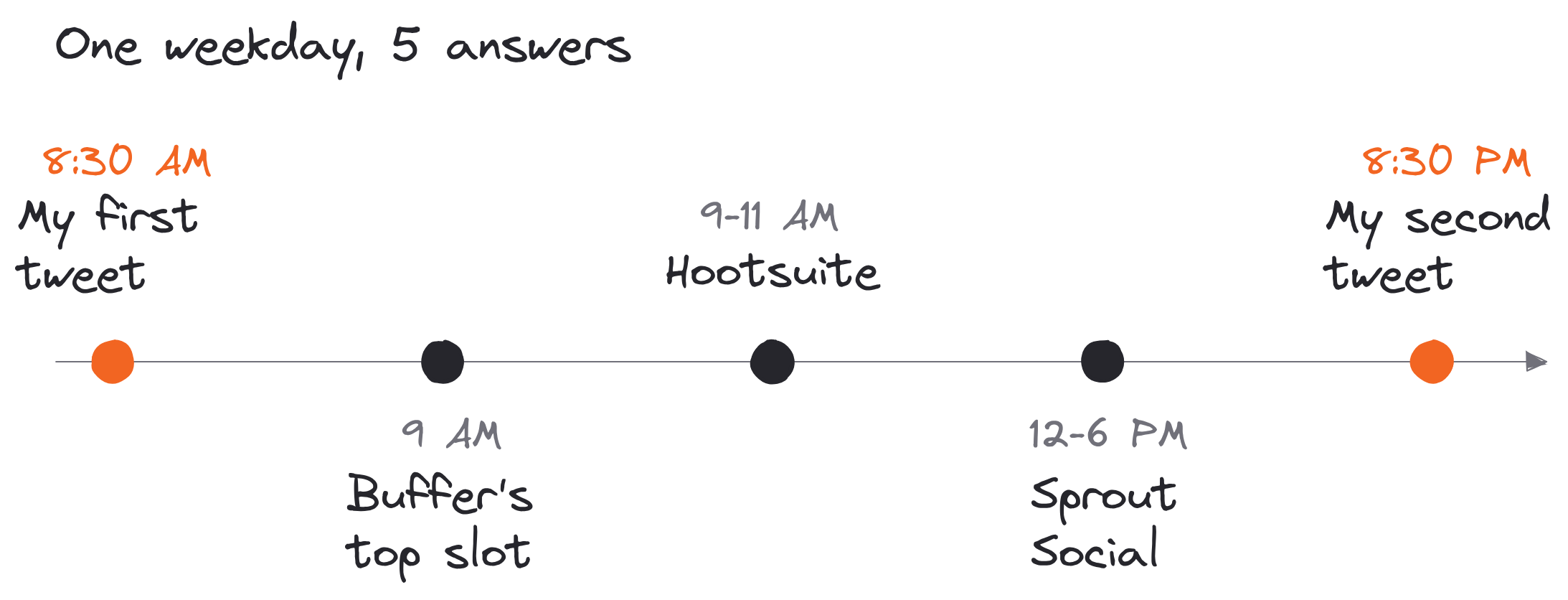
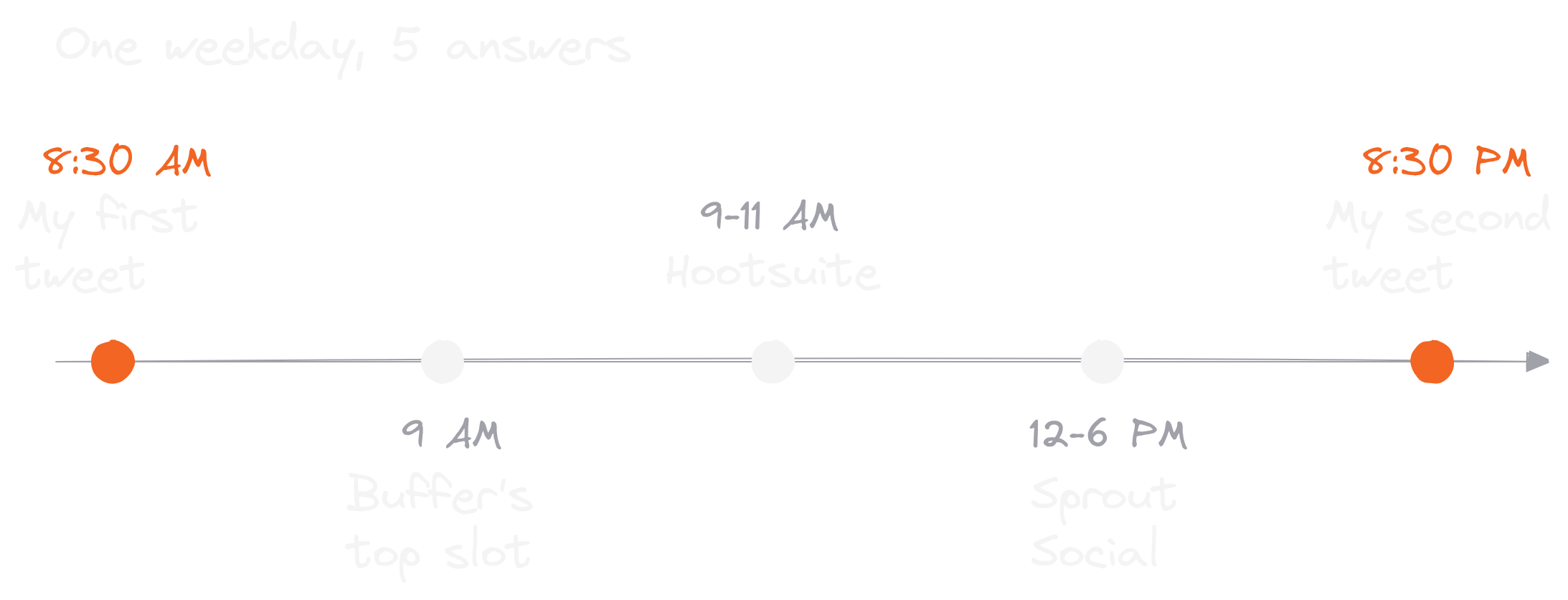
Put all the answers on one weekday and they spread from 8:30 in the morning to 8:30 at night. A 12-hour spread tells you the studies measure the habits of the accounts inside them. Your readers have habits of their own.
So the hour matters less than three things around it:
- What's in the tweet. A weak first line dies at any hour. Before you tune the clock, learn how to write a hook that stops the scroll.
- Showing up at the same times. Readers who see you at 8:30 every morning start looking for you then. A random schedule teaches them nothing.
- Being around when it goes out. Replies in the first hour are where Twitter engagement starts, so post when you can answer them.
Cole puts the first point more bluntly: for the first six months of creating content on the internet, the time you post doesn't matter. He's published at 9 AM, 9 PM, noon and 4 in the morning. What matters early is whether you post anything at all.
Start with a weekday morning slot and an evening one, then let your own numbers move them. That's the best time to post on Twitter until your readers say otherwise.
Study #1: Buffer's Best Time To Post On Twitter
Buffer's answer is the most precise of the three: 9 AM on Tuesday.
Its 2026 study, published March 13, 2026, analyzed more than 8.7 million tweets sent through Buffer and ranked every hour by its median engagement rate, in local time. Its three best slots are Tuesday at 9 AM, Wednesday at 10 AM and Wednesday at 9 AM. And the pattern holds every day of the week: each day's top three hours fall between 8 and 11 AM.
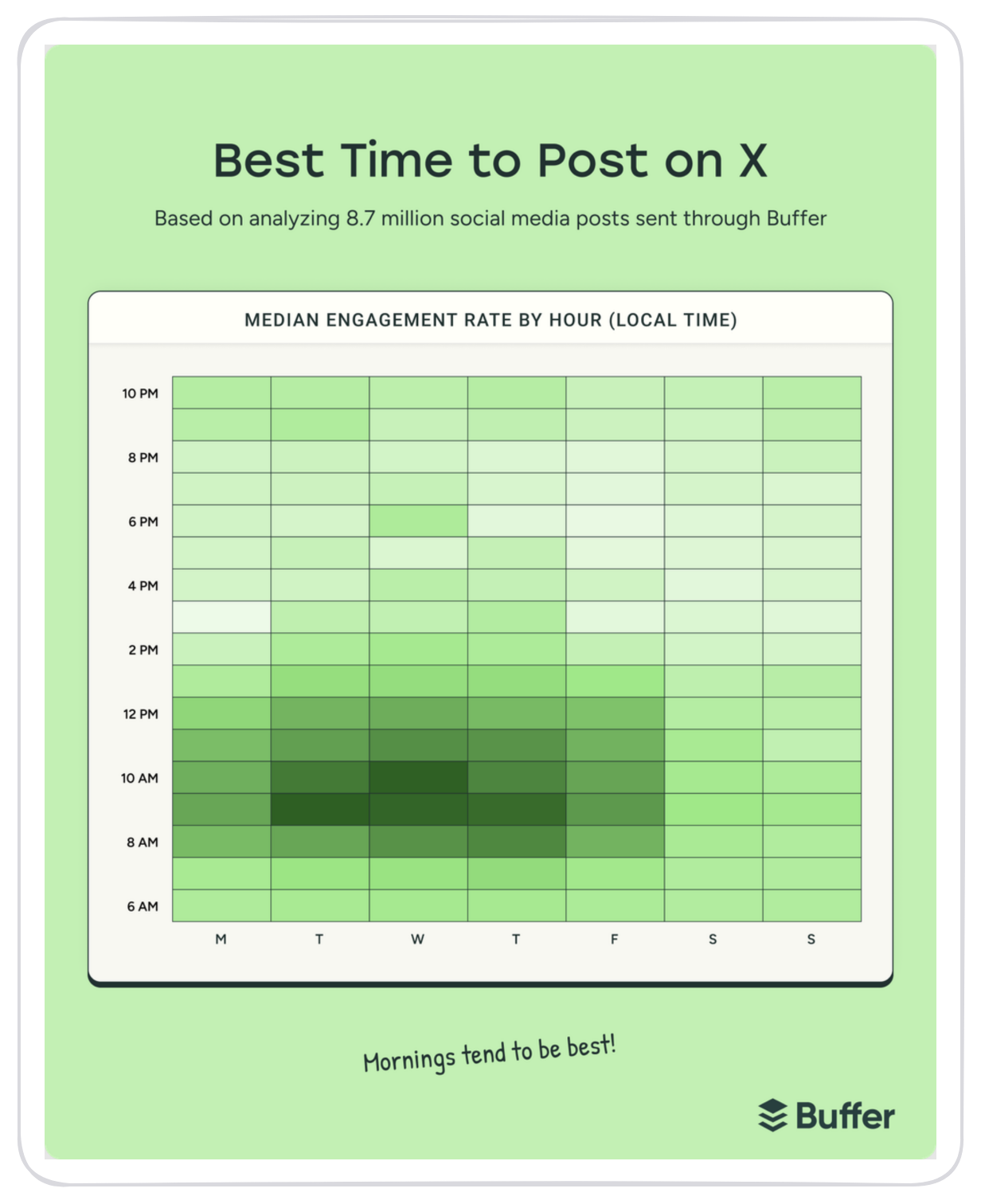
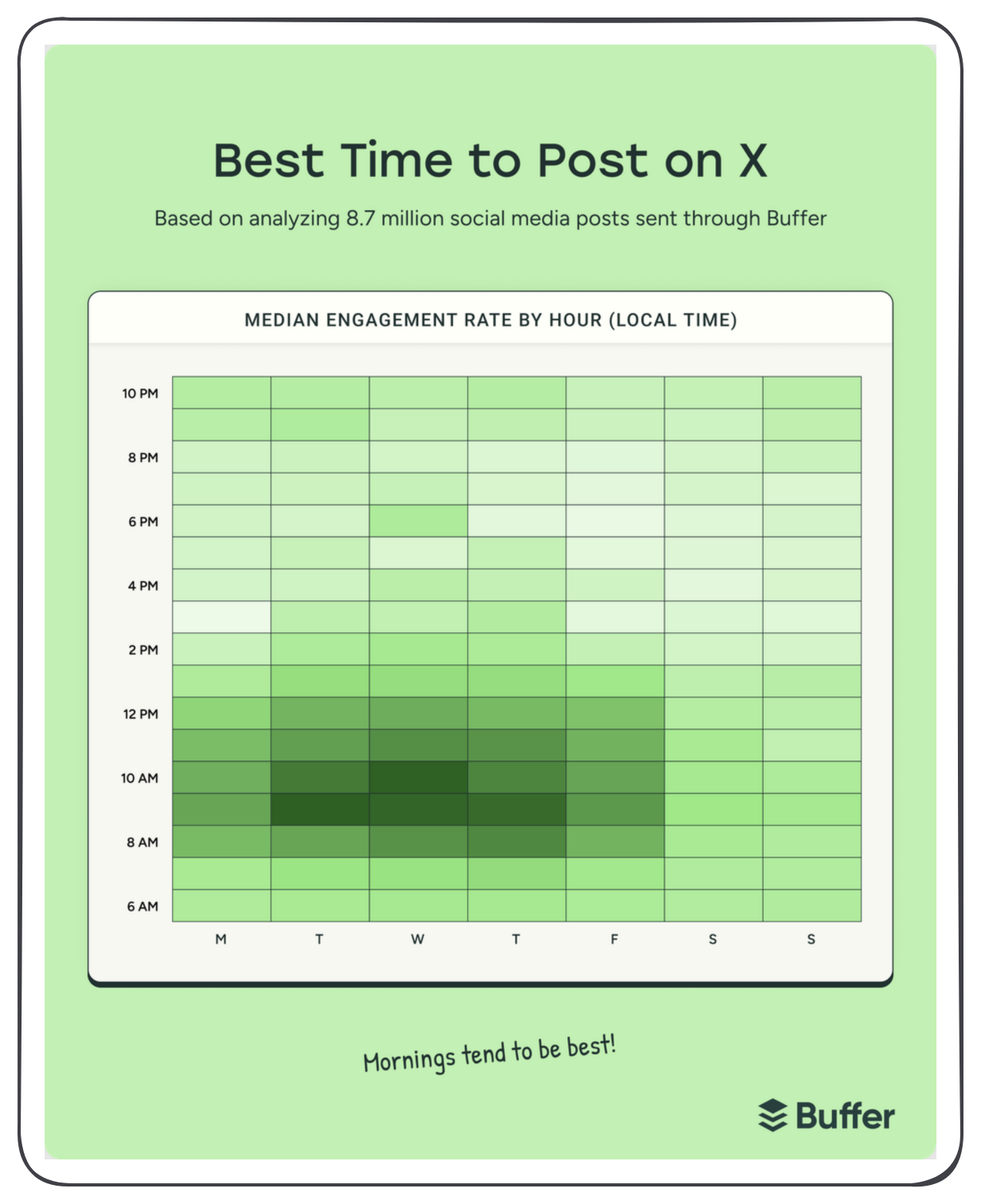
Look at the shape of that chart. The dark band sits between 8 and 11 AM, and everything after lunch fades out. By 4 PM, the cells are about as pale as they get. Buffer's own line under the chart sums it up: "Mornings tend to be best!"
Two things to know before you copy it.
The first is what Buffer counts. It charts the engagement rate, which is engagement divided by the people who saw a tweet. So a morning tweet earns more reactions from each person who sees it. The second is whose tweets these are. Buffer is built for small businesses and creators, so its sample sits closer to a person writing on their own account than a big brand's social team does.
That makes it the study I'd trust most for a writer. Buffer's best time to post on Twitter is your morning slot.
Study #2: Hootsuite's Best Time To Post On X
Hootsuite agrees on the morning and stretches it later in the week.
Its study of the best time to post on each platform, dated November 19, 2025, comes from over 1 million social posts it analyzed with the data agency Critical Truth, with times made time-zone agnostic across 118 countries. (It doesn't give a separate count for X.) Its best time to post on X: 9 to 11 AM on Wednesday, Thursday and Friday. Day by day, it reads like this:
- Monday: 10 AM
- Tuesday: 10 AM
- Wednesday to Friday: 9 to 11 AM
- Saturday: 8 to 10 AM
- Sunday: 9 AM to noon
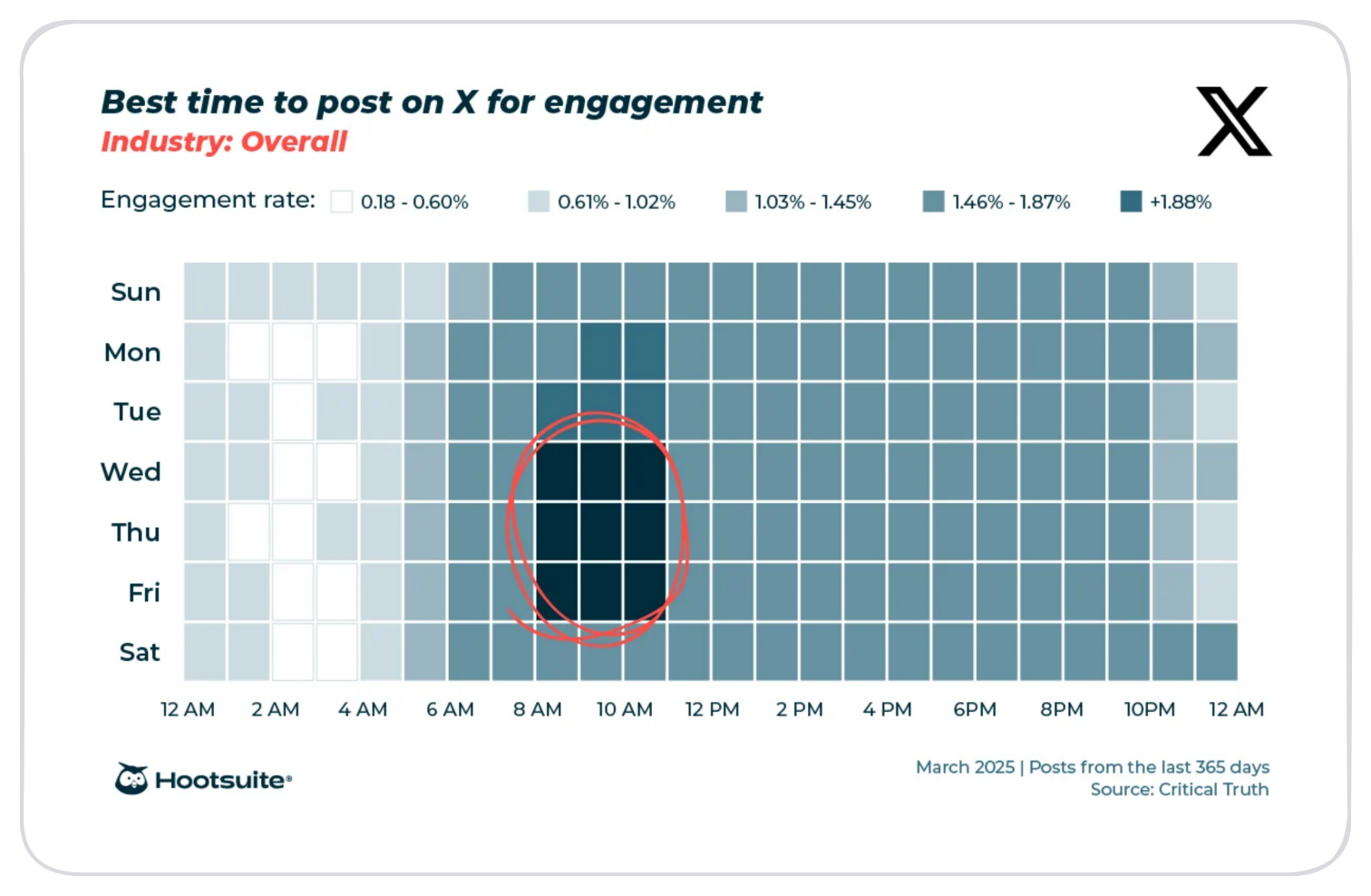
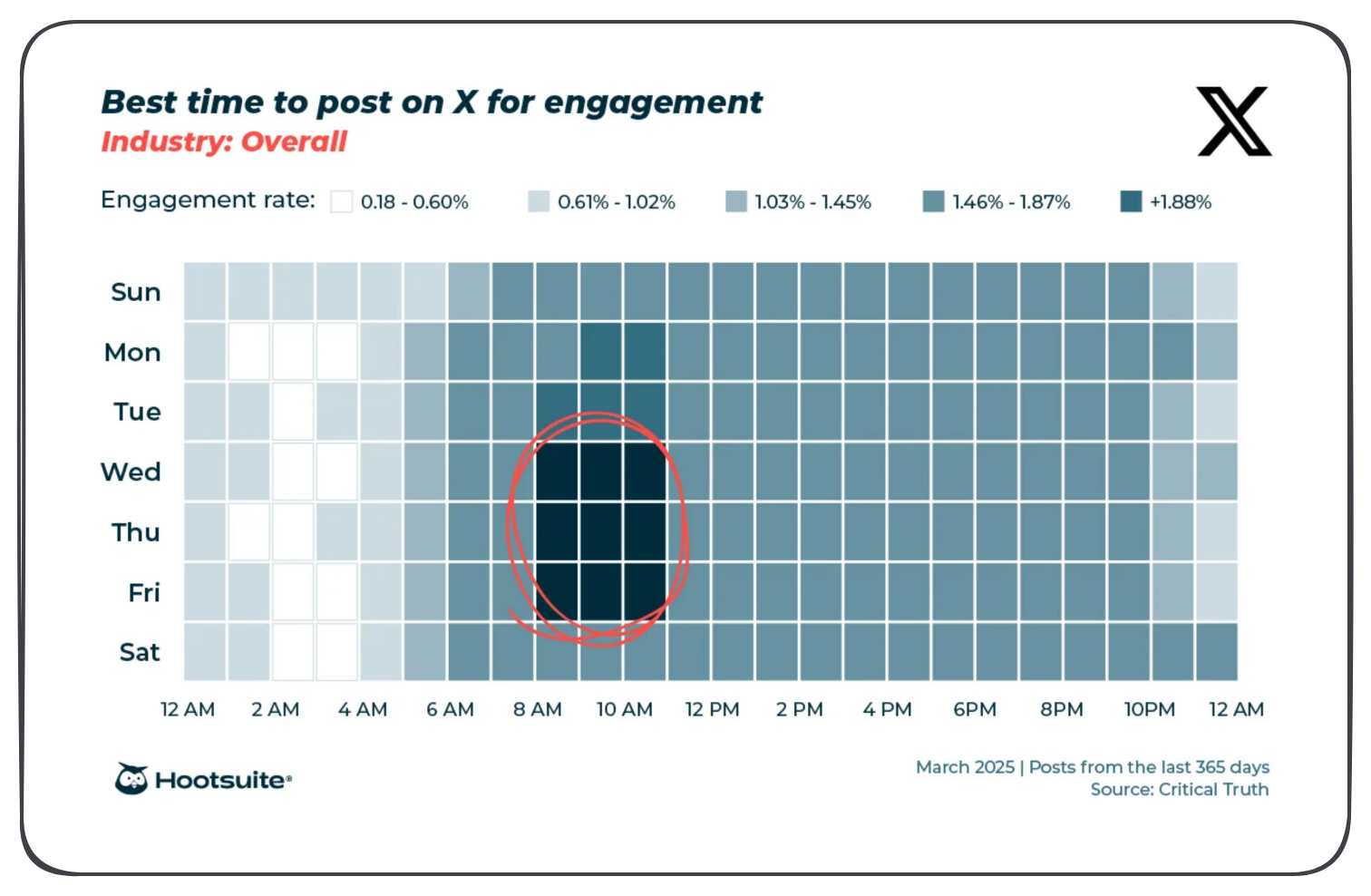
Notice how flat the rest of that chart is. Outside the circled block, most cells from 6 AM to 10 PM sit in the same middle shade. So Hootsuite's data says there's a clear peak in the morning and a long, even plateau after it. Its worst time is before 5 AM, every day of the week.
One caveat. Hootsuite's chart is dated March 2025 and covers posts from the year before it, so it's the oldest of the three. X's feed has changed since. Still, it lands on almost the same hours as Buffer's newer data, which makes the morning answer harder to argue with.
If you can only post once a day, Hootsuite's best time to post on X is the slot to start with.
Study #3: Sprout Social's Best Time To Post On X
Sprout Social disagrees with the other two.
Its 2026 analysis looked at nearly 2 billion engagements across about 307,000 social profiles from November 2025 to February 2026, with every time in the local time of the people posting. Its best time to post on X is noon to 6 PM, Tuesday to Thursday. The rest of the week reads:
- Monday: 2 to 3 PM, and 5 PM
- Friday: noon to 6 PM, with less engagement than midweek
- Saturday: avoid posting
- Sunday: 2 to 6 PM, with less engagement than midweek
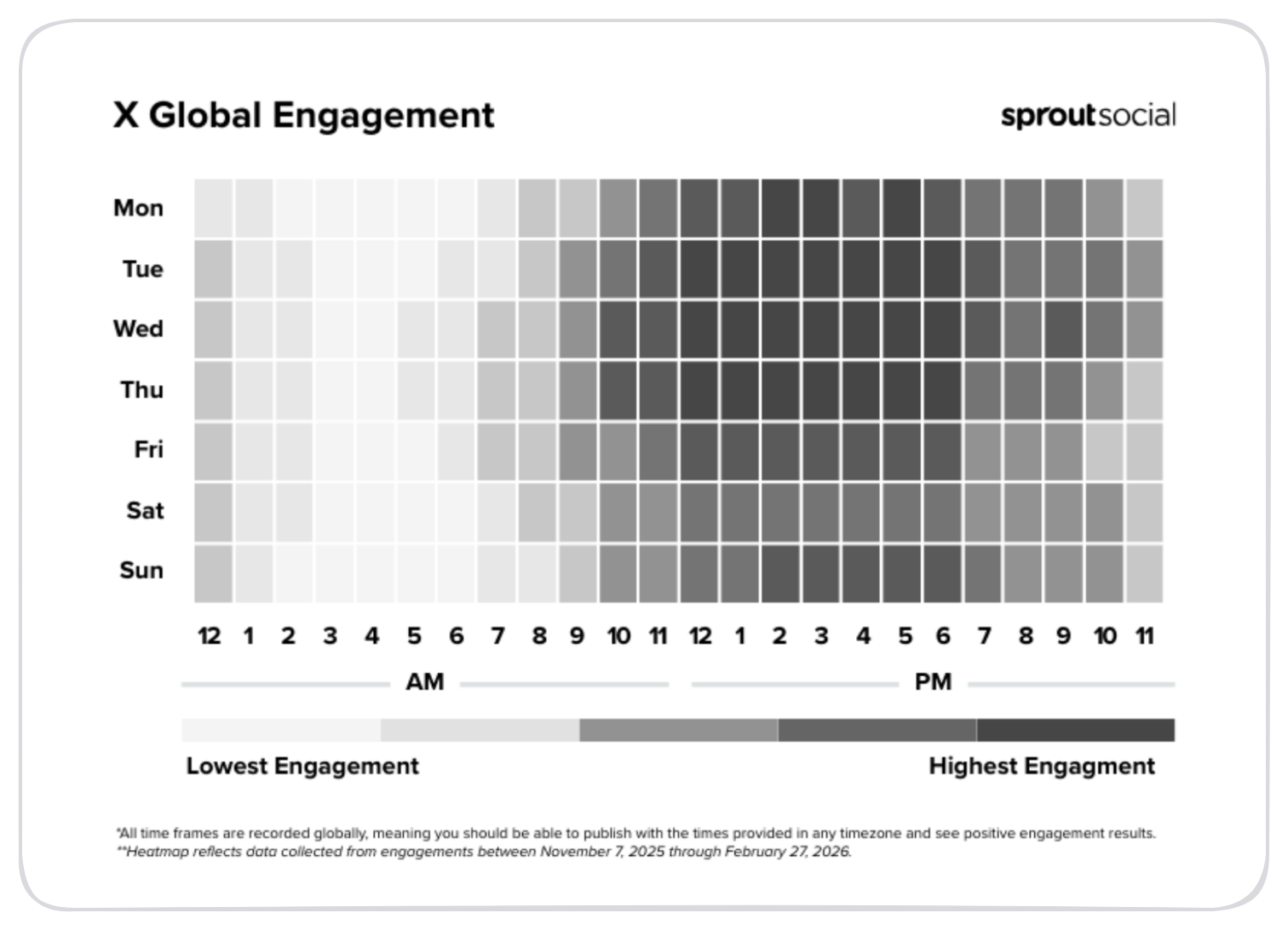
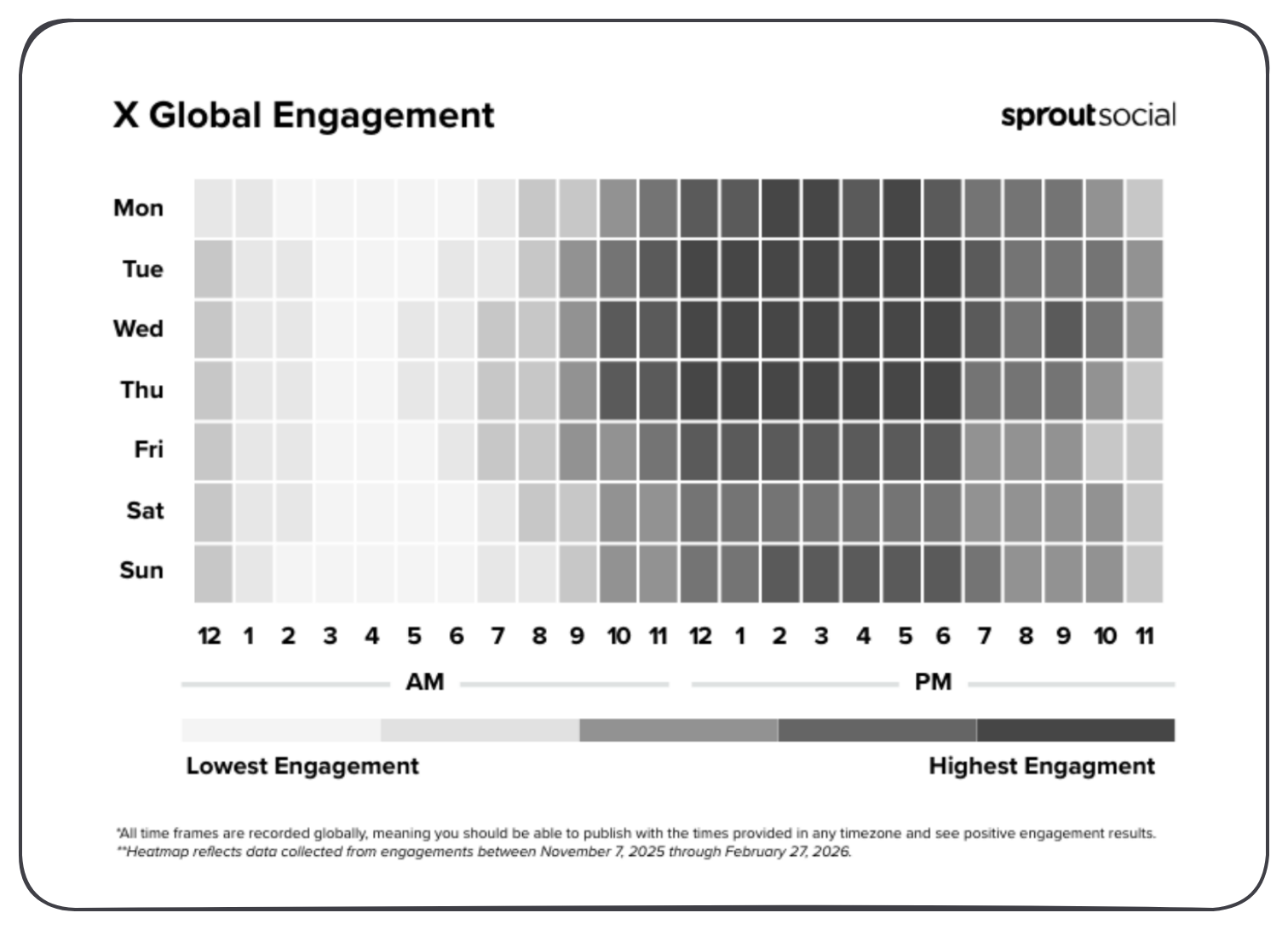
How can it land in the afternoon when the other two say morning? Look at what it counts. Sprout measures total engagement, so its chart shows when the most likes and replies happen across X as a whole. That's when the crowd is biggest. But a crowded feed is also where a single tweet is easiest to miss, and a total counts the whole feed at once.
And look at whose accounts these are. Sprout sells to companies and their social media teams, so most of those 307,000 profiles are brands. A brand's product update and a writer's idea reach different readers, for different reasons.
So Sprout answers a different question: when is X busiest? If your readers are at work and scroll at lunch, Sprout Social's best time to post on X is your afternoon candidate.
What The 3 Studies Agree On: The Best Day To Post On Twitter
The hours disagree, but the days mostly don't.
Put the three studies side by side and three things hold in all of them:
- Midweek is strongest. Wednesday is Buffer's best day, sits in Hootsuite's top window and is one of Sprout's three peak days. Tuesday and Thursday are close behind in all three.
- Saturday is weakest. Buffer ranks it last, Sprout says to avoid it, and Hootsuite leaves it out of its top window.
- Friday fades. Buffer ranks Friday second-worst, and Sprout calls Friday "moderate" next to its peak days. (Hootsuite is the exception: Friday is in its top window.)
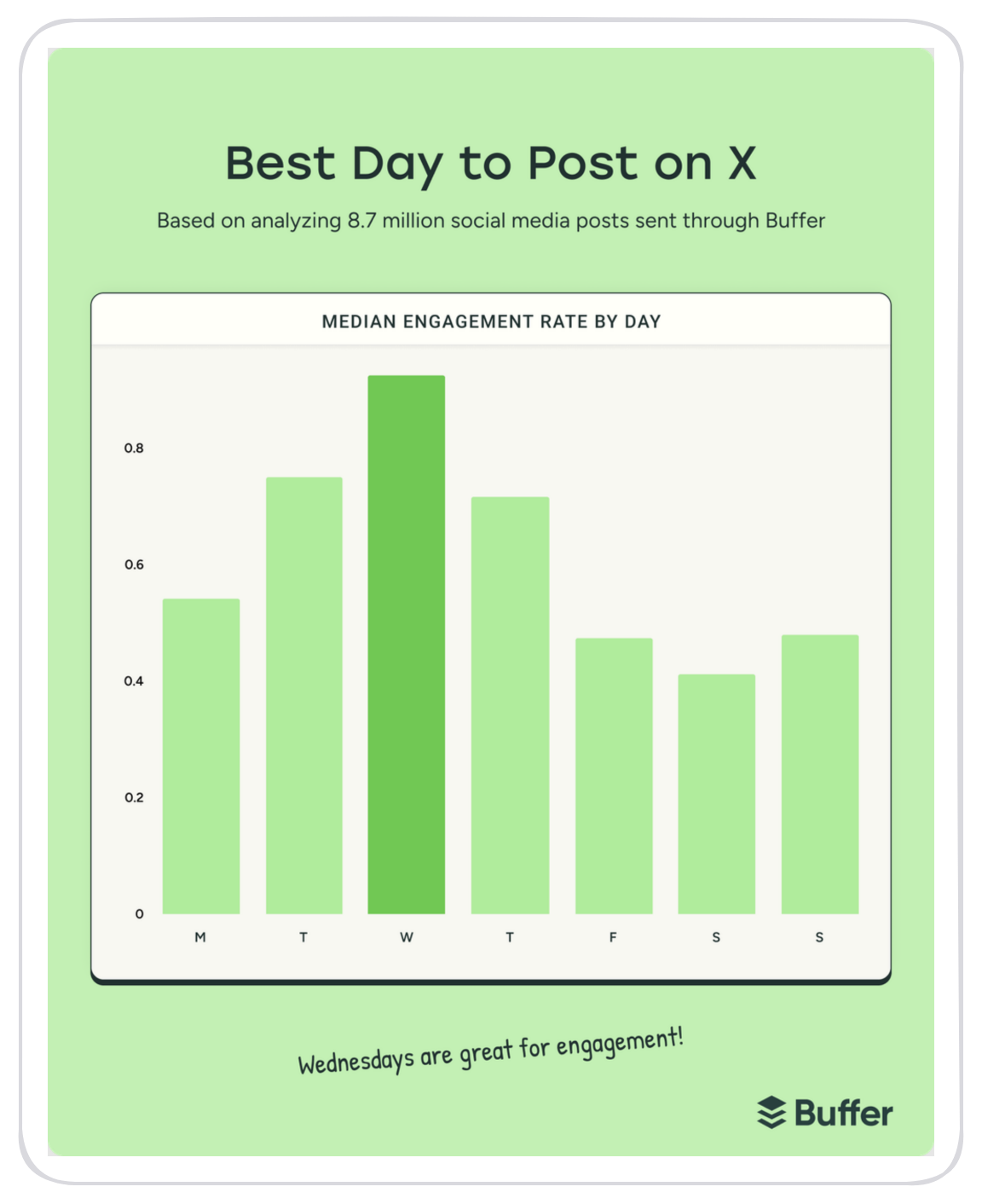
So the best day to post on Twitter is Wednesday, then Tuesday and Thursday. If you're only posting a few days a week, start there and add the rest as you build up.
But I post on the other four days too.
A Saturday tweet still gets read, by fewer people. I post every day, weekends included, because the habit is worth more than the best day. And the studies disagree on the hours for reasons you can check:
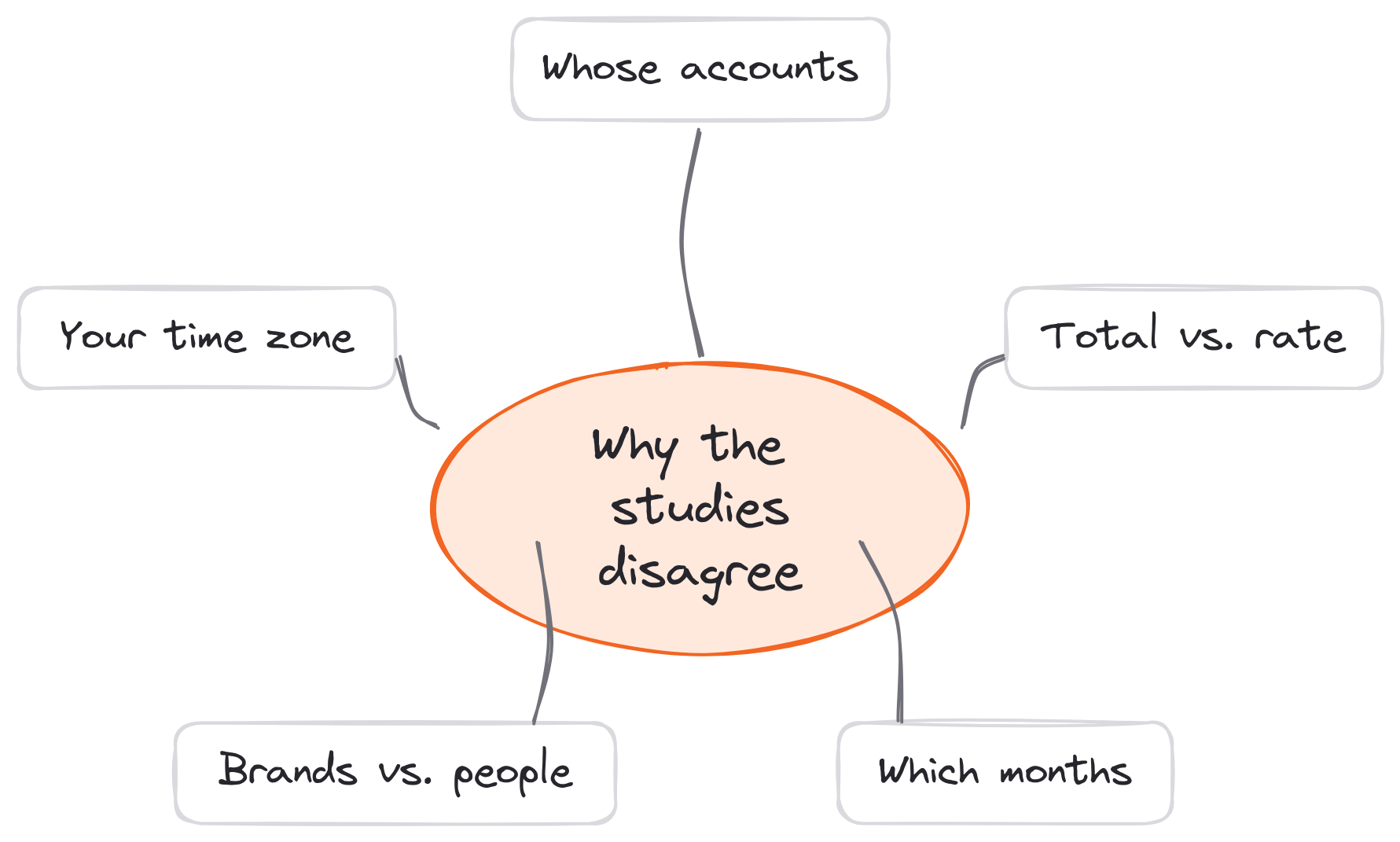
- Whose accounts. Each study only sees its own customers. Sprout's lean toward brands, Buffer's toward small businesses and creators.
- Total vs. rate. Sprout counts total engagement, which peaks when X is busiest. Buffer and Hootsuite chart the engagement rate, which peaks when each reader reacts most.
- Which months. Hootsuite's chart is from March 2025, Sprout's data runs November to February, and Buffer's study came out in March 2026.
- Brands vs. people. A company account and a person's account reach readers in different ways.
- Your time zone. Every study converts to local time, but your readers might not live where you do.
That last one is the one you control. The best day to post on Twitter is midweek; the best hours are whatever your readers answer.
Why I Post Twice A Day At 8:30 AM And 8:30 PM
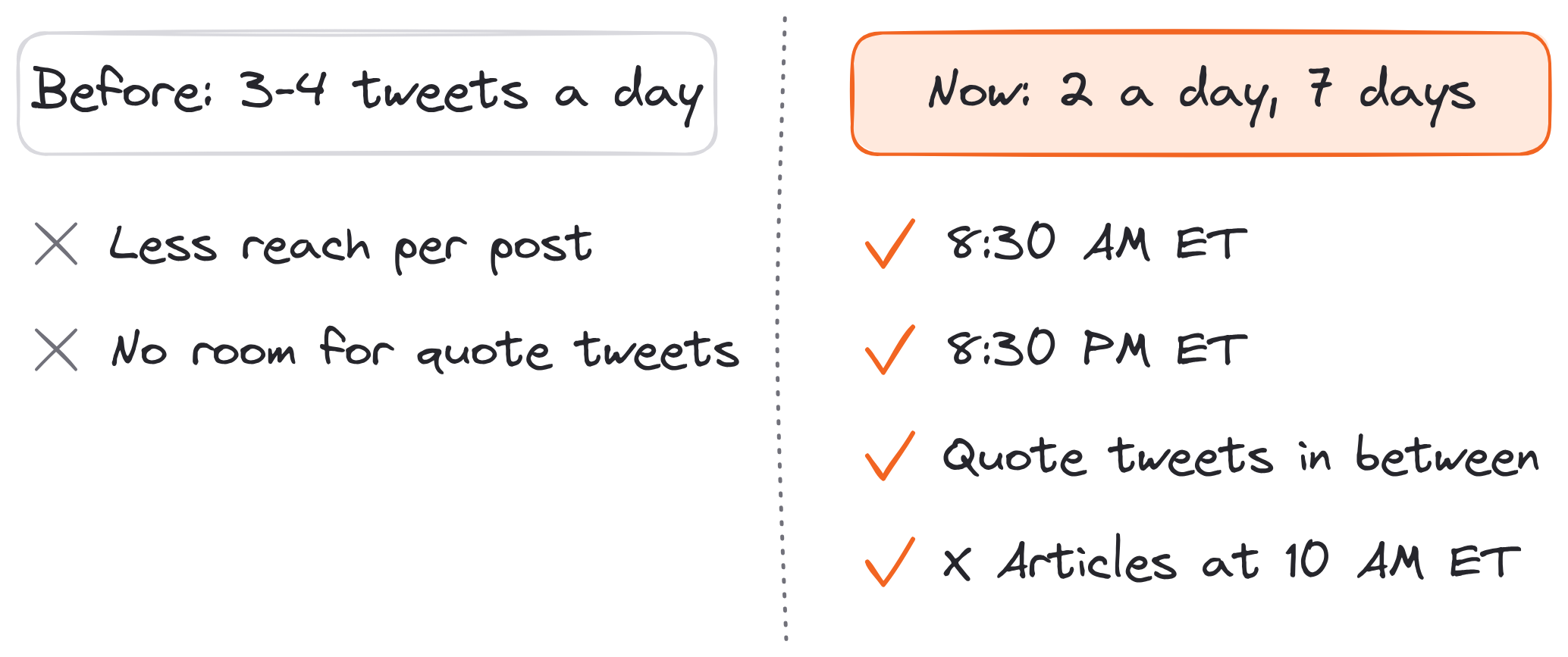
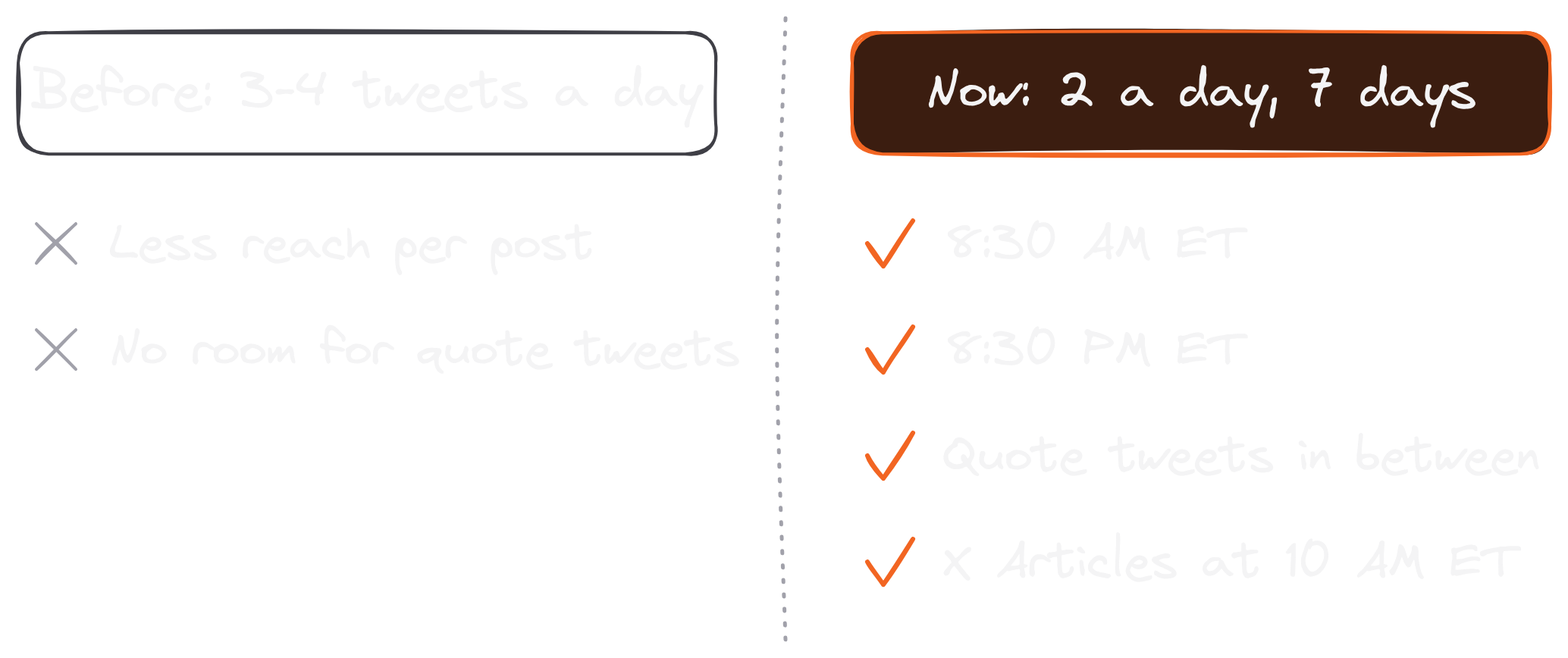
I used to post 3 or 4 times a day.
Then we noticed that volume on X is marginally punished compared with how it used to be. Each extra tweet earned a little less reach. So we cut back to 2 short-form posts a day, at 8:30 AM and 8:30 PM ET, every day of the week. That's the same cadence I keep in the breakdown of everything I publish each week, and I cross-post both to Substack Notes at the same times.
Two slots beat one perfect hour for a few reasons:
- You catch both scrolls. The morning slot sits right before the 9 to 11 AM window that Buffer and Hootsuite both rank highest. The evening slot reaches the people who were in meetings all day.
- You reach two time zones. 8:30 PM in New York is the next morning in Tokyo. One tweet a day can only be early for one half of your readers.
- You leave room for the unplanned. Fewer scheduled tweets leave space for off-the-cuff tweets and quote tweets. We post 5 to 7 quote tweets a week, unscheduled, whenever a viral question deserves an answer. (Here's how to quote tweet so it borrows the original's reach.)
- You give long-form its own slot. My X Articles go out 3 times a week at 10 AM ET, inside that morning window, because they get outsized reach.
The minute itself is arbitrary. In my 2023 plan, my daily Atomic Essay on Twitter went out at 8 AM. What stayed the same was the habit: the same two times, every day, for years.
And here's where I'd side with Cole. If a tweet is good, it doesn't matter whether you post at 7 AM or 7 PM: the world will see it. Posting twice a day gives you twice as many chances to write that tweet.
That's why I post twice a day at 8:30 AM and 8:30 PM.
The 4-Week Test: Find The Best Time To Post On X For Your Readers
The only study that counts is the one you run on your own readers.
It takes 4 weeks and two candidate slots. Slot A is your morning default, 8:30 or 9 AM. Slot B is the strongest rival. I'd test an afternoon slot from Sprout's window, 1 PM, or move your second daily tweet from evening to afternoon. Then alternate them:
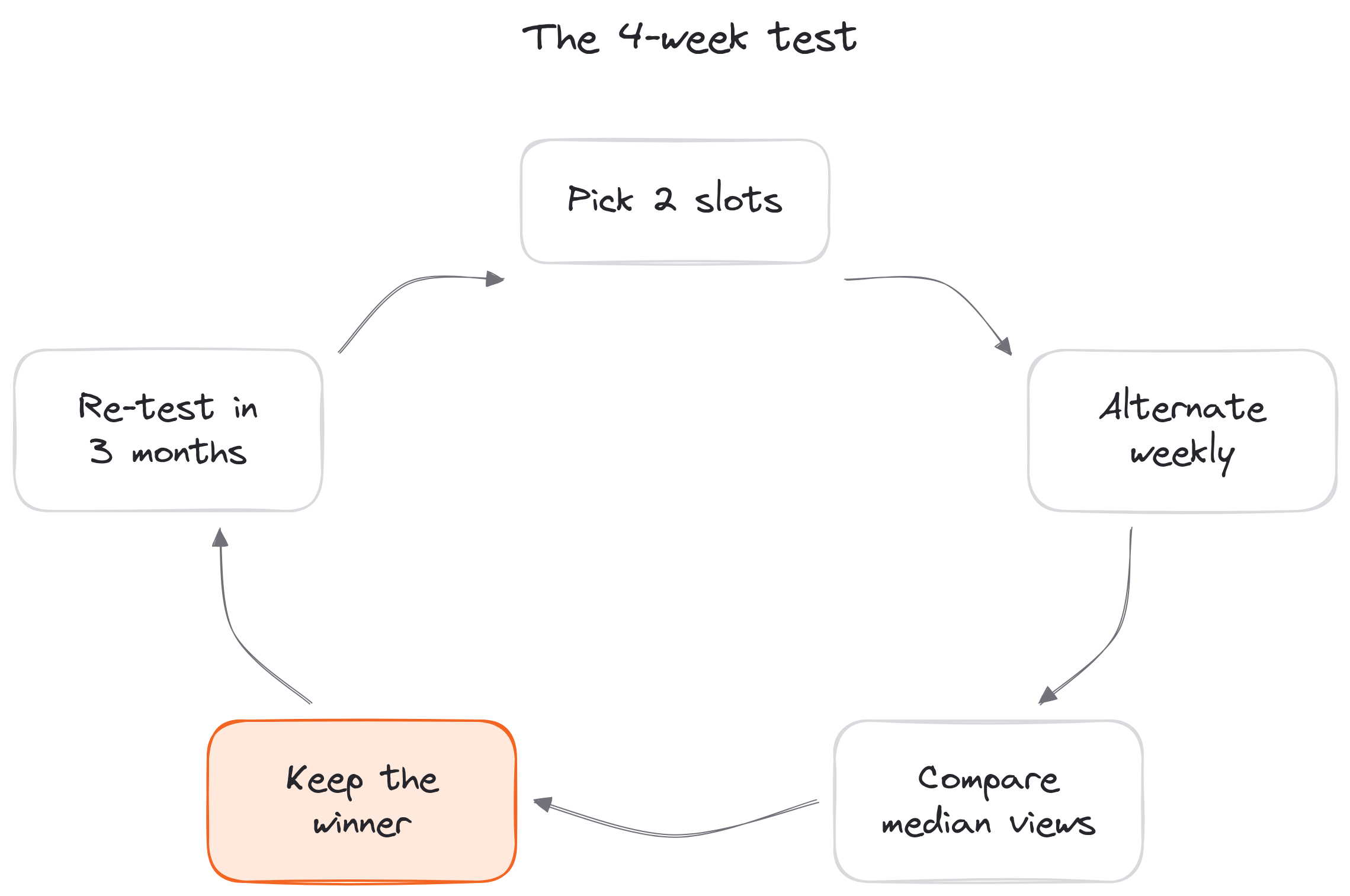
- Week 1: post every planned tweet at slot A. Same days you post now. Don't change anything else.
- Week 2: move them to slot B. Same days, same kinds of tweets, same length.
- Week 3: back to slot A. Alternating weeks keeps one viral tweet (or one holiday week) from deciding the whole test.
- Week 4: back to slot B. Now each slot has two weeks of tweets behind it.
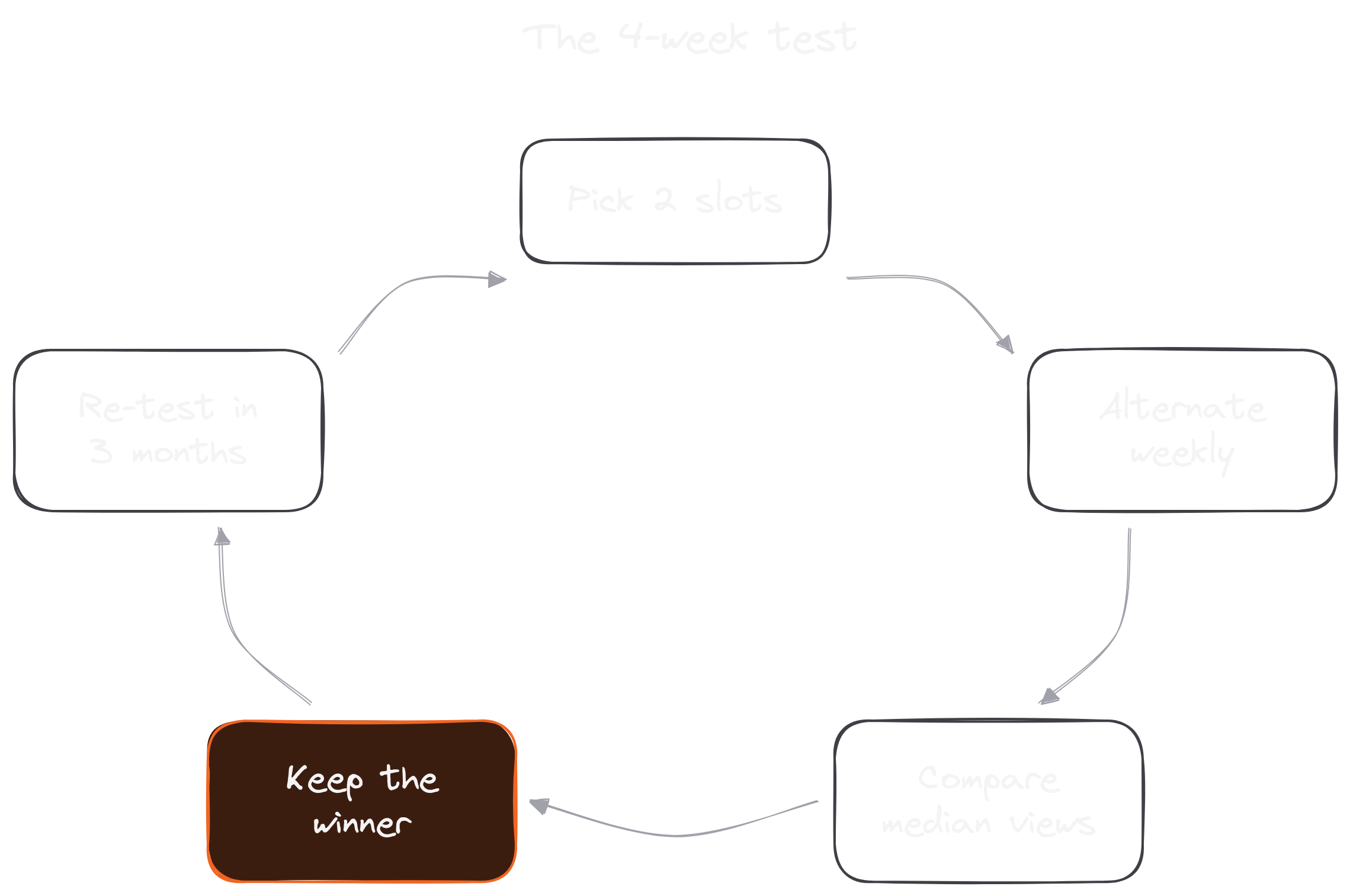
- Compare and keep the winner. Note each tweet's views, likes and replies 7 days after it went out, then compare the typical tweet from each slot: the median, the one in the middle of the pack.
Where do the numbers come from? X puts a view count under every post. Or, if you post through Typeshare, open Analytics, set the Platform filter to X, and every tweet sits in the Posts table with its views. X shares views with Typeshare, and Typeshare reads each post 2 hours, 1 day, 3 days and 7 days after it goes out, so the 7-day number fills in on its own.
A few rules keep the test honest:
- Change one thing. If week 2 is all threads and week 1 was single tweets, you're testing formats, not times.
- Expect noise. One tweet that takes off can swamp a week. That's why you compare the median and run each slot twice.
- Call a tie a tie. If the slots come out close, keep the one that's easier to hit every day.
The best time to post on X is a question only your readers can answer, and 4 weeks is enough to hear them.
How To Post At The Best Time On X Every Day
A winning slot is worth nothing if you miss it.
This is where most people slip. They find their time, hit it twice, then a busy morning knocks them off. The fix is to stop relying on being free at 8:30. Write ahead, and let each tweet go out on its own:
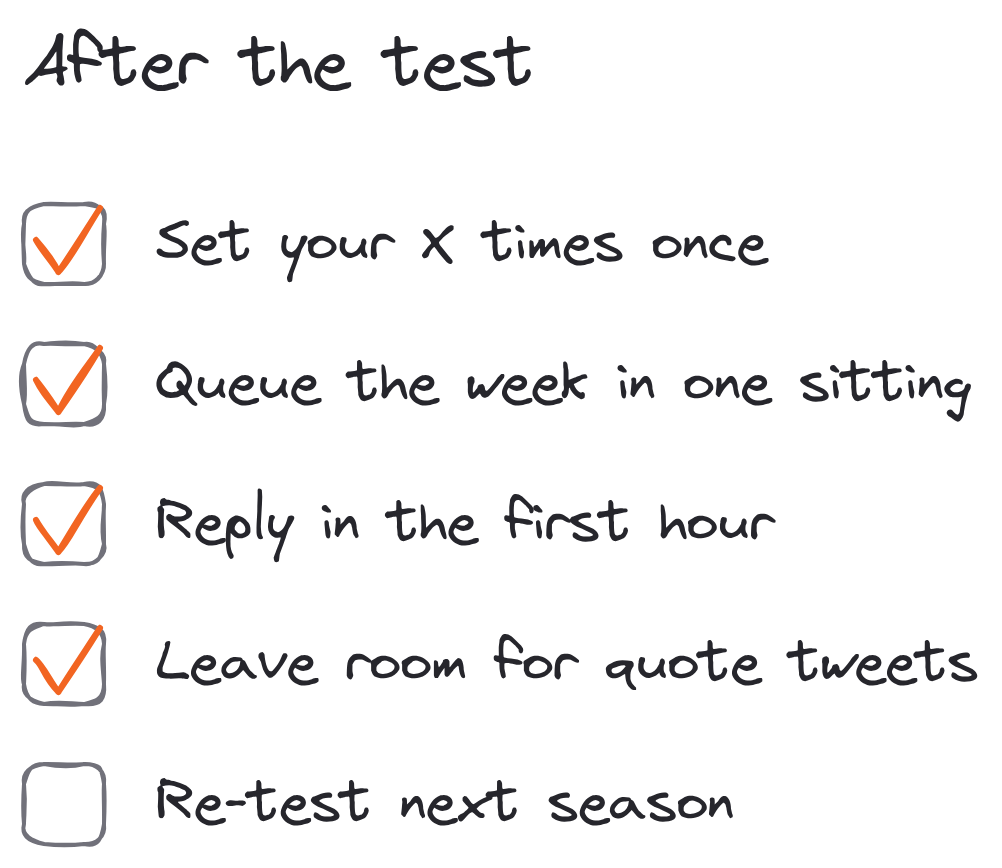
- Set your times once. In Typeshare, open Schedule, click Edit times, pick X at the top, then click Schedule: … and start from a preset: Beginner (one tweet each weekday morning, around 8 AM), Pro (every day around 8 AM and 8 PM, the closest to mine) or Expert (every day around 8 AM, noon and 8 PM). Drag a time to your winning slot and click Save. The scheduling help doc covers every option.
- Queue the week in one sitting. Write on Sunday, add each tweet to your queue, and it takes the next open slot. Here's how to schedule tweets step by step.
- Reply in the first hour. Your posting time is also your reply time. Cole spends 20 minutes interacting with his audience every morning.
- Leave room for quote tweets. Two scheduled slots a day leaves the rest of the day open for whatever is going viral.
- Re-test next season. Your readers change, and so does X. Run the 4 weeks again every few months.
Two settings worth knowing. Natural times is on by default: each tweet goes out up to 30 minutes either side of its slot, at a different minute each day, so your posts don't look scheduled (turn it off for a time if you want the exact minute). And your times follow your space's time zone, so if most of your readers live in New York and you don't, set the zone to New York and post at their morning.
And if filling two slots a day is the hard part, the X Agent drafts tweets from your own past writing for the open slots, and you review each one before it goes out.
Find your best time to post on X once, then post at it every day.
FAQ
What is the best time to post on Twitter?
A weekday morning between 9 and 11 AM in your readers' time zone is the safest start, with Tuesday at 9 AM ranked first by Buffer's study of 8.7 million tweets. Sprout Social puts it later, noon to 6 PM. Post a second tweet in the evening and run a 4-week test to settle it for your own readers.
What is the best day to post on Twitter?
Wednesday, with Tuesday and Thursday close behind. All three big studies rank midweek highest, and Buffer and Sprout Social both rank Saturday lowest.
Is it better to tweet in the morning or the evening?
Studies of engagement rate (Buffer, Hootsuite) favor the morning. The evening reaches people who were busy all day, and readers in other time zones. I post at both, 8:30 AM and 8:30 PM ET.
How many times a day should you tweet?
Once or twice a day is plenty for most writers. I cut back from 3 or 4 tweets a day to 2, because volume on X is marginally punished compared with how it used to be.
Should you post on Twitter on weekends?
You can. Saturday gets the lowest engagement in the studies, but posting every day builds the habit, for you and your readers. I post 7 days a week.
Does the best time to post on X depend on my time zone?
Yes: it depends on your readers' time zone. Every study gives local times, so if most of your readers are in New York and you're in London, post at their morning.