How To Write A Hook: 7 Steps To A First Line That Gets The Second One Read (In Posts, Newsletters And Essays)
Nicolas ColeNovember 14, 2026
How to write a hook in 7 steps: pick the reader and the promise, draft 10, cut the warm-up and check the first line where it shows. Plus essay hooks.
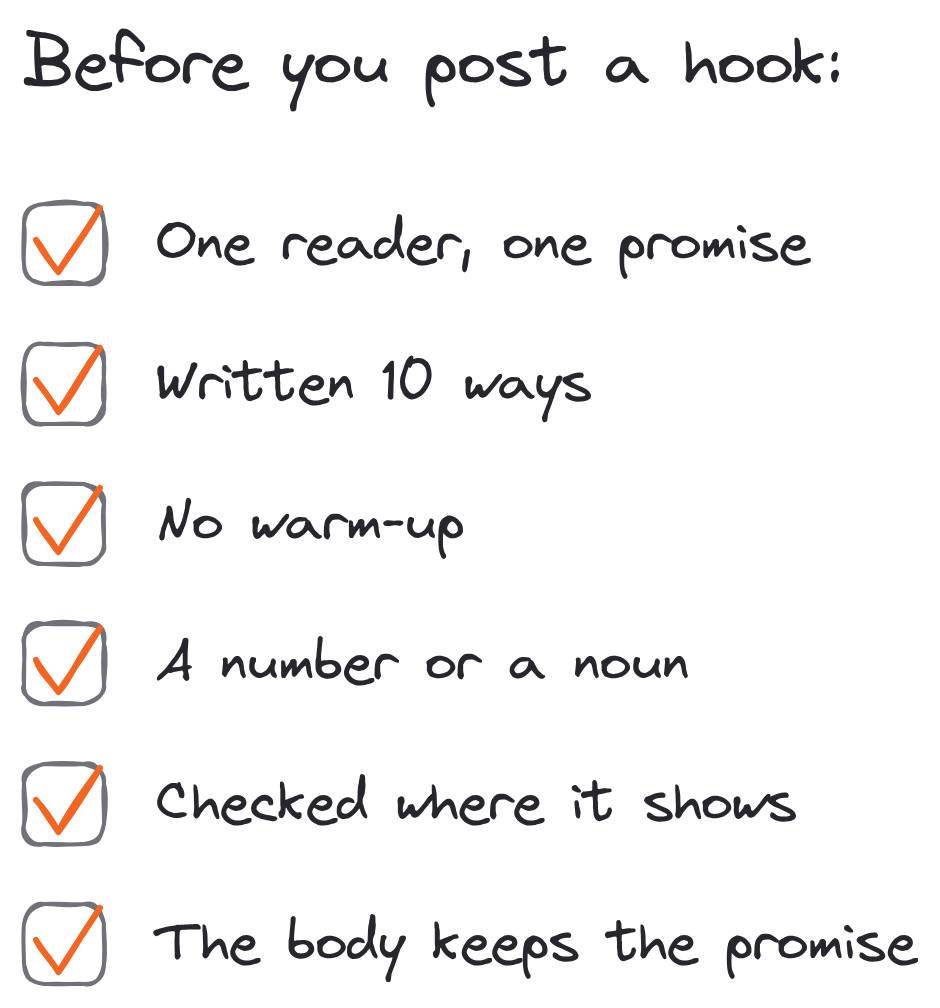
Your first sentence has a job: get the reader to read the second one.
Most writers know that by now. Where they get stuck is the how. They stare at the top of a blank draft, type something that sounds like an introduction and hope it's good enough. It usually isn't, because a reader gives your first line a second or two before they decide. Nobody can write a great opening by hoping.
So this is the process, step by step.
Why listen to me? I've spent more than 3,500 hours obsessing over how to write the perfect headline. With Dickie Bush I've taught more than 10,000 writers through Ship 30 for 30, where we spend 2 of our 8 live sessions on hooks and headlines alone. Below are the 7 steps I'd give any of them, plus how to write a hook for an essay. If you're not sure what counts as a hook yet, start with what a hook is. If you'd rather copy than build, there are 100 hook examples sorted into 10 types. And when you're ready to try one, write your next post in Typeshare. You do the writing; the robots do the rest.
Step #1: Know The One Reader And The One Promise (How To Write A Hook That Starts From The Reader)
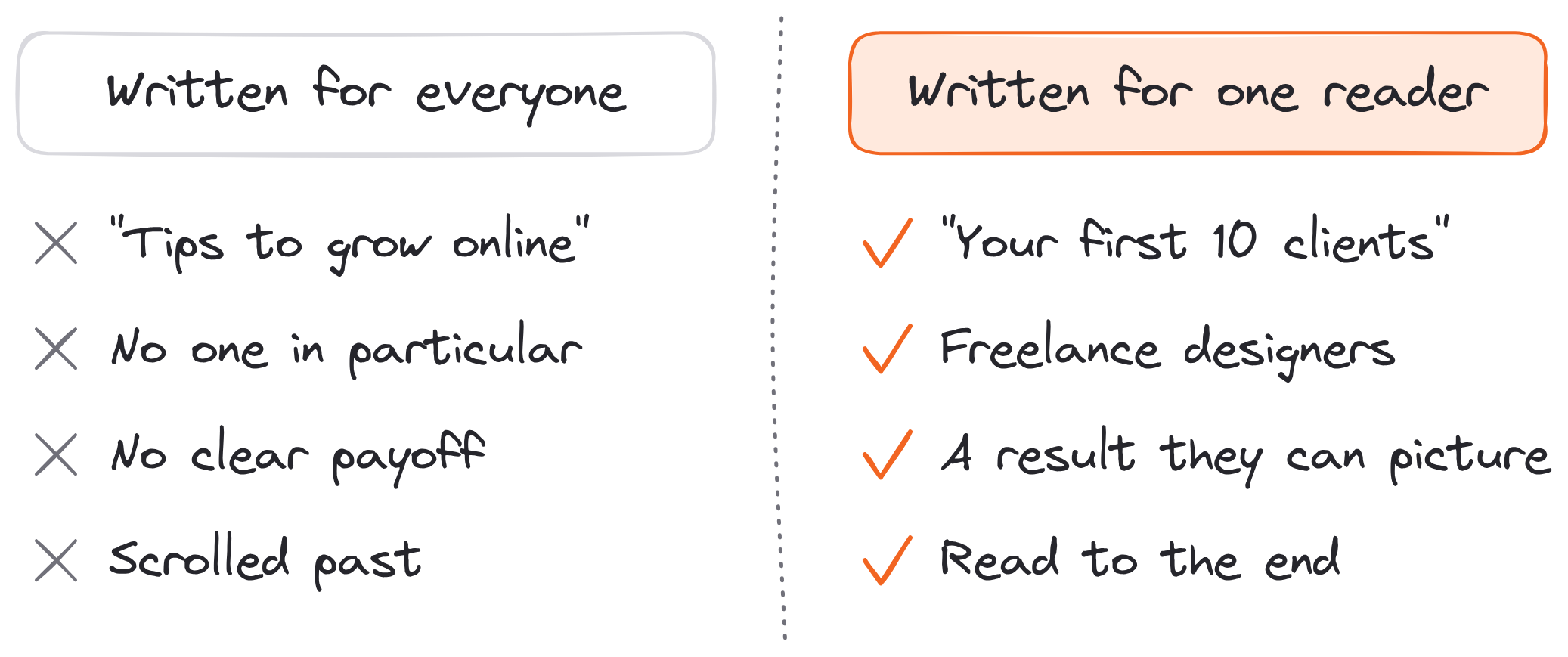
A hook written for everyone is read by no one.
That's the first trap, and I've written about it more than once: 99% of writers try to write for everyone. The result is a first line so general that nobody feels it was meant for them. Before you write a single word of your hook, you need two things. One reader, and one promise to that reader.
Answer these three questions first:
- Who is this for? Name them: freelance designers in their first year. New managers. Writers with fewer than 100 subscribers.
- What problem do they have right now? The one they'd type into a search bar at 11 p.m.
- What do they get for reading? A result they can picture: a first client, a calmer Monday, a newsletter that gets opened.
Write the three answers down in plain words, even if they're clumsy. Your hook is going to be a short, sharp version of the third answer, aimed at the person in the first. As I put it in one of my weekly reminders: your reader is the main character, not you.
Know the one reader and the one promise, and the hook is half written.
Step #2: Pick A Hook Type (The Starting Points That Already Work)
You don't have to invent a hook from nothing.
Most hooks that work follow a small number of patterns, and readers respond to them because they've been working for a very long time. In my post on 4 proven writing hooks, I called them offers: a ton of value for minimal time, cost or effort, or something you want, instantly. The hook examples page sorts 100 of them into 10 types. Here are 6 of those types, with one sample of each (I wrote these as samples, so swap in your own topic and numbers):
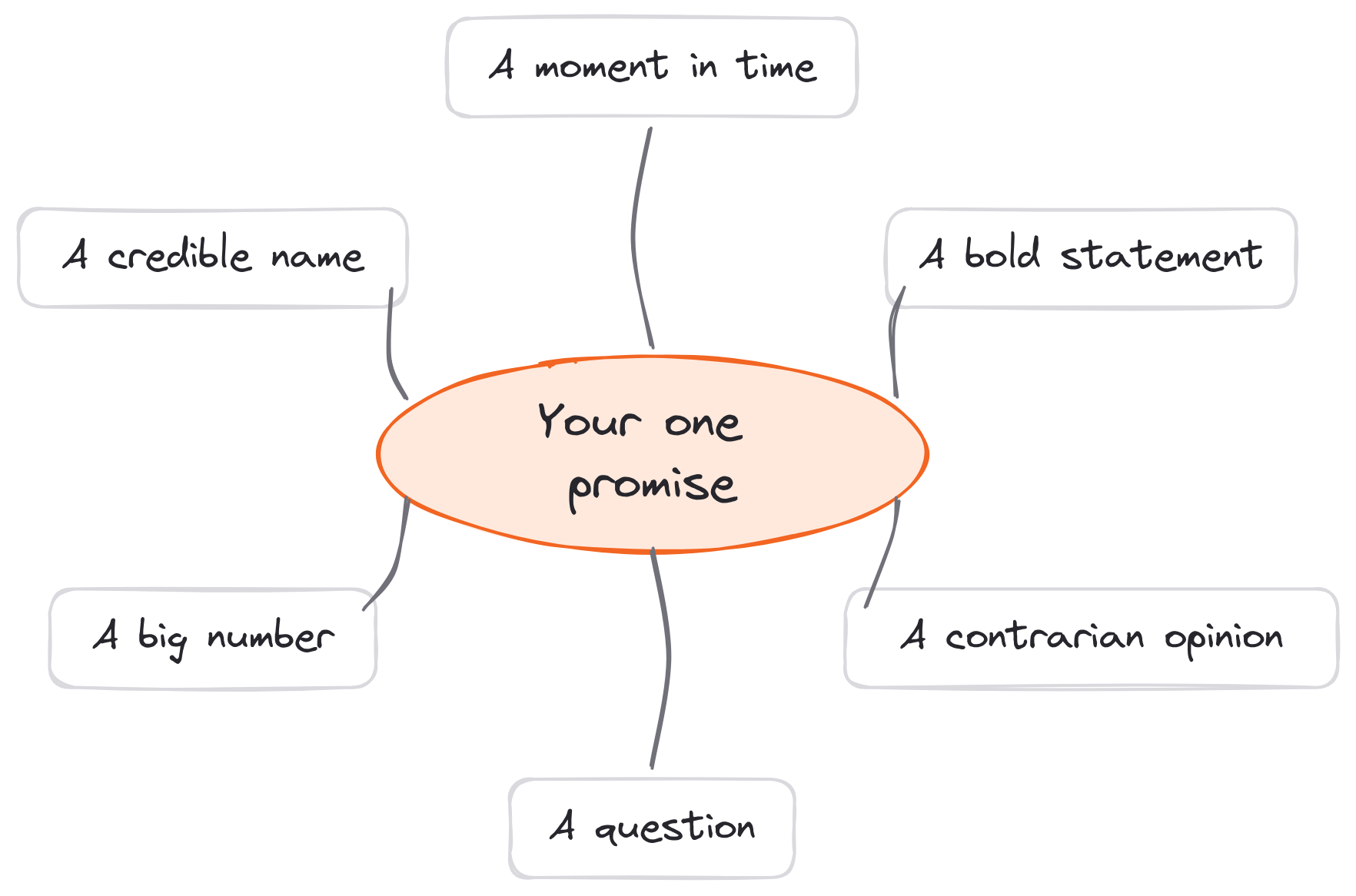
- A moment in time: "The week I lost my biggest client, I wrote my first newsletter."
- A bold statement: "Your first draft is supposed to be bad."
- A contrarian opinion: "Posting every day is the worst advice for new writers."
- A question: "What would you write about if nobody you knew could read it?"
- A big number: "Out of 1,000 first lines, 5 patterns did all the work."
- A credible name: "What a bestselling author told me about my opening paragraph."
Pick the type that fits the promise from Step 1. A story fits a moment in time. A strong opinion fits a contrarian hook. A list of tools fits a big number. (Rotate them. A feed full of questions reads as a quiz.)
Pick a hook type, and the blank page becomes a frame to fill.
Step #3: Write 10 Hooks, Not 1 (The Fastest Way To Write A Good One)
Your first hook is almost never your best one.
It's the most obvious one, which is a different thing. The first version tends to be the line every other writer on your topic would have written too. You only get past it by writing more. So set yourself a number before you start.
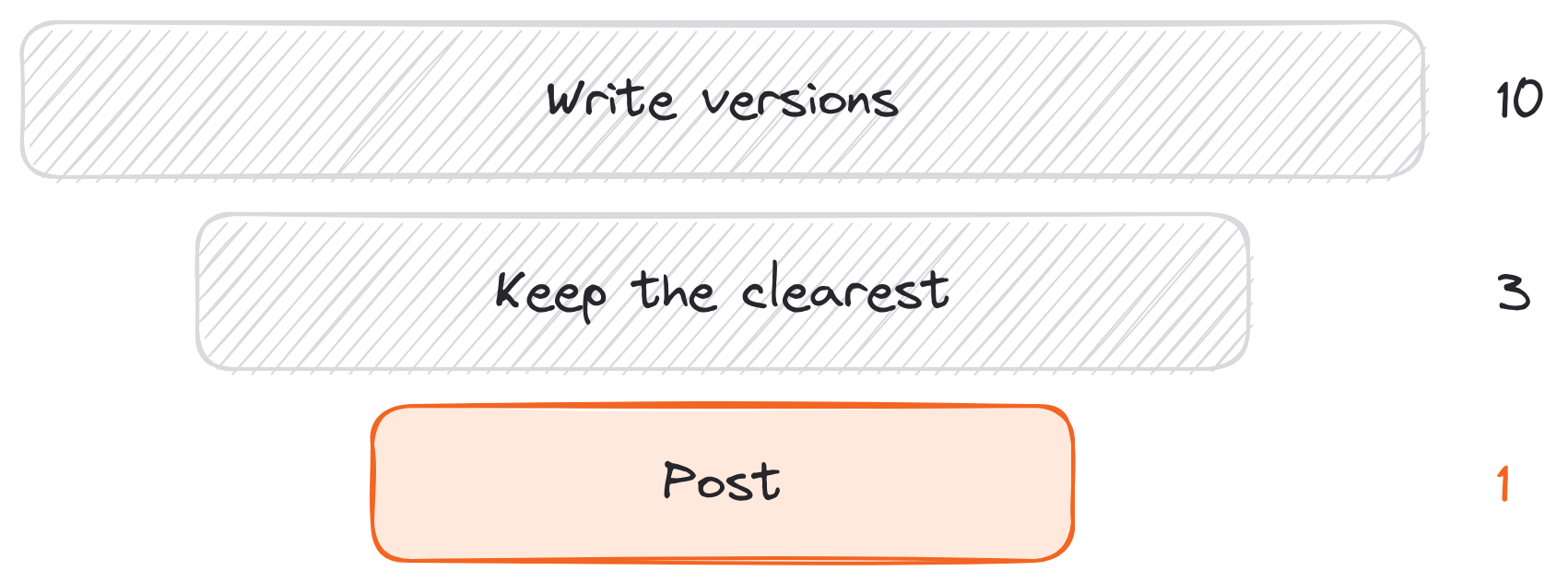
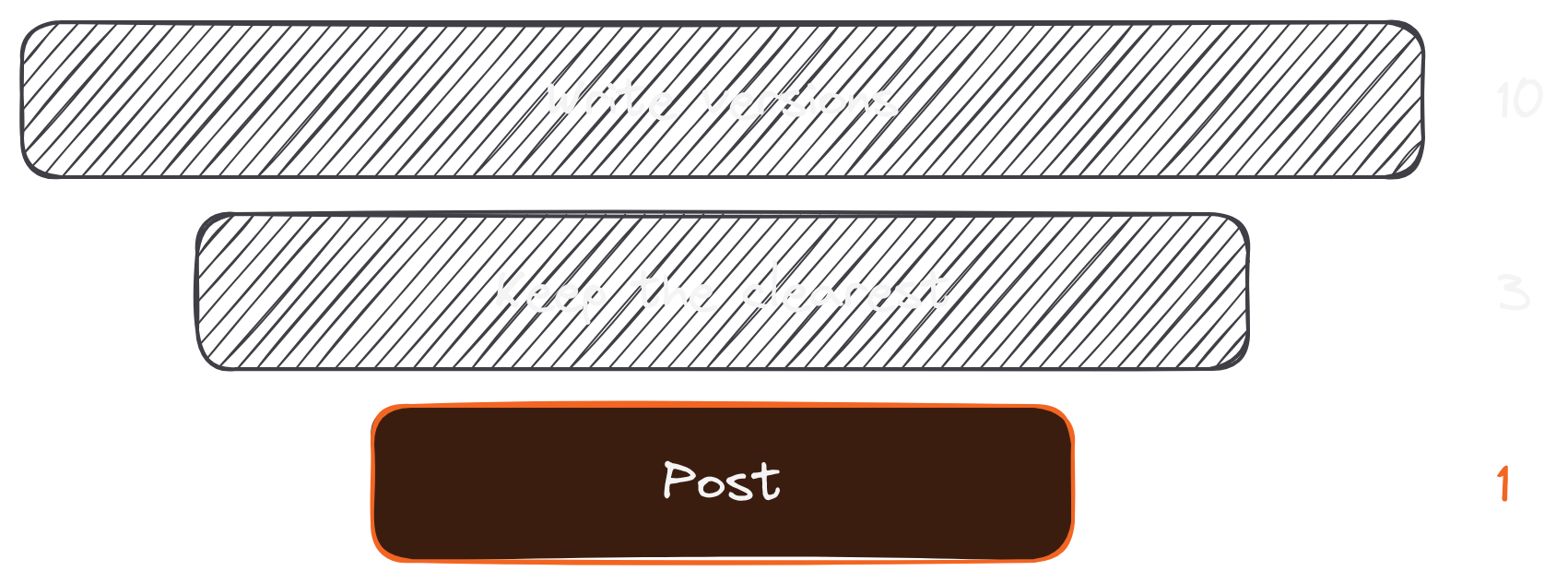
Here's the routine:
- Write 10 versions of the same promise. Use 2 or 3 different types from Step 2.
- Cross out anything vague. If a reader can't picture it, it goes.
- Keep the 3 clearest. Clever can wait.
- Read those 3 out loud. The one you'd say to a friend across the table wins.
- Save the other 9. A hook that lost today is often next week's post.
This takes ten minutes, maybe fifteen. It's also the part most writers skip, because writing the same sentence ten times feels like wasted effort. It's the cheapest editing you'll ever do. Every bad version you write is one you won't post.
Write 10 hooks, not 1, and the best one shows up on its own.
Step #4: Cut The Warm-Up (Start Where Your Point Starts)
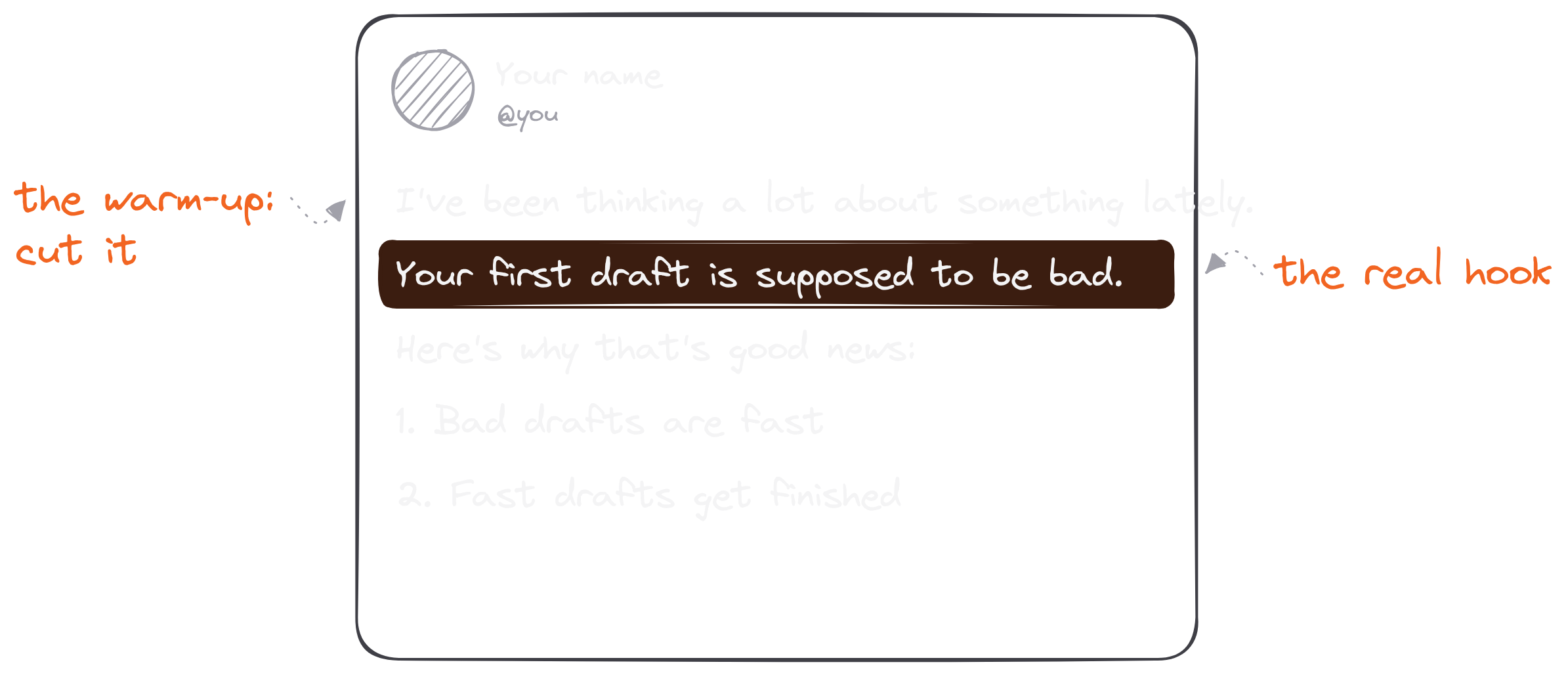
"I've been thinking a lot about something lately."
That's how most first drafts open, and it's a sentence the reader didn't need. We warm up when we write, the way you'd clear your throat before a speech. That's fine in a draft. It's a problem when the warm-up is still there when you hit Post, because the warm-up is what the reader sees first.
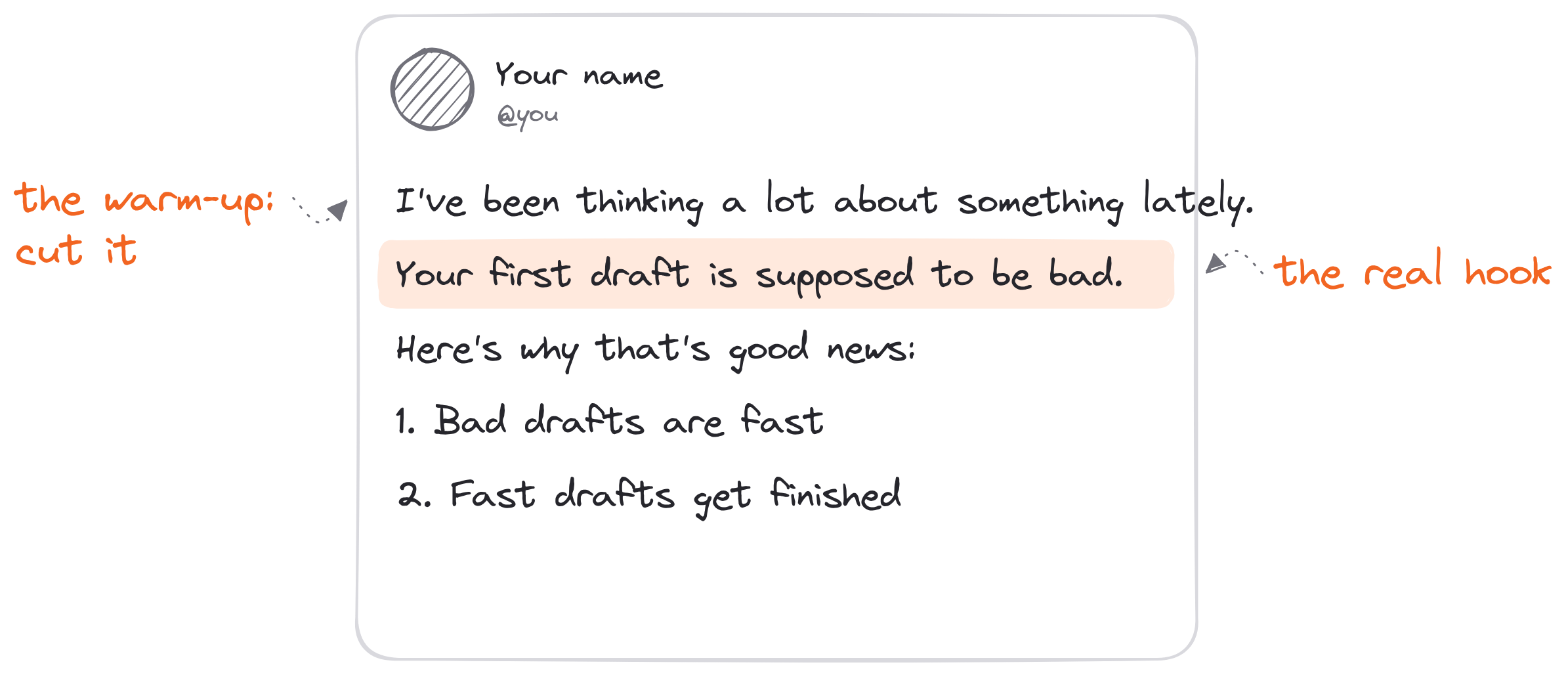
Look for these and delete them:
- Throat-clearing: "I want to talk about…", "Here's something I've noticed…"
- Background: the history of the problem before the problem.
- Opening "I" phrases: "I think", "I believe", "I've learned". You're the author, so the reader already knows these are your thoughts.
- Scene-setting: "It was a beautiful Monday morning." As I wrote in my post on good and bad first sentences, "It was a dark and stormy night" is a scene nobody asked for.
Then try the simplest edit in writing: delete your first sentence and see if the post still works. Most of the time it reads better. The real hook was the second line all along. When I start a story, I never open with background. I open with the action, and the context comes once the reader is already in.
Cut the warm-up, and your hook starts where your point starts.
Step #5: Make It Tangible (Numbers, Nouns And Outcomes)
You can be 100% right and still lose the reader.
I wrote a whole piece on this. Intangibles are ideas: "how to be happy," "my thoughts on success." Tangibles are things the reader can almost hold: a template, a playbook, a number, a named result. A hook full of intangibles makes the reader work out what it's worth. A tangible one tells them.
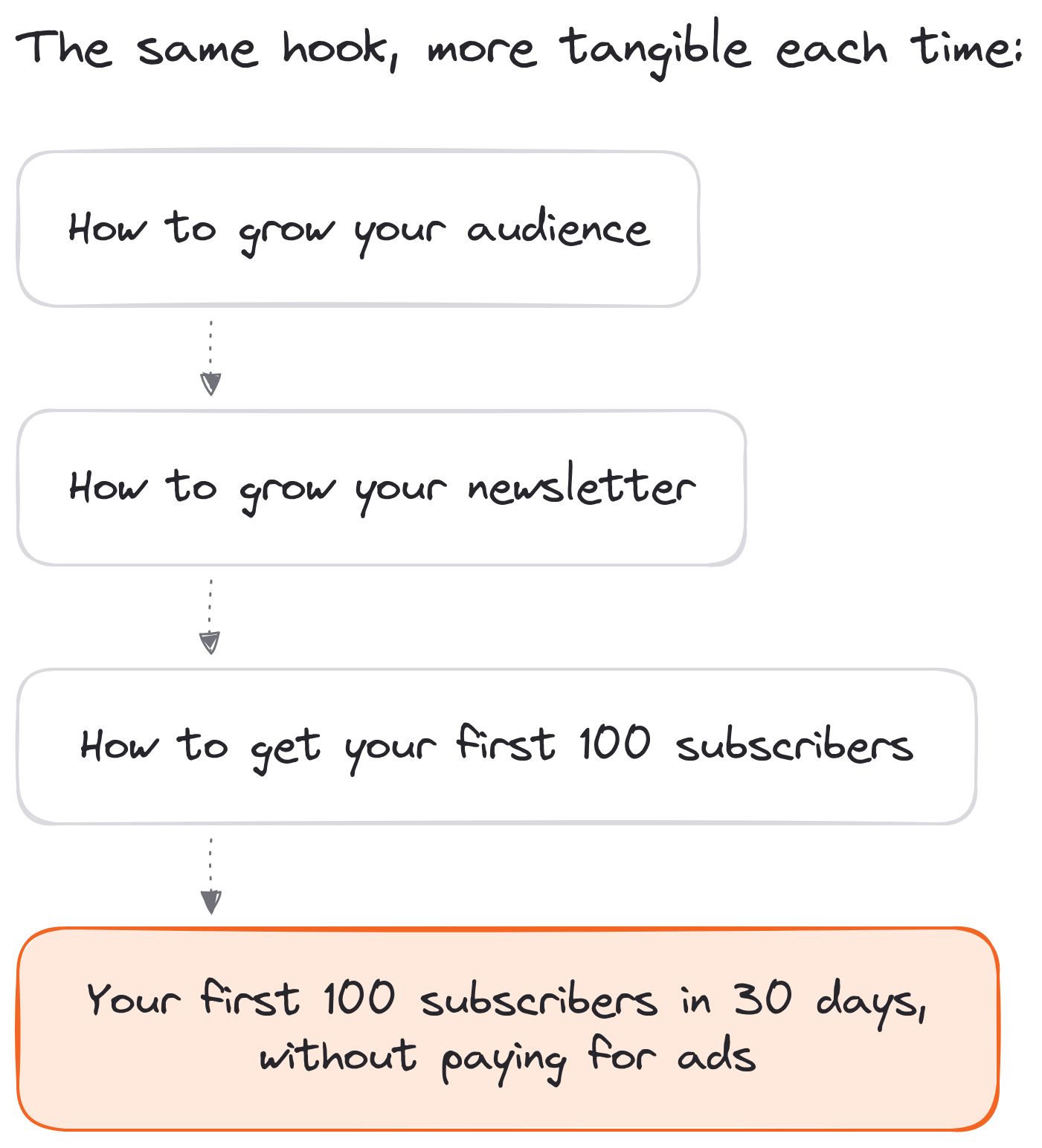
Watch one hook get sharper, version by version (a sample):
- "How to grow your audience."
- "How to grow your newsletter."
- "How to get your first 100 newsletter subscribers."
- "How to get your first 100 newsletter subscribers in 30 days, without paying for ads."
Each version swaps something abstract for something concrete. A who replaces "your audience." A number replaces "grow." A deadline and a cost replace nothing at all. The last one also does what I call twisting the knife: it promises the result and takes away the thing the reader dreads (here, paying for ads).
So when you're stuck between two hooks, pick the one with more nouns and numbers. As I like to put it: when in doubt, get more specific.
Make it tangible, and the reader knows what your hook is worth in one glance.
Step #6: Check How Your Hook Looks On The Platform (LinkedIn, X, Threads And Email)
A hook that reads well in your notes app can still get cut in half.
Every platform frames your first line in its own way. On LinkedIn, readers see the first two or three lines before "…see more", and that's all they judge you on. On X and Threads, your first line sits in a feed next to dozens of others. In an email, the subject line and the preview text do the hooking from the inbox. Same words, different windows.
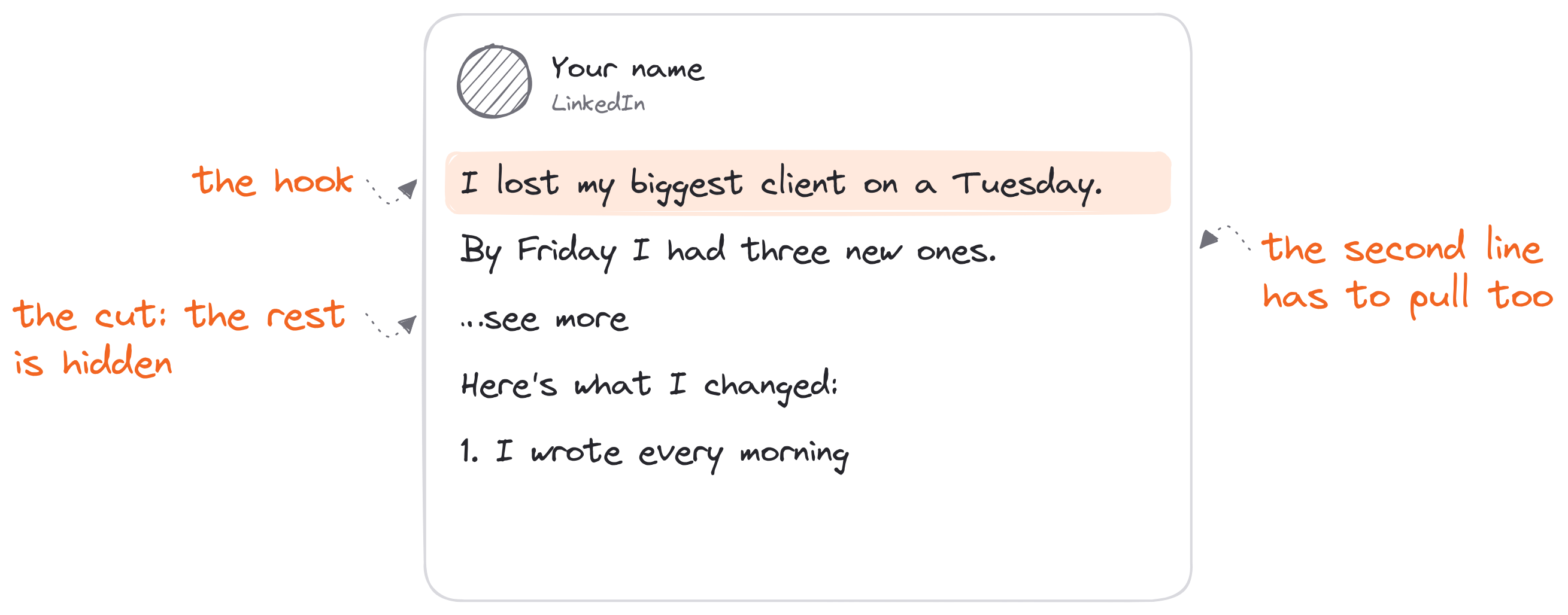
Before you post, check four things:
- Does the hook fit above the cut? On LinkedIn, your promise has to land before "…see more". (LinkedIn post size covers where the cut falls.)
- Does the line break where you want it? A hook split across two lines on a phone loses its punch.
- Does the second line pull too? On LinkedIn, the reader sees it before they decide, so it has to earn the click as much as the first.
- In email, does the preview text add to the subject? It should give a second reason to open.
The easiest check is to see your post the way the platform will show your readers. Typeshare for LinkedIn shows your post as LinkedIn will, with the hook in the first lines before "…see more", so you can edit until it reads right.
Check how your hook looks on the platform, because that's where the reader judges your first line.
Step #7: Make The Body Keep The Hook's Promise (Or It's Clickbait)
The hook makes a promise, and the rest of the post pays it off.
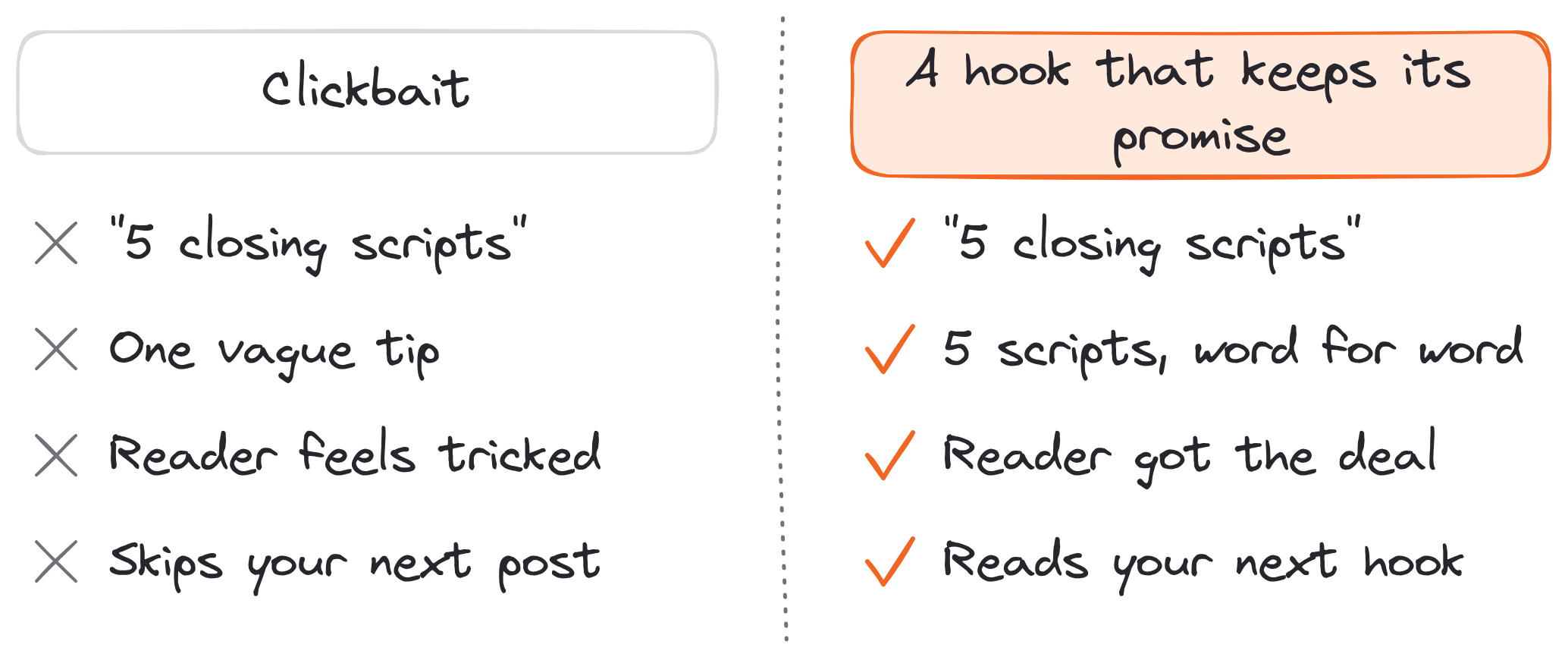
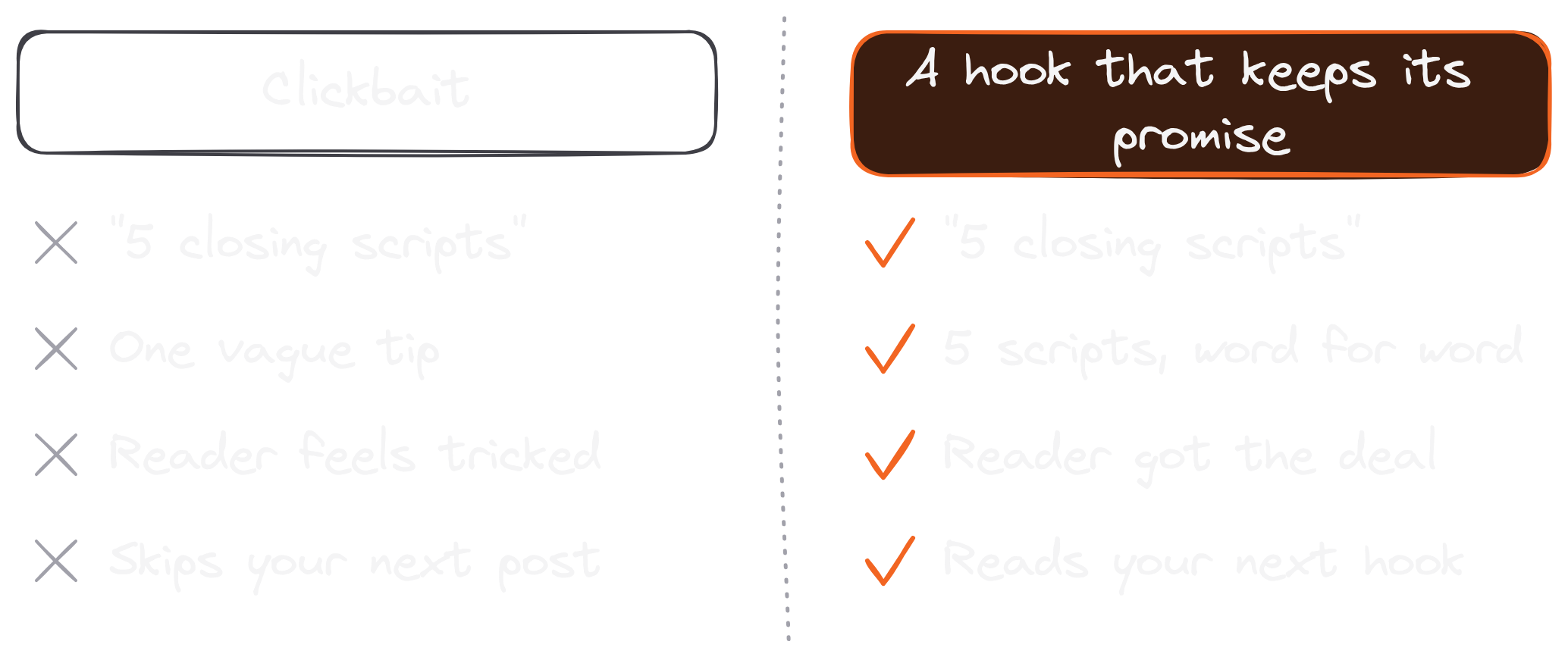
I've said it before: it's only clickbait if you fail to keep your promise to the reader. A big hook followed by a thin post is the problem. If your first line promises 5 scripts and the post delivers one vague tip, the reader feels tricked, and they remember your name for the wrong reason.
This matters for three reasons:
- Trust compounds. A reader who got what your hook promised reads your next hook more generously.
- The second line is part of the promise. It's where the reader checks if you meant it, so it should start delivering at once.
- The action depends on it. A reply, a follow or a click on your call to action only comes from a reader who felt the post was worth their time.
So reread your hook after you finish the draft. If the body delivers less than the hook promises, you have two fixes: make the body better, or make the hook smaller. Either one keeps you out of clickbait.
Make the body keep the hook's promise, and every hook you write after it works a little better.
How To Write A Hook For An Essay (The School And College Version)
An essay hook does the same job with a stricter reader.
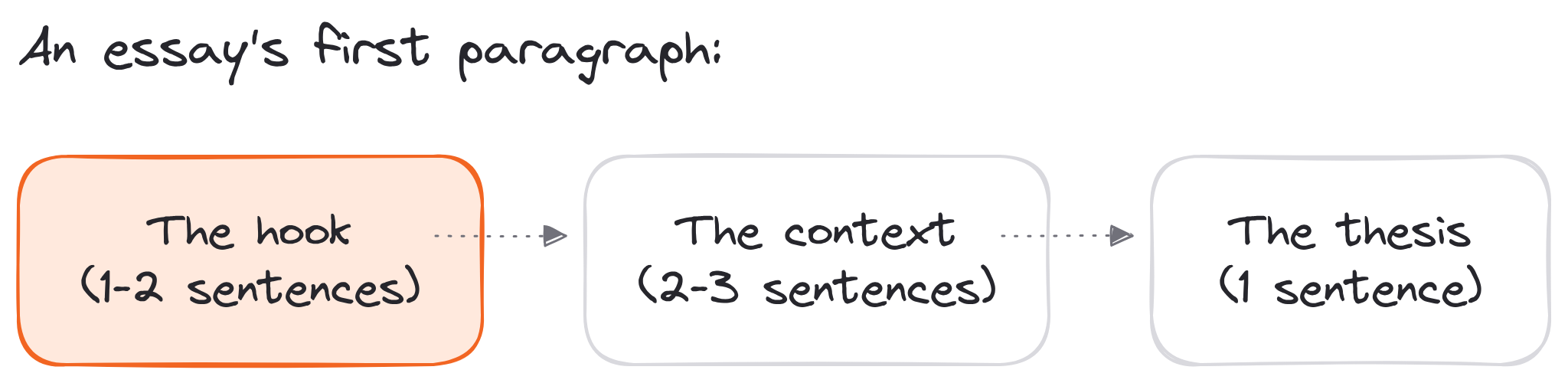
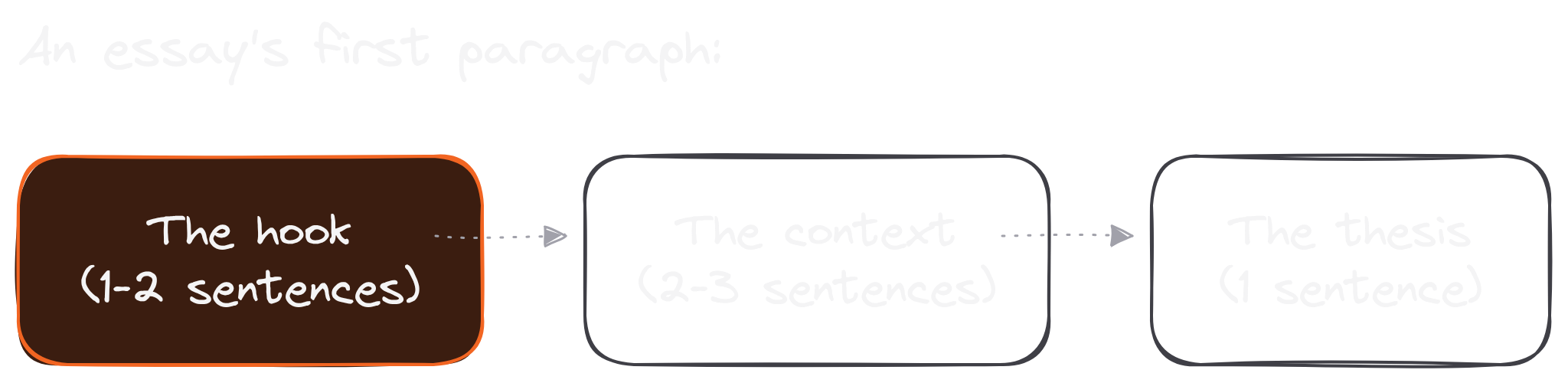
Your reader might be a teacher with a stack of 30 essays to get through. The job is the same: make them want the second sentence. The difference is what comes after the hook. In an essay, the hook leads into a sentence or two of context and then your thesis statement, all in the first paragraph.
Here's how to write a hook for an essay:
- Write your thesis first. You can't hook a reader into an argument you haven't decided on.
- Pick one of the four essay hook types below that fits the thesis.
- Write the hook in one or two sentences, then a bridge of context that leads to the thesis.
- Cut the dictionary definition. "Webster's defines courage as…" is the essay version of a warm-up.
The four types, with a sample opening for each (samples I wrote for this article):
- A question: "What would you give up to never be bored again?" (an essay on phones and attention)
- A surprising fact: "An octopus has three hearts, and one of them stops beating when it swims." (an essay on how animals adapt)
- A quotation: "'It was a pleasure to burn.' Ray Bradbury opens Fahrenheit 451 with a fireman who loves his job." (an essay on censorship)
- A short story: "The night before my first debate, I rewrote my opening seven times." (a personal essay)
One habit from my own writing helps here too: open with a 1/3/1 sequence. One short sentence as the hook, three sentences of context, then one sentence that lands your thesis. The first and last sentences read easily, and the middle carries the value.
That's how to write a hook for an essay: decide the argument, then write the line that opens the door.
FAQ About How To Write A Hook
How long should a hook be?
As short as the promise allows. For a social post, usually one sentence on its own line. For an essay, one or two sentences before the context starts.
What's the difference between a hook and a headline?
A headline is the title above a piece and gets the click. The hook is the first line inside it and gets the next line read. Social posts often have no headline, so the hook does both jobs.
Can AI write hooks for you?
It can give you options to choose from, which helps with Step 3. AI Cole, Typeshare's writing coach built from my frameworks, writes hooks when you ask and gives you feedback on your own. You still pick the reader, the promise and the final line.
How do I get better at writing hooks?
Write more of them. Write 10 for every post, save the ones you didn't use, and notice which first lines get you to stop when you scroll. Then borrow the pattern and write your own words.
How do I write a hook for a story?
Start in the middle of the action. Drop the reader into a moment ("The email arrived twelve minutes before the meeting") and explain the background once they're already reading. More story openings are in the storytelling guide.